Get Full Government Meeting Transcripts, Videos, & Alerts Forever!
Maryland outlines AHEAD model to expand primary care; hospitals warn of workforce, capacity and physician‑cost pressures
Summary
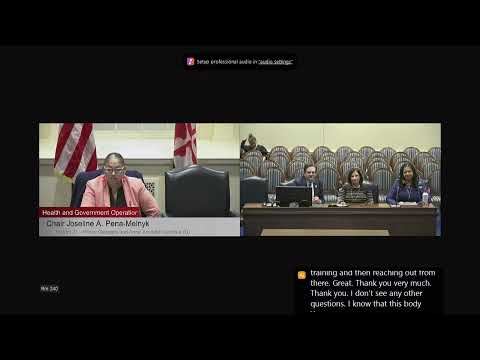
Maryland health officials and HSCRC staff told the House Health and Government Operations Committee on Jan. 31 that the federal AHEAD model will extend the state—s total cost of care approach to population‑based payments and primary care investment, while hospital leaders warned workforce shortages, rising physician costs and regional capacity gaps require rapid policy fixes before full implementation.
Maryland health officials and the Health Services Cost Review Commission told the House Health and Government Operations Committee on Jan. 31 that the federal AHEAD model will extend the state—s long-standing total cost of care approach to fund primary care, population health and a statewide health equity plan.
The AHEAD, or All‑Payer Health Equity Advancing Development, model "is an attempt to—move other states to the work that Maryland has done," Laura Herrera Scott, secretary of the Maryland Department of Health, said, adding the model focuses on "population‑based payments" and investment targets for primary care.
Maryland created its all‑payer hospital rate setting and then the total cost of care model in order to stabilize hospital financing and curb growth in health spending. John Crum, executive director of the Health Services Cost Review Commission (HSCRC), told the committee participation in the federal model preserves federal flexibilities and payments "—there's 1,700,000,000.0 in federal payments for Medicare and Medicaid patients," that support the state's hospital financing structure.
Why it matters: AHEAD would broaden state payment levers beyond hospitals by linking investments in primary care, data and workforce to health equity goals recommended by the Centers for Medicare & Medicaid Innovation (CMMI). Officials said expanded primary care and population health work could reduce downstream hospital use, but both state staff and hospital leaders warned that workforce shortages, rising physician costs and regional bed distribution could threaten hospital financial stability if policy details are not settled quickly.
What officials told the committee
- "The…
Already have an account? Log in
Subscribe to keep reading
Unlock the rest of this article — and every article on Citizen Portal.
- Unlimited articles
- AI-powered breakdowns of topics, speakers, decisions, and budgets
- Instant alerts when your location has a new meeting
- Follow topics and more locations
- 1,000 AI Insights / month, plus AI Chat