Get Full Government Meeting Transcripts, Videos, & Alerts Forever!
Get email alerts on the Ahead Model topic
No spam. Unsubscribe anytime.
Maryland outlines AHEAD model to expand primary care; hospitals warn of workforce, capacity and physician‑cost pressures
Summary
Maryland health officials and HSCRC staff told the House Health and Government Operations Committee on Jan. 31 that the federal AHEAD model will extend the state—s total cost of care approach to population‑based payments and primary care investment, while hospital leaders warned workforce shortages, rising physician costs and regional capacity gaps require rapid policy fixes before full implementation.
Maryland health officials and the Health Services Cost Review Commission told the House Health and Government Operations Committee on Jan. 31 that the federal AHEAD model will extend the state—s long-standing total cost of care approach to fund primary care, population health and a statewide health equity plan.
The AHEAD, or All‑Payer Health Equity Advancing Development, model "is an attempt to—move other states to the work that Maryland has done," Laura Herrera Scott, secretary of the Maryland Department of Health, said, adding the model focuses on "population‑based payments" and investment targets for primary care.
Maryland created its all‑payer hospital rate setting and then the total cost of care model in order to stabilize hospital financing and curb growth in health spending. John Crum, executive director of the Health Services Cost Review Commission (HSCRC), told the committee participation in the federal model preserves federal flexibilities and payments "—there's 1,700,000,000.0 in federal payments for Medicare and Medicaid patients," that support the state's hospital financing structure.
Why it matters: AHEAD would broaden state payment levers beyond hospitals by linking investments in primary care, data and workforce to health equity goals recommended by the Centers for Medicare & Medicaid Innovation (CMMI). Officials said expanded primary care and population health work could reduce downstream hospital use, but both state staff and hospital leaders warned that workforce shortages, rising physician costs and regional bed distribution could threaten hospital financial stability if policy details are not settled quickly.
What officials told the committee
- "The goal of the total cost of care model is to ensure [a] world class system of health for all Marylanders," Laura Herrera Scott said, adding that the AHEAD model will require data, workforce development and administrative simplification to succeed. She also said the Maryland Commission on Health Equity will serve as the governance body for parts of AHEAD and that the commission's membership was expanded to include hospital, clinician, payer and community representatives.
- John Crum said AHEAD "does establish a statewide health equity strategy," and preserves the state's authority to set hospital global budget policy, while noting that the state agreement with CMMI "doesn't enumerate solutions to all challenges" such as physician costs and volume adjustments. He said the HSCRC has already increased hospital rates and provided targeted hardship funds in the past year, including a temporary hardship fund "of over $80,000,000" and annual rate adjustments that "grown hospital rates by over a billion dollars."
Hospital concerns and requests for near‑term policy work
- Melanie Griffith, president and CEO of the Maryland Hospital Association, and Tom Kleinhansel, president and CEO of Frederick Health and chair of the MHA board, told the panel they support the model—s goals but urged faster, concrete policy work before hospitals commit to changes that begin next year.
- Kleinhansel described ongoing financial strain: "We had 200 days cash in our bank savings account before COVID. We now have 145 days. So we've spent down 65 days of cash. That's because we've had a negative operating margin." He told the committee he wants regulatory clarifications on market share, capital funding and growth policy "in short order" so hospital boards can plan for the transition.
- Hospital leaders repeatedly raised physician compensation as a major unregulated cost that is increasing far faster than hospital facility costs and said HSCRC and the department should move quickly to collect better data and consider policy options.
State actions and timelines
- Officials said Maryland will continue to develop HSCRC global budget policies and will launch stakeholder processes to refine volume, capital and market‑share policies before AHEAD's full implementation. The department said the primary care elements of AHEAD are expected to begin in 2026 and that the state has already disbursed approximately $20 million to develop new primary care access sites across underserved areas of the state.
- The Maryland Commission on Health Equity will produce a State Health Equity Plan aligned to five CMMI core domains plus an optional domain; officials reported they selected maternal health outcomes as the optional domain and will focus on reducing disparities for Black women in maternal mortality and morbidity.
Discussion vs. decision
- Discussion: Committee members and agency staff discussed model goals, gaps in authority (physician costs sit outside HSCRC regulated facility costs), workforce shortages and regional differences in utilization and bed needs.
- Direction: Officials said they will continue stakeholder work at HSCRC and MDH, expand data‑collection and convene technical work groups (including a data advisory committee) to support the health equity plan.
- Decision: No formal vote or legislative action occurred during the hearing; agencies described plans and requested ongoing engagement.
Context and clarifying details
- Federal payments: HSCRC staff referenced "1,700,000,000.0" in federal payments cited in the briefing as a key fiscal element of the state—s arrangement with the federal government.
- Recent state adjustments: HSCRC representatives said they created an $80,000,000 temporary hardship fund, made a permanent midyear staffing adjustment, modified capital funding for a new Easton hospital project, and introduced a high‑cost drug policy in the past year.
- Primary care investment target: Officials said Maryland is moving primary care investment from about "4½–5½ cents on the dollar" toward approximately "8–9 cents on the dollar" under the new model's primary care commitments.
- Governance: The Maryland Commission on Health Equity was named the governing structure for components of AHEAD; the commission's membership now includes hospital, MCO, clinician, tribal and patient representatives.
What comes next
Officials asked lawmakers and stakeholders for sustained engagement during 2025 policy work and urged quicker resolution of a short list of HSCRC policies that hospitals say they need clarified before the AHEAD primary care payments begin in 2026.
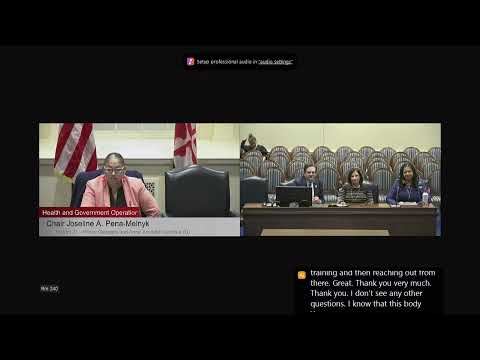
Sources and attribution: Committee chair Jocelyn Pena Melnick presided; the presentation was led by Laura Herrera Scott, secretary of the Maryland Department of Health; John Crum, executive director, HSCRC; and speakers representing the Maryland Hospital Association and multiple hospital systems.
Ending: Committee members said they will continue oversight and asked for periodic reports on data collection, primary care rollout and any short‑term rate adjustments as AHEAD implementation proceeds.