Get Full Government Meeting Transcripts, Videos, & Alerts Forever!
Get email alerts on the Transmission Policy topic
No spam. Unsubscribe anytime.
Committee weighs bill to create Washington Electric Transmission Office as stakeholders debate scope and eminent‑domain powers
Summary
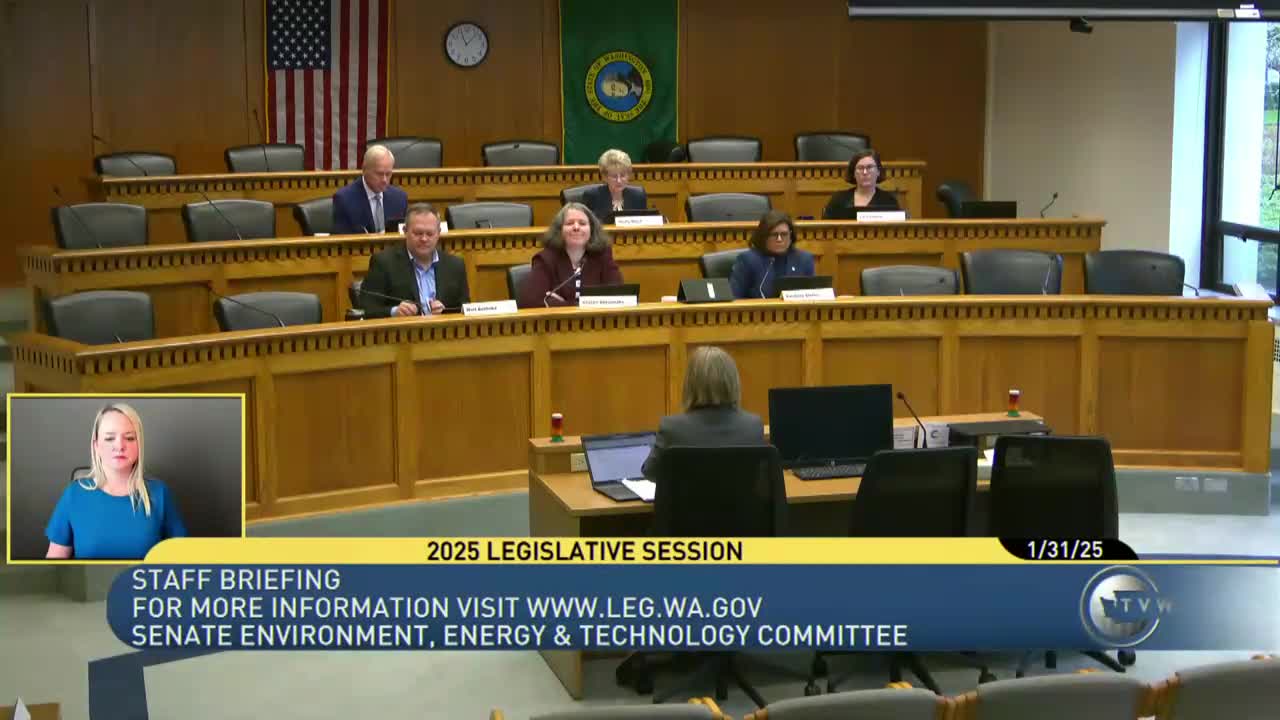
Senators received a detailed briefing and lengthy public testimony on Senate Bill 5466, a proposal to establish a Washington Electric Transmission Office within the Department of Commerce and to authorize a range of activities intended to expand transmission capacity and speed upgrades.
Senators received a detailed briefing and lengthy public testimony on Senate Bill 5466, a proposal to establish a Washington Electric Transmission Office within the Department of Commerce and to authorize a range of activities intended to expand transmission capacity and speed upgrades.
The bill and why it matters: Staff described SB 5466 as a statewide effort to assess 20‑year transmission needs, identify priority corridors, support non‑wire alternatives, coordinate upgrades and provide permitting and technical support to local and tribal governments. Supporters say Washington needs a statewide authority to address interconnection backlogs and transmission constraints that otherwise limit clean‑energy deployment and industrial growth.
Key bill provisions summarized by staff
Kim Cushing, committee staff, briefed the bill. She said it would establish an Electric Transmission Office in Commerce, create a seven‑member Electric Transmission Advisory Board, require a 20‑year transmission needs assessment (first due June 30, 2026) and a transmission system enhancement roadmap, and authorize a broad range of powers including rulemaking, contracts, partnerships, property acquisition and — subject to statutory limits — exercising eminent domain to secure rights of way. The bill would create operating and capital accounts, allow categorical SEPA exemptions for certain reconductoring within existing rights of way, and authorize limited rate‑of‑return incentives for investor‑owned utilities that deploy reconductoring for the benefit of ratepayers through 2040. The staff fiscal summary listed partial fiscal impacts for Department of Archaeology and Historic Preservation and Ecology rulemaking (roughly $300,000 and $260,000 in specific biennia).
Public testimony: consensus on need, debate on powers and structure
Supporters included labor groups, renewable advocates and environmental organizations. Rebecca Poncio and Dan Seaman of the Department of Commerce framed the bill as an agency‑request measure to coordinate planning, community engagement and permitting best practices. Maya Gillette of BlueGreen Alliance and Renewable Northwest’s Casey McClain said the bill would fill a gap by creating an entity that can plan transmission with an eye to state policy and jobs. The Northwest and Intermountain Power Producers Coalition and several utilities endorsed the concept while recommending changes to scope and governance.
Common concerns raised by multiple witnesses
• Structure and independence: Several industry witnesses and utilities urged that the office be an independent authority with its own board rather than a subdivision of Commerce to avoid appearance of political influence and to insulate project‑selection decisions.
• Eminent domain and state ownership: Utilities, industry groups and large energy customers voiced caution about granting the state power to acquire rights of way by eminent domain and to own or operate transmission; they asked for clear sideboards to protect ratepayers and ensure private capital participation.
•Permitting and duplication: Multiple testifiers warned the bill could duplicate existing regional planning (Western Power Pool, Westech) and federally required planning processes, and said the primary barrier to building new energized transmission lines is permitting time and uncertainty rather than planning alone.
•SEPA categorical exclusion scope: Tribes and conservation groups supported streamlined treatment for reconductoring within existing rights‑of‑way but asked for stronger protections for tribal cultural resources and careful consultation with the Department of Archaeology and Historic Preservation and affected tribes.
Notable technical and budget details
•Reconductor incentive: The bill would allow an increment up to 2% to the rate of return for investor‑owned utilities for reconductoring projects that benefit ratepayers, for projects installed after July 2025 and through the depreciable life of the investment (but no later than Dec. 31, 2040). UTC would report on the incentive’s effects.
•Fiscal estimates: Staff cited a partial fiscal note estimating roughly $300,000 (2025‑27) and $260,000 (2027‑29) for DAHP and Ecology rulemaking; Commerce’s cost estimate was not yet available.
Voices from tribes, labor and industry
Dawn Vivian of the Yakama Nation voiced general support but asked for clarifying language to ensure treaty‑reserved resources are protected and that confidentiality and advanced survey needs are addressed. Labor and apprenticeship representatives urged inclusion of worker safety and qualification standards. Renewable and environmental groups emphasized maximizing use of existing rights of way, non‑wire alternatives and tribal consultation. Utilities such as Avista and Puget Sound Energy supported the objective but pressed that the bill does not address permitting timelines and warned about duplicative effort and state operations responsibility.
Committee next steps
Senator Shoemake, the bill’s prime sponsor, framed the measure as an incubation approach inside Commerce with an eye toward eventual establishment of a standalone authority if warranted. Committee members asked for follow‑up on public records protections, clarification on interactions with DNR and federal processes (NEPA/FERC), and suggested further work on membership and governance details.
Ending
The committee closed public testimony after more than 40 witnesses and a large number of written submissions; no committee action or vote on SB 5466 was taken during the hearing.