Get Full Government Meeting Transcripts, Videos, & Alerts Forever!
Get email alerts on the International Medical Graduates topic
No spam. Unsubscribe anytime.
Senate committee hears bill to make clinical-experience license for international medical graduates permanent
Summary
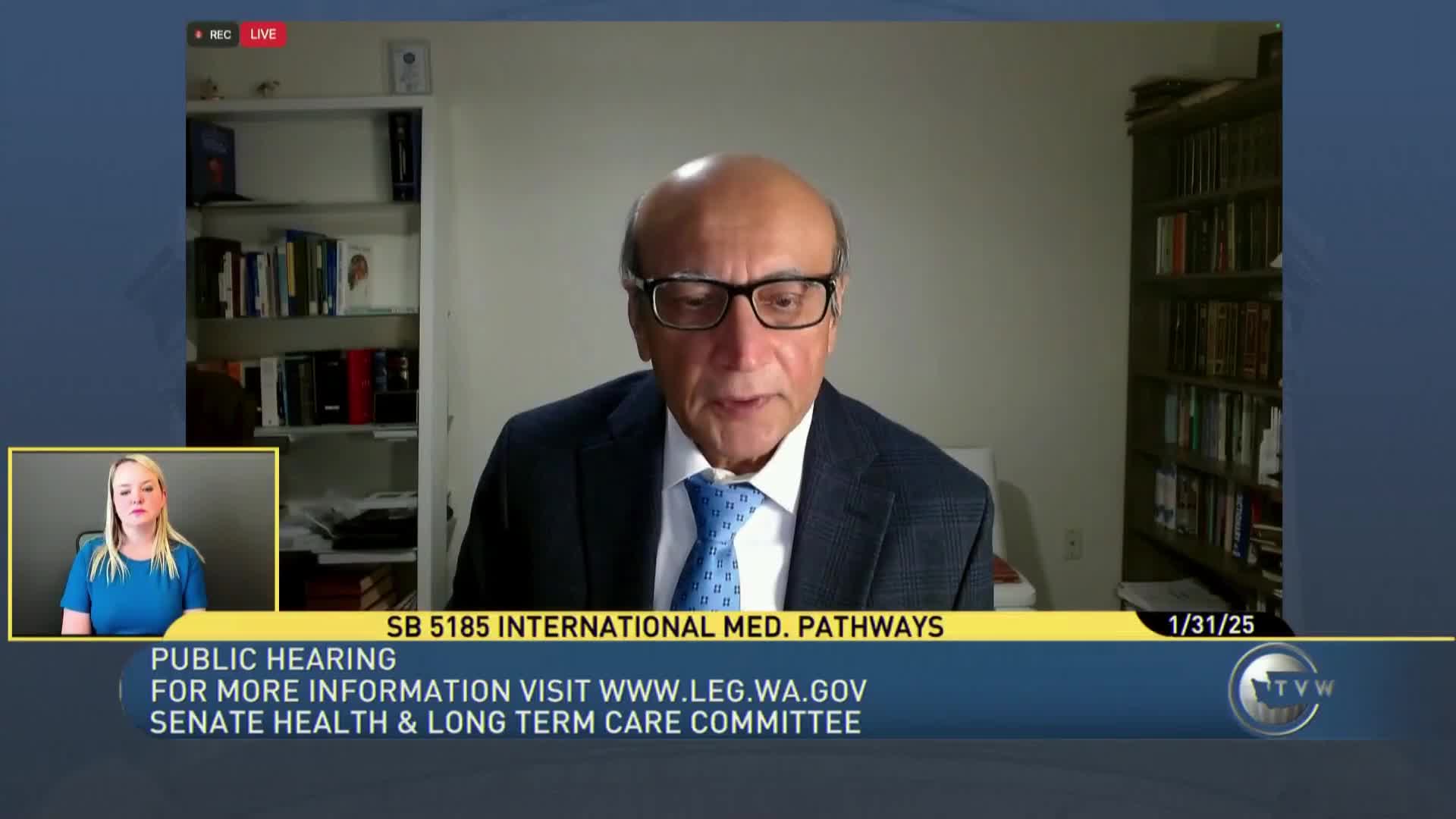
Senate Health and Long Term Care opened a public hearing on Jan. 31 on Senate Bill 5118, which would remove the sunset on Washington—s clinical-experience license for international medical graduates and change qualifications, including USMLE step requirements and renewal limits.
Senate Health and Long Term Care opened a public hearing on Senate Bill 5118 on Jan. 31, a measure sponsored by Sen. Javier Valdez that would remove the sunset for Washington—s time-limited clinical-experience (CE) license for international medical graduates and adjust qualifying standards.
The bill would remove a one-year state residency requirement, require only USMLE Steps 1 and 2 (instead of all steps), add physician employment groups to the list of permissible nominating organizations, create a hardship pathway for alternative assessments, lengthen potential renewals (up to three renewals for a total of eight years) and raise the supervising physician—s cap from two to four limited-license holders.
Supporters told the committee the CE license has been used to place about 40 immigrant physicians who together have served roughly 35,000 patients in Washington since the pathway began in 2021. Mohammed Khalifa of the International Medical Graduates Academy said the license "further[s] improving access to care" and noted the IMG work group unanimously supported the changes. Micah Matthews, deputy executive director of the Washington Medical Commission, said the commission can regulate the revised license and that it has issued more than 40 CE licenses since 2021 with only two complaints, both found without merit.
Opponents and some physician groups raised concerns about the bill—s effect on the original intent of the license. Alex Wehinger of the Washington State Medical Association said the association supports integrating IMGs into the workforce but warned that allowing renewals up to eight years risks creating a "quasi permanent" license that moves away from the CE license—s initial purpose—helping IMGs gain US clinical experience to match into residency. Wehinger and other physicians emphasized the role of residency training as the primary post-graduate pathway to independent practice.
Witnesses described where CE license holders practice: Mohammed Khalifa and others said roughly 70 to 80 percent of CE physicians work in rural or underserved locations, including Whidbey Island and other districts represented by committee members. World Education Services and other national organizations testified that Washington—s model has been influential and that multiple other states are pursuing similar pathways.
No committee action was taken during the hearing. The committee recorded proponent testimony from physicians who said the license preserved access for high-need patients, and cautionary testimony from physician representatives who urged limits that keep residency the central route to full licensure. A fiscal note for the bill is available.