Get Full Government Meeting Transcripts, Videos, & Alerts Forever!
Get email alerts on the Housing Safety Smoke Detection topic
No spam. Unsubscribe anytime.
Committee hears bill to move smoke-detector enforcement to state patrol after families say 2019 law went unenforced
Summary
Senate Bill 5329 would make the Washington State Patrol solely responsible for enforcing a 2019 law requiring sellers to provide smoke detectors; family members of a 2016 fire victim and a nonprofit that installs alarms urged the committee to pass it, saying local officials have not enforced the earlier statute.
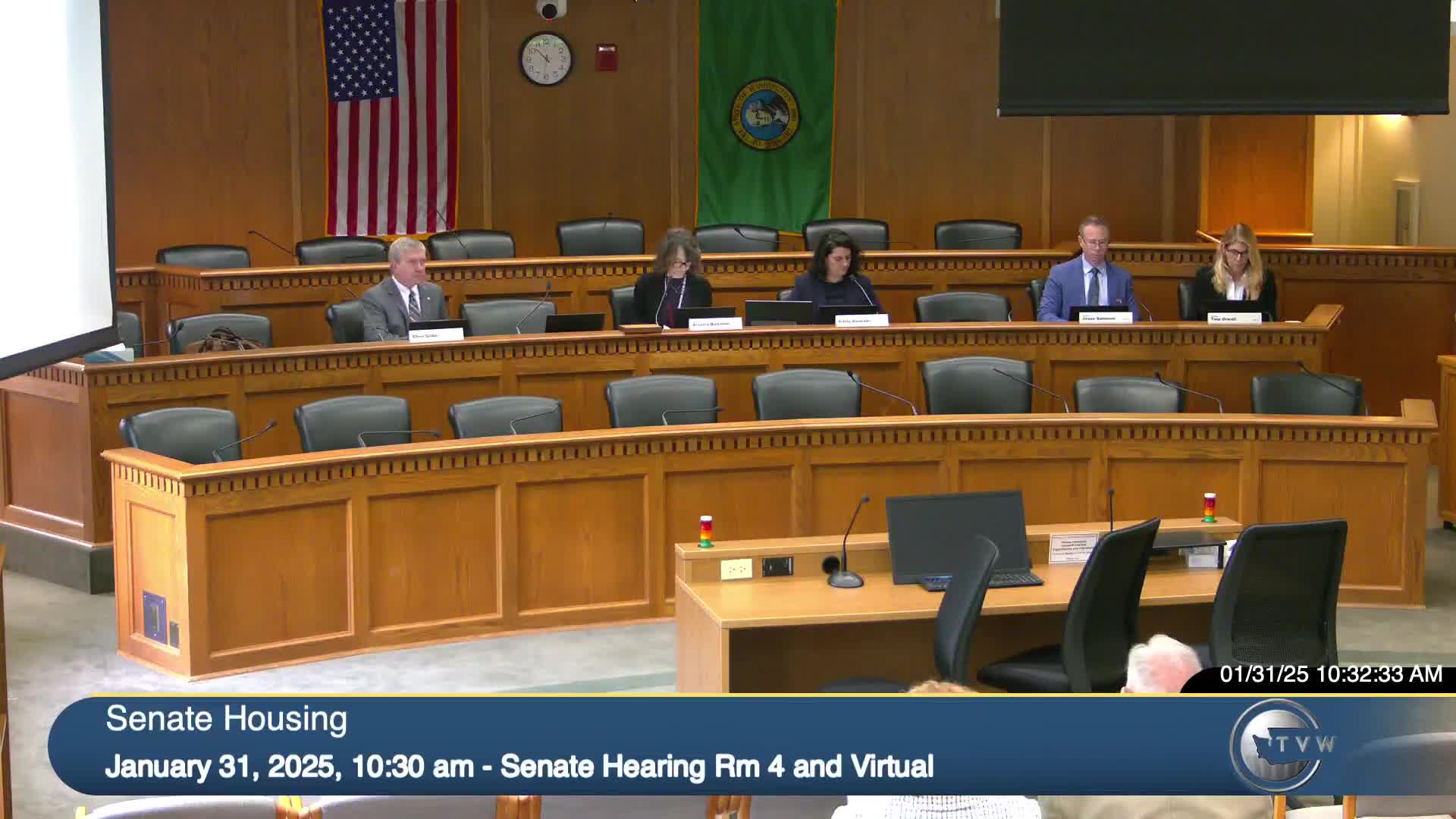
Senate Bill 5329, which would make the Washington State Patrol solely responsible for enforcing state requirements on the installation of smoke-detection devices, received a staff briefing and public testimony at the Senate Housing Committee hearing on Jan. 31.
The bill would transfer enforcement authority from local fire officials to the state patrol and require the patrol to develop and share education materials with county fire marshals and other local officials, Bill Fosbury, Senate committee staff, told the committee. “Before you is Senate Bill 5329 related to the enforcement of laws regulating the installation of smoke detection devices,” Fosbury said in his summary.
The bill’s sponsor, Senator Mark O’Lia (21st District), said the measure responds to a 2016 house fire that killed his classmate, Greg Gibson, and to what he described as a failure to enforce a 2019 law requiring property sellers to leave at least one smoke detector in units when they sell. “In 2019, we passed legislation that requires property sellers to provide at least a smoke detector, before a buyer moves in,” O’Lia said. He told the committee that, in practice, “this law is not being enforced” and that local fire marshals often do not realize the fine structure exists.
Jerry and Bonnie Gibson, parents of the fire victim and founders of the nonprofit Gibbyhole Fire Prevention, testified in support. Jerry Gibson said repeated outreach to the State Patrol and the State Fire Marshal’s Office yielded little enforcement. “We’ve met with the state patrol, written to them, the state fire marshal’s office. And in each instance, they say it’s their responsibility at the local level to handle this. The local level says we haven’t gotten any guidelines,” he said. Bonnie Gibson pressed for a change in mandatory language, pointing out that the earlier statute used “may” and saying the bill’s use of “shall” should require action: “When you say may, that doesn’t really mean you need to do it. So in this bill, it is shall,” she said.
The Gibsons described their nonprofit’s work installing nearly 7,000 free smoke alarms and cited a statistic from the State Fire Marshal’s 2024 State Fire Fatalities Report: “71% of fire fatalities in dwellings did not have smoke alarms or working smoke alarms,” Jerry Gibson said.
Fosbury noted a fiscal note was released “right before the committee” and had not yet been reviewed by financial staff. No formal committee action was taken on SB 5329 at the hearing; the item remained in the public-hearing phase.
The testimony supplied several points the committee may weigh if it advances the bill: (1) whether a statewide enforcement lead would increase the number of fines levied under the 2019 statute and thereby generate education funds, (2) whether statewide guidance and materials developed by the patrol would reach local fire marshals who currently say they lack awareness, and (3) the scale of known fire fatalities tied to missing or nonworking alarms described in the state report. The committee closed the hearing on SB 5329 and moved on to other bills on the agenda.
Looking ahead, if the committee advances SB 5329 it would likely need to resolve fiscal and operational questions about the State Patrol’s new enforcement role and the mechanism for generating and directing education funding raised by fines.
Speakers quoted or referenced in this article: Bill Fosbury (Senate committee staff); Senator Mark O’Lia (sponsor, 21st District); Jerry Gibson (co-founder, Gibbyhole Fire Prevention); Bonnie Gibson (co-founder, Gibbyhole Fire Prevention).