Get Full Government Meeting Transcripts, Videos, & Alerts Forever!
Get email alerts on the Health Care And Wellness topic
No spam. Unsubscribe anytime.
Contentious public hearing on bill declaring public‑health responses must follow 'best available science'
Summary
House Bill 1531 would require state and local public‑health responses to communicable diseases to be guided by the "best available science" and would void contrary local measures; the House Health Care & Wellness Committee held a lengthy, divided public hearing on Jan. 31.
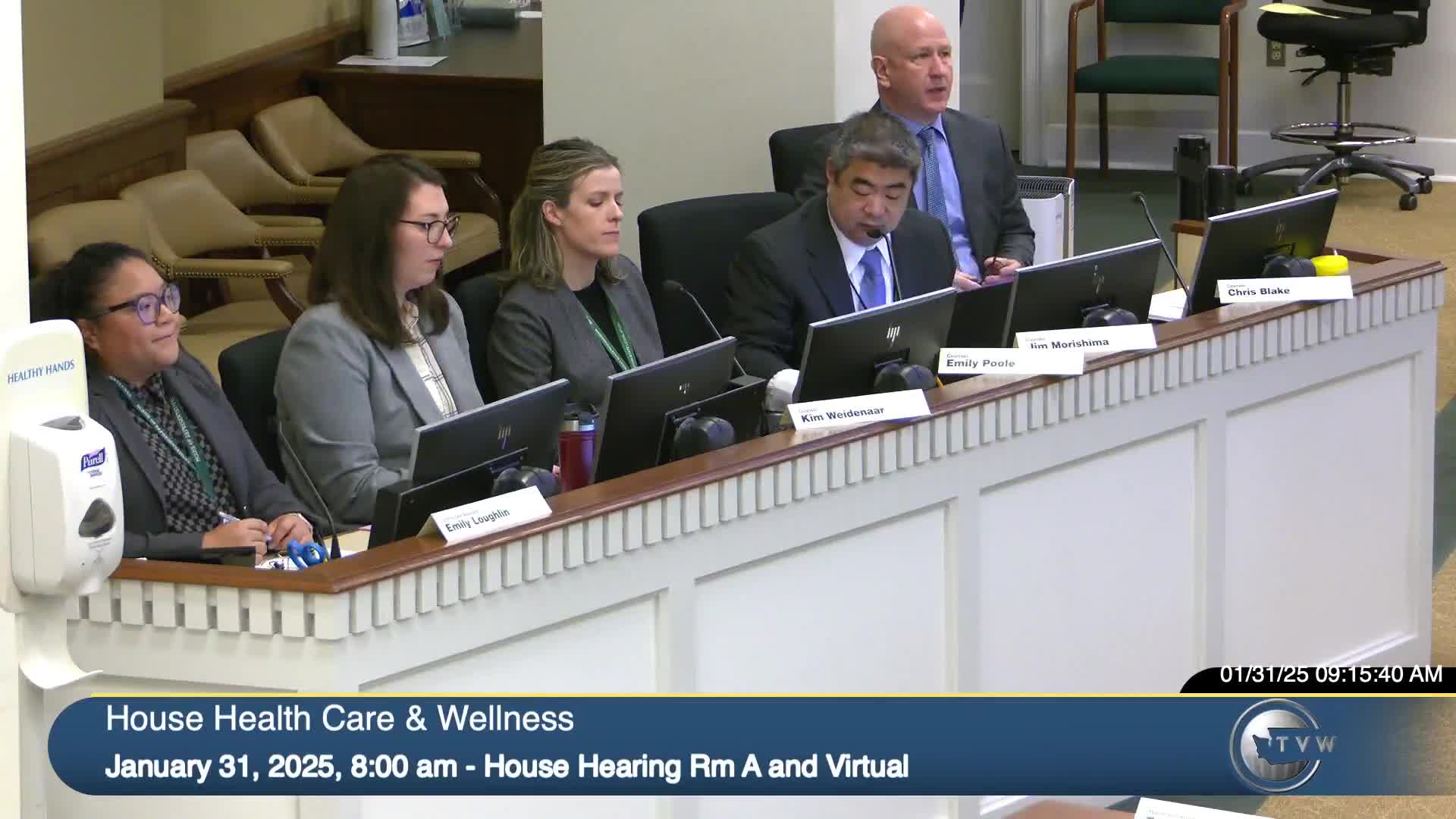
House Bill 1531 drew a long and contentious public hearing before the House Health Care & Wellness Committee on Jan. 31. The bill declares it state policy that public‑health responses to communicable diseases be guided by the "best available science" on safety and efficacy, "including immunizations and vaccinations," requires state and local officials to implement such measures, and declares contrary local statutes, ordinances, rules or policies null and void.
Committee staff summarized the proposal and noted that both state and local boards of health already have statutory duties for communicable disease prevention and control. The bill’s prime sponsor said the measure was requested by a local health jurisdiction to protect the ability of local public‑health agencies to share evidence‑based recommendations with residents.
Supporters included Governor Jay Inslee’s senior health policy adviser, Caitlin Safford, and Dr. Maria Hung of the Washington Chapter of the American Academy of Pediatrics. Dr. Thao Kwan Get, state health officer with the Department of Health, testified that immunization data and other evidence‑based measures are essential to protecting children and communities and noted a recent increase in under‑immunized children and pertussis cases.
Opponents — a large number of citizen witnesses who signed up in person and remotely — raised concerns that the bill is redundant, vague and centralizes power. Speakers repeatedly cited loss of public trust following the COVID‑19 pandemic and said the bill could enable overreach or immediate emergency measures through an emergency clause. Informed Choice Washington and other witnesses argued existing statutes and administrative rules already direct health officers to use scientific information during outbreaks.
The hearing spanned clinicians, local health officers, advocacy groups and many individuals offering personal testimony for and against the bill. Committee members closed the hearing and invited members to follow up offline with witnesses; no committee vote was taken during the Jan. 31 session.