Get Full Government Meeting Transcripts, Videos, & Alerts Forever!
Get email alerts on the Sustainable Agriculture And Innovation topic
No spam. Unsubscribe anytime.
WSDA outlines threats to farm viability and outlines climate‑resilience, tech and workforce priorities
Summary
Department of Agriculture staff briefed the committee on threats to agricultural sustainability — rising input costs, consolidation and labor shortages — and described plans including an agricultural competitiveness study, a climate resilience plan and programs to support soil health, precision agriculture and workforce development.
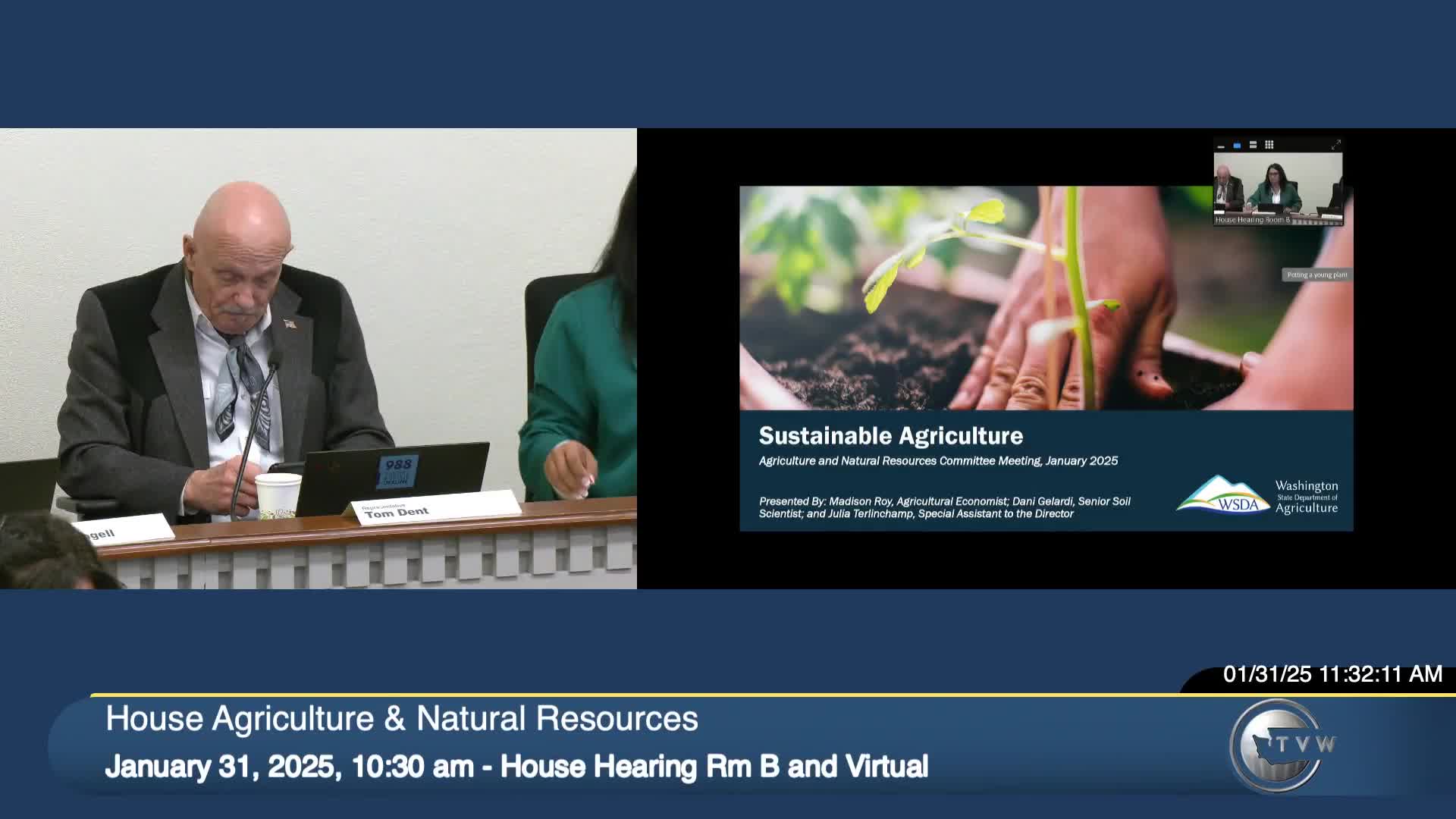
Department of Agriculture staff briefed the Agriculture and Natural Resources Committee on Jan. 31 about efforts to support sustainable agriculture in Washington, focusing on economic viability, stewardship, climate resilience and technology adoption.
Madison (“Maddie”) Roy, an agricultural economist at WSDA, summarized current trends she said threaten farm sustainability: rising input costs (noting a 12% production‑expenditure rise between 2022 and 2023 with labor accounting for a large share of the increase), consolidation (WSDA figures cited a 10.4% drop in farm numbers over five years with remaining farms growing in size), and pressure on rural livelihoods. She said Washington produces more than 300 commodities, accounts for roughly $14 billion in agricultural production value, and exported about $2.34 billion in food and fiber products in 2022.
Roy described an ongoing agricultural competitiveness study with Washington State University’s Impact Center to examine challenges and opportunities for Washington producers, and listed priority interventions raised by producers at a recent conference: technical assistance, land and capital access, workforce development, incentives for stewardship practices and market support.
Danny Gilardi, senior soil scientist and WSDA climate coordinator, highlighted evidence that conservation practices can both improve resilience and raise farm profitability. He cited national and Washington surveys showing no‑till and cover‑crop benefits — lower input costs, reduced erosion and improved soil moisture — but said upfront equipment costs and lack of localized research and technical support limit adoption, particularly for small and historically disadvantaged operations.
Julia Charlenchamp (special assistant to the director) discussed ag‑tech and innovation that can address labor gaps and resource efficiency: precision irrigation and sensors, autonomous and electric platforms, robotic harvesters, and AI research partnerships (WSU Ag AID Institute and Smart Orchards). She noted pilot programs such as AgTech lending libraries, Snohomish County sensor programs that reduced water use, the STAR incentive pilot and WSU AgWeatherNet as critical data infrastructure.
WSDA asked lawmakers to consider investments in lab and composting infrastructure, workforce pipelines and flexible financing or partnership models that can lower barriers to adopting sustainable practices. Presenters also flagged ongoing efforts: the Washington Soil Health Initiative, a soon‑to‑be‑published Climate Resilience Plan outlining six goals and 27 strategic actions, and programs to expand diversity in the veterinary and ag workforce.
Committee members asked about differences across commodity types, indoor farming and financing for costly equipment; staff said the competitiveness study will break out impacts by commodity and farm size and noted existing federal and state grant programs while calling for more flexible public‑private partnerships and lending solutions.
The briefing closed with an invitation to lawmakers to review the department’s forthcoming climate‑resilience plan and related decision packages.