Get Full Government Meeting Transcripts, Videos, & Alerts Forever!
Get email alerts on the Personnel Records Access topic
No spam. Unsubscribe anytime.
Committee advances proposed substitute on personnel-file access after rejecting several narrowing amendments
Summary
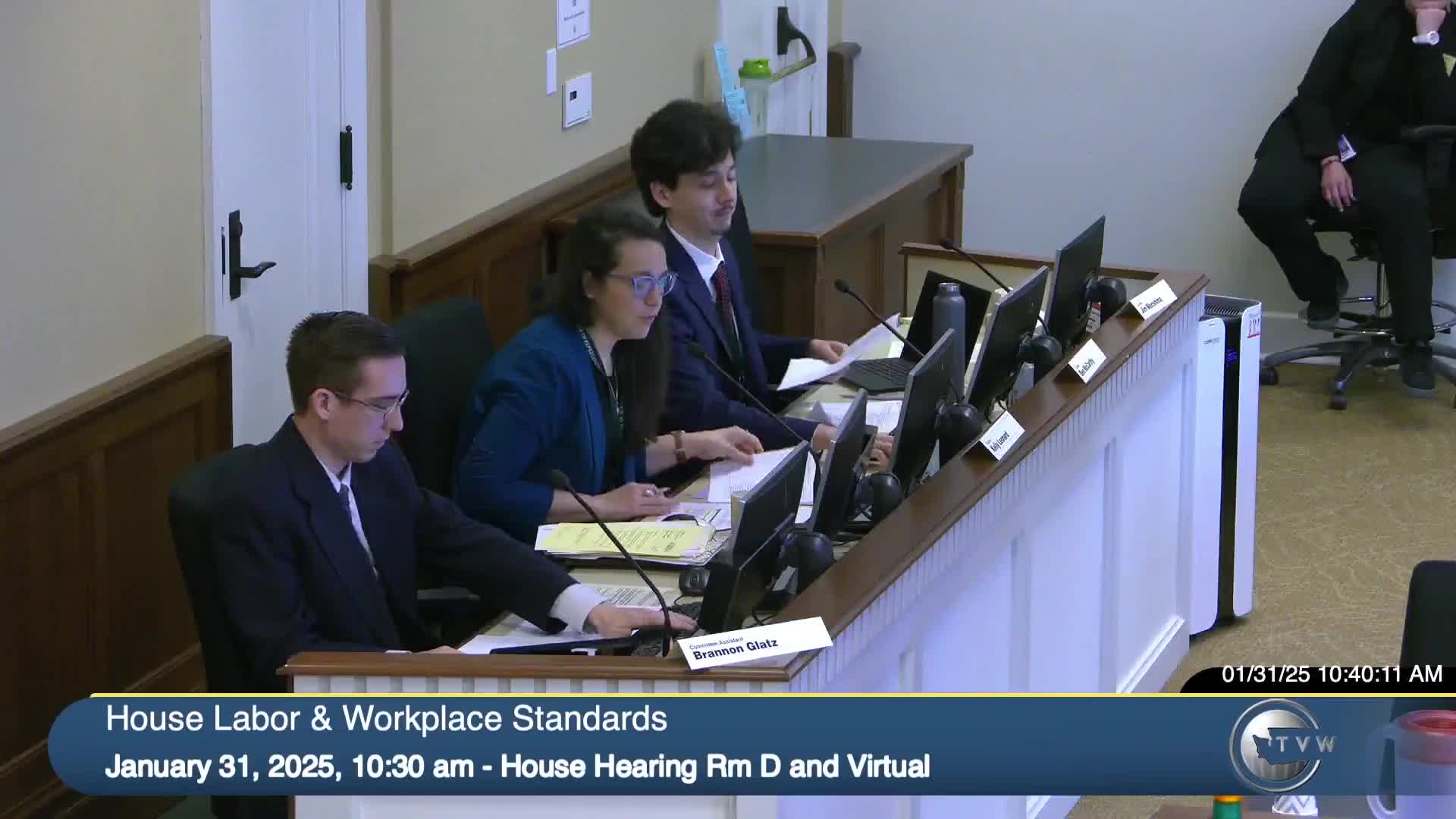
The committee reported the proposed substitute of House Bill 1308, requiring employers not subject to the Public Records Act to provide personnel-file copies within 21 days, out of committee with a due-pass recommendation on a 6–3 vote after rejecting six line amendments.
The proposed substitute to House Bill 1308, addressing employee access to personnel files, was reported out of committee with a due-pass recommendation on a 6–3 vote after extensive debate and multiple unsuccessful line-amendment attempts.
Staff summarized the proposed substitute: for employers not subject to the Public Records Act, an employer must provide an employee or former employee a copy of the personnel file within 21 days of request and provide a former employee, upon request, a statement of the discharge date and reasons, if any, for the discharge. The proposed substitute would make those specific provisions apply only to employers not subject to the Public Records Act; employers subject to the Public Records Act must follow Public Records Act procedures for responding to personnel-file requests.
Ranking Member Representative Schmidt offered six line amendments (Leon 906–911) that would have narrowed aspects of the personnel-file definition, limited what medical or disciplinary records must be produced, allowed an additional 21 calendar days in some circumstances, and removed the proposed private cause of action, replacing it with enforcement by the Department of Labor and Industries and a stepped penalty scheme (first violation: notice/offer of assistance; second: up to $750; subsequent: up to $1,000). Committee members repeatedly stated concerns about narrowing the file definition or eliminating a private right of action: Representative Ortiz Self argued the private right is “reasonable and a critical enforcement mechanism” because existing 10-day compliance has been unreliable; Representative McIntyre and others raised concerns about balancing employer and employee interests.
All six line amendments (Leon 906, 907, 908, 909, 910, 911) were put before the committee and not adopted. The committee then voted to report the proposed substitute itself out of committee with a due-pass recommendation. The roll call recorded votes as: Berry (aye), Fosse (aye), Scott (aye), Schmidt (nay, do not pass), Ybarra (nay without recommendation), Bernofsky (aye), McIntyre (nay without recommendation), Obras/ Opruss (aye), Ortiz Self (aye). Staff announced the result as 6 ayes and 3 nays.
Key clarifications recorded in committee debate: Leon 910 (not adopted) would have allowed a private employer acting in good faith an additional 21 calendar days to produce a personnel file if the employer gives at least three days' written notice before the initial 21-day period expires. Leon 911 (not adopted) would have removed the bill's private cause of action against employers not subject to the Public Records Act and instead assigned enforcement to L&I with a graduated penalty schedule: first violation — notice/assistance; second — up to $750; subsequent — up to $1,000.
What happens next: the proposed substitute advances from committee with a due-pass recommendation; members indicated ongoing concerns about implementation details, enforcement mechanisms, and whether 21 days is the correct timeframe.
Votes at a glance: Proposed substitute House Bill 1308 — reported out of committee with a due-pass recommendation; tally: 6 ayes, 3 nays.