Get Full Government Meeting Transcripts, Videos, & Alerts Forever!
Get email alerts on the Workers Comp Ptsd Coroners topic
No spam. Unsubscribe anytime.
Committee advances bill recognizing PTSD as occupational disease for coroners, medical examiners
Summary
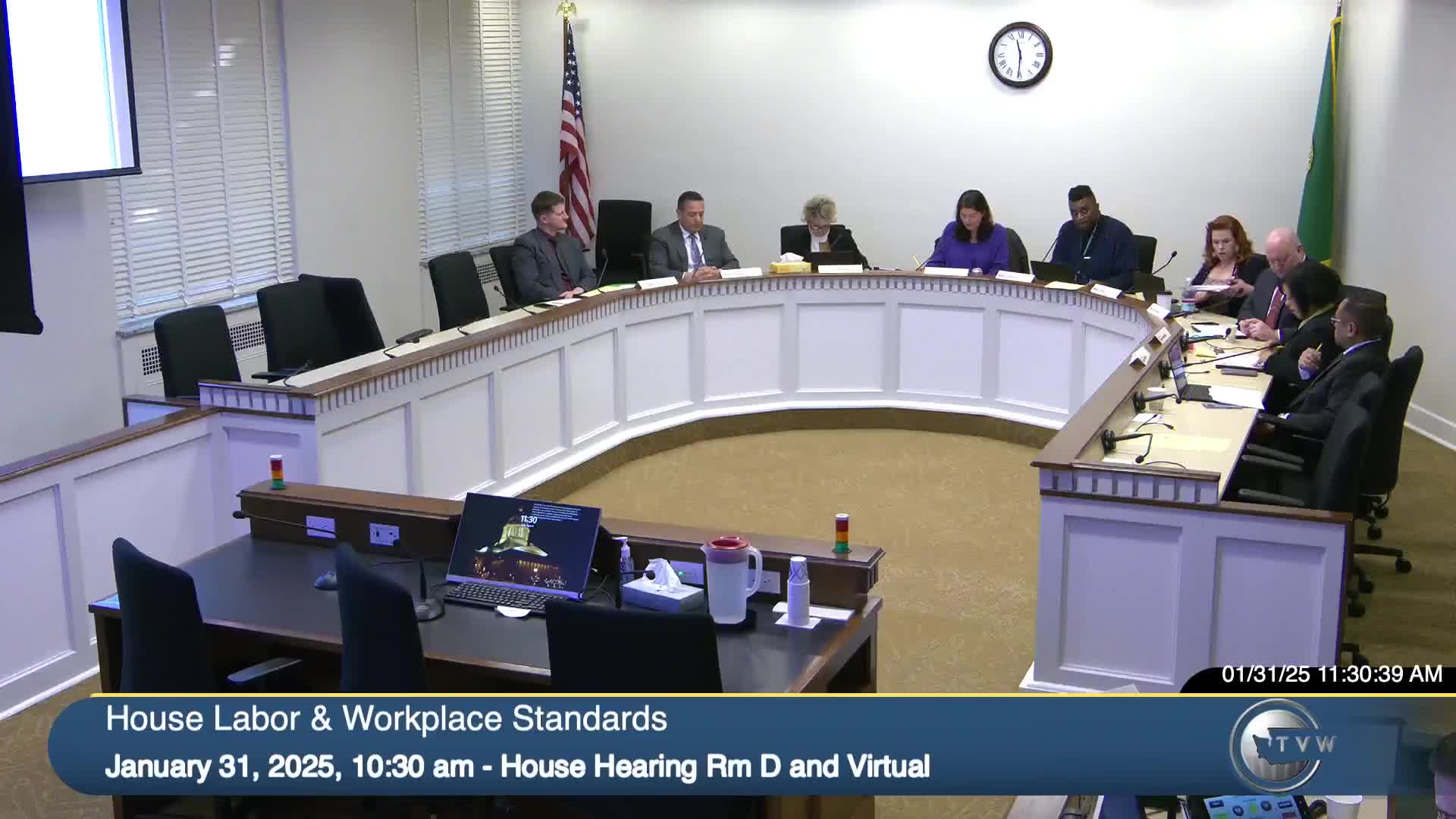
House Bill 1002, which would allow county coroners and medical examiner personnel to file PTSD-based workers' compensation claims, was reported out of the Labor & Workplace Standards Committee with a due-pass recommendation on a 7–2 vote.
House Bill 1002, which would allow county coroners and medical examiner personnel to file workers' compensation occupational disease claims for post-traumatic stress disorder, was reported out of the Labor & Workplace Standards Committee with a due-pass recommendation on a 7–2 vote.
The bill as presented to the committee would add coroners and medical examiner staff to classes eligible to seek PTSD-based workers' compensation claims. Staff described two amendments in the bill packet related to how costs from the claims should be handled by the Department of Labor and Industries (L&I).
The bill matters because workers who regularly investigate traumatic deaths, the staff and lawmakers said, face elevated PTSD risk and may need access to workers' compensation benefits to cover treatment and recovery. Committee debate focused less on whether these workers should be covered and more on how to pay for the claims and whether costs should be “socialized” across all employers or assigned to specific rate classes.
Ranking Member Representative Joe Schmidt (ranking member) proposed an amendment (MCCB012) that would require L&I to set the premium rate for the coroner/medical examiner risk class to the lesser of an actuarially indicated rate change or a director-set maximum and to allow general rate changes that apply to all risk classes. Schmidt said the amendment is intended to reduce cross-subsidization across unrelated industries: “this is trying to be a little bit more fair with that and not have other industries across the whole state pay for more of the PTSD claims.”
Chair Berry and others said they welcome the policy conversation but wanted more time to study premium-setting and claims administration before changing who bears the cost. Chair Berry asked members to withhold support for the amendment so staff and lawmakers can craft a more complete approach in the interim. The committee voted not to adopt MCCB012.
On final passage the committee adopted the motion to report HB 1002 out of committee with a due-pass recommendation. The roll call that was read aloud in the transcript recorded votes as: Berry (aye), Fosse (aye), Scott (aye), Schmidt (nay), Ybarra (aye), Bernofsky (aye), McIntyre (nay), Opruss/Opras (aye), Ortiz Self (aye). Staff announced the result as 7 ayes and 2 nays.
What happens next: the committee advanced the bill to the next step with a recommendation to pass. Members who opposed the final motion said they intend to continue working on implementation details—particularly claims processing capacity at L&I and rate-setting—during the interim.
Votes at a glance: House Bill 1002 — reported out of committee with a due-pass recommendation; tally: 7 ayes, 2 nays.