Get Full Government Meeting Transcripts, Videos, & Alerts Forever!
Get email alerts on the Right To Repair topic
No spam. Unsubscribe anytime.
Public hearing on Right-to-Repair bill draws broad coalition of supporters and opponents over security, waste and small-business impact
Summary
House Bill 1483, a proposed Right-to-Repair Act, received extensive testimony for and against during a Jan. 31 committee hearing. Proponents, including small repair shops, environmental groups, and major tech firms, argued the bill would reduce e-waste, help small businesses and preserve consumer ownership rights. Opponents raised concerns about
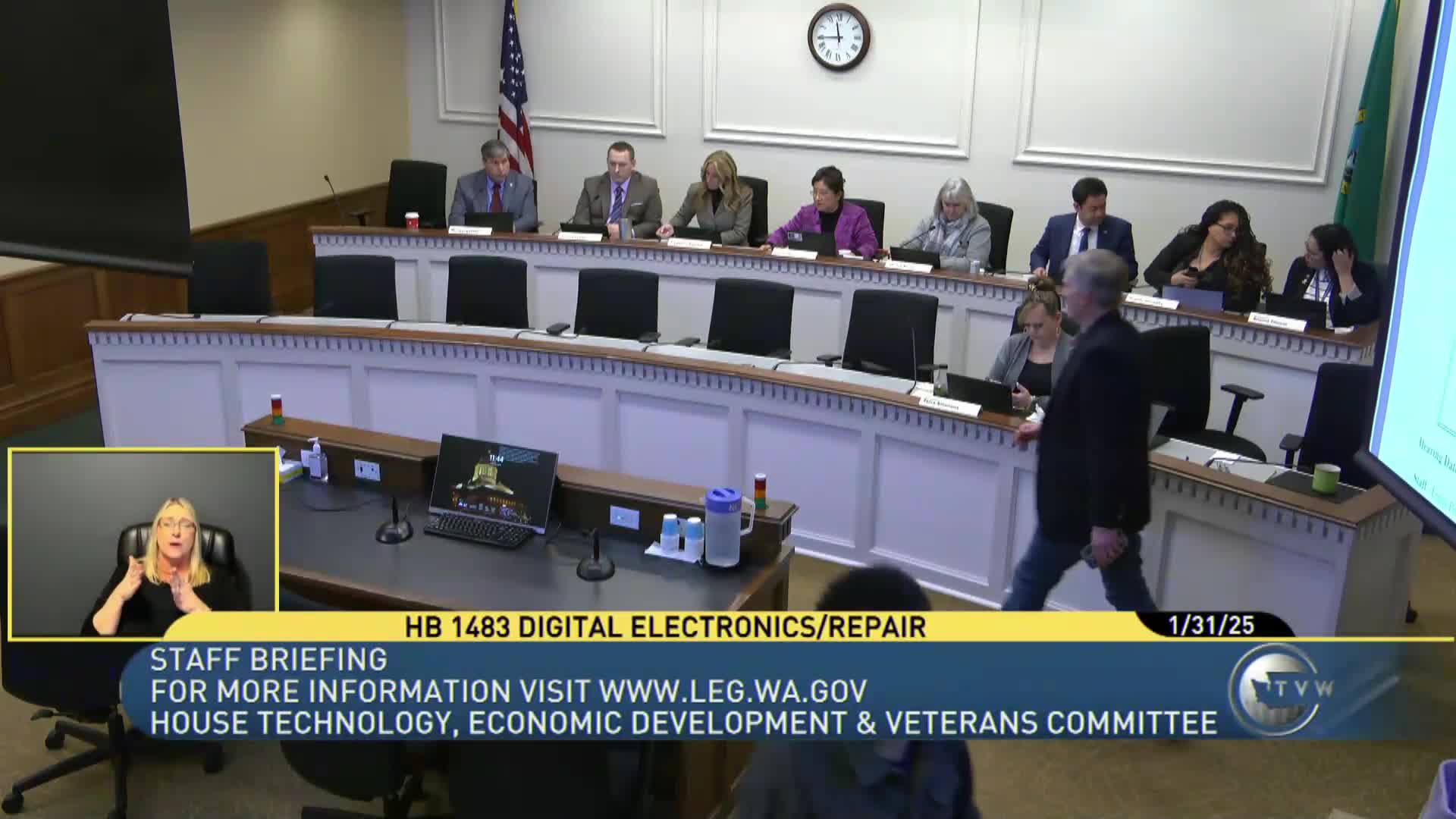
The Technology, Economic Development and Veterans Committee held a public hearing Jan. 31 on House Bill 1483, a proposed Right-to-Repair Act that would require manufacturers of certain digital electronic products to make parts, tools and documentation available to independent repair providers on fair and reasonable terms.
Committee staff Emily Pool opened the briefing by explaining the bill’s scope and proposed substitute. Under the substitute briefed to the committee, a manufacturer that offers repair services is an authorized repair provider only when the manufacturer does not have an arrangement with another authorized provider; the substitute also modifies the bill’s definition of “fair and reasonable terms,” adjusts the definition of “part,” clarifies that listed exemptions apply to the whole act (not only one section) and adds an exemption for life-safety systems (fire alarms, intrusion detection and physical access control equipment). The bill would apply to digital electronic products first manufactured or first sold or used in Washington after July 1, 2021 (with additional rules for items manufactured/sold after Jan. 1, 2025). Enforcement would be through the state Attorney General under the Consumer Protection Act as an unfair or deceptive act.
Supporters who testified included small repair businesses, environmental advocates, consumer-rights organizations, community-reuse nonprofits and several national technology firms:
- Small repair-business owners said access to schematics, diagnostics, parts and tools is essential to keep devices in working order and sustain small businesses. Steven Rine, owner of a Vancouver repair shop, described using right-to-repair laws in other states to obtain documentation and parts that made repairs economically feasible. Kyle Wiens, CEO of iFixit, and other national advocates described state law in Colorado, Minnesota and Oregon as working models.
- Environmental and reuse organizations, including representatives from Zero Waste Washington and Interconnection, cited electronic waste as a fast-growing municipal waste stream and said repair would reduce landfill volumes and carbon impacts.
- Google and other manufacturers signaled support for the bill as crafted, with Google saying it designs products for repairability and praising the bill’s balance on parts pairing and security protections.
Opponents and cautious stakeholders raised concerns about privacy, safety, counterfeit parts and the potential for unauthorized or unsafe repairs:
- The Taxpayers Protection Alliance and NetChoice argued the bill could increase privacy and cybersecurity risks by making devices and components available outside manufacturer or authorized channels. Representatives of CTIA, wireless industry groups and some private-sector coalitions recommended certification programs and safeguards; they pointed to Colorado’s language as an example of a compromise.
- The Repair Done Right Coalition and other industry groups warned a mandated, broad supply of parts and diagnostic information could undermine manufacturer quality-control and increase risks when certain equipment is repaired by unqualified providers; they recommended targeted exemptions and certification pathways.
Committee members asked questions about security risks, parts-pairing protections, customer notifications, and the scope of exemptions. Representative Gregersen, the bill sponsor, said the legislation follows models adopted in other states and emphasized environmental and consumer benefits; she said some requested industry amendments were accepted in previous sessions and that sponsors sought to preserve a broad coalition of supporters.
The committee did not vote. Members were told the bill is slated for executive session in week 5 and sponsors and stakeholders were asked to file proposed amendments for committee consideration.