Get Full Government Meeting Transcripts, Videos, & Alerts Forever!
Get email alerts on the Digital Equity topic
No spam. Unsubscribe anytime.
Committee holds public hearing on expanding digital equity duties to Office of Equity, shifting some broadband responsibilities
Summary
The Technology, Economic Development and Veterans Committee heard public testimony Jan. 31 on House Bill 1503, which would expand digital-equity duties and move outreach and plan implementation responsibilities from the state Broadband Office to the Office of Equity.
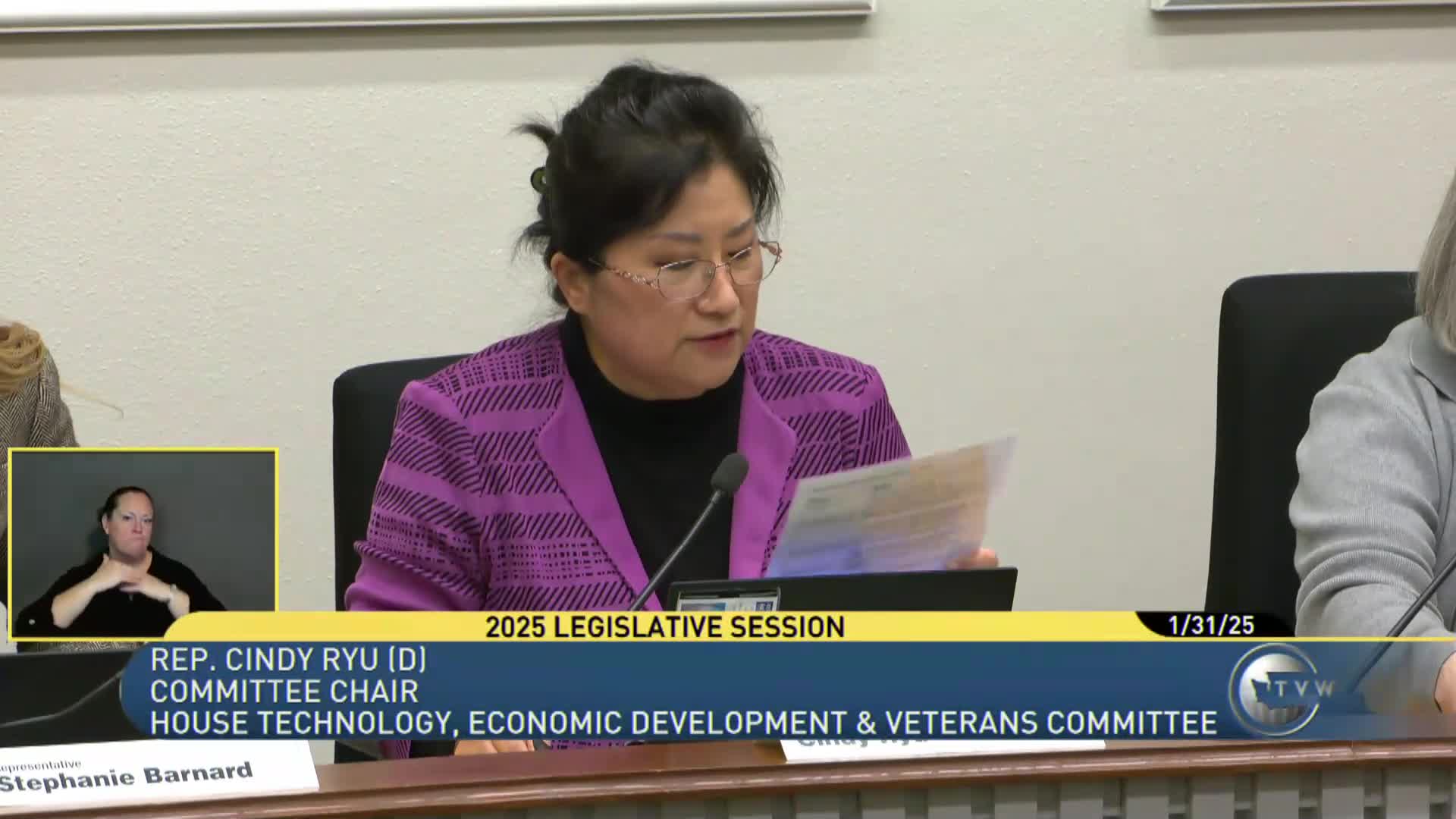
The Technology, Economic Development and Veterans Committee held a public hearing Jan. 31 on House Bill 1503, a bill to expand Washington's digital-equity efforts and reassign certain duties from the state Broadband Office to the Office of Equity.
Committee staff Emily Pool briefed members, explaining that HB 1503 would expand the Broadband Office’s purpose to include digital equity while reassigning some outreach and plan-development duties to the Office of Equity. The Office of Equity would be required to develop and monitor implementation of the state digital equity plan, provide staff support to the Digital Equity Forum, and submit a progress report by Dec. 1, 2026; the office would also submit a revised digital equity plan every two years. The bill updates the state's definitions for broadband service and sets new broadband goals for 2028, 2030 and 2032.
Representative Gregersen, the prime sponsor, described the legislation as a ‘‘trailer’’ to prior pandemic-era statute intended to consolidate state efforts and improve coordination across agencies, infrastructure partners and community organizations. She and many testifiers stressed three “legs of the stool” necessary for digital inclusion: adequate, affordable internet service; devices; and digital skills/navigation supports.
Public testimony included school-system and library representatives, nonprofits that provide digital navigation and device support, industry and local-government witnesses and state agencies:
- Mitra Chernisky, representing the Office of the Superintendent of Public Instruction, supported the bill and noted that about 91% of school districts now have a 1-to-1 student device program but said federal funding that helped create those programs has lapsed and schools still need ongoing supports, including media literacy training.
- Carolyn Logue of the Washington Library Association described libraries as critical anchor institutions that provide device access, digital literacy training and support for students and families who lack devices or home broadband.
- William Booth of Braiding Pathways and other community nonprofits described work providing digital-literacy workshops for seniors and veterans and urged passage.
- Dave Pringle of the Department of Commerce and Patrick Stickney of the Office of Equity described an existing interagency agreement under which the Office of Equity has taken on staffing of the Digital Equity Forum and the offices’ ongoing partnership; Commerce said it is working on federal funding opportunities that could provide more than $1 billion for infrastructure.
- Representatives of public-utility districts, ports, and other local utilities raised concerns about proposed changes to statutorily set broadband speed goals: several witnesses urged the committee not to lower or remove speed goals before federal funds are appropriated and projects completed. Testimony asked for clarity on how the Broadband Office and the Office of Equity will coordinate contracting and program administration to ensure underserved and historically marginalized communities stay centered.
Committee members asked agency witnesses to describe how the two offices will coordinate and whether reassigning outreach tasks would speed or slow delivery of services; agency staff said the bill aligns work already underway and that they intend to continue partnering on implementation.
The committee did not take action; the public hearing record will be used as committee members prepare amendments for executive session.