Get Full Government Meeting Transcripts, Videos, & Alerts Forever!
Get email alerts on the Quantum Economic Development topic
No spam. Unsubscribe anytime.
Committee backs bill to create quantum advisory committee and state grant program, adopts amendment tightening eligibility and reporting dates
Summary
The committee approved substitute House Bill 1360 with an amendment that narrows advisory committee membership, sets reporting deadlines, and adds a private match requirement for state grants supporting quantum technology economic development.
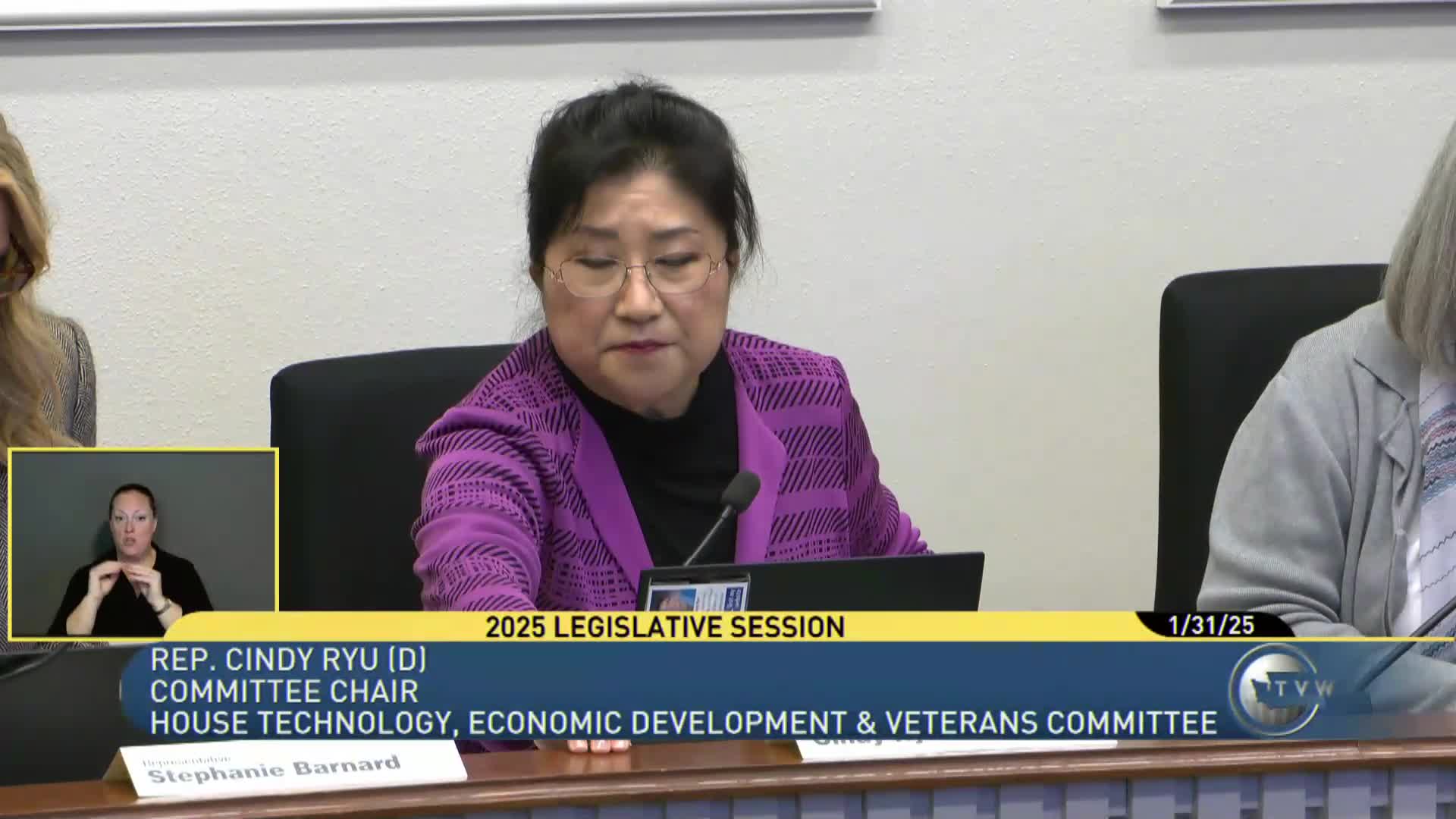
The Technology, Economic Development and Veterans Committee on Friday adopted an amendment and reported substitute House Bill 1360 out of committee with a due-pass recommendation.
The committee approved Amendment WALE 208 and then voted to report the substitute with the amendment. Staff announced a final committee tally of 10 ayes, 2 nays and 1 excused.
House Bill 1360 is intended to advance economic development related to quantum technologies by creating an advisory committee to make recommendations and by establishing a state grant program to support applicants pursuing federal grants tied to quantum technologies. Committee staff, Martha Whaling, summarized the amendment and the bill's core elements: the amendment removes one statewide elected official from the advisory committee, reducing membership from 10 to 9; requires that a committee member who represents a company that builds and sells quantum computers and software represent a company that has a factory in the state (the amendment language specifies the company must have a factory in Washington, not that the committee member personally must have a factory); sets deadlines for the advisory committee's reporting and work products (annual reports due Nov. 1, 2025 and Nov. 1, 2026; workforce development plan due June 30, 2026); requires applicants for the new state grant program to provide at least five times matching private funds to receive state grant funds; creates a public records exemption for financial and commercial information submitted by private applicants for state grants; and includes a null-and-void clause.
Vice Chair Clobba moved adoption of WALE 208 and noted the amendment was a work in progress; she asked colleagues to send further suggestions as the bill moves to appropriations. Representative Penner said members on his side were mixed: he praised the commission approach and said his side appreciated the opportunity to improve the bill but indicated he would not recommend the bill. Representative Clobba and other supporters emphasized workforce development and cybersecurity implications, noting quantum computing will have significant effects on cryptography and password protections.
The committee proceeded with a roll call. The staff-recorded vote for the substitute was 10 ayes, 2 nays and 1 excused. Committee staff announced the result and the bill was reported out of committee with a due-pass recommendation.
Proponents argued the advisory committee, composed of technical and policy stakeholders, would help state agencies align workforce training and pursue federal funding opportunities; dissenters raised concerns about committee composition and some policy details that they said need further refinement at later stops in the process.
Proponents and staff asked members to forward suggested amendments prior to the next stop at appropriations.