
Planning Commission introduces ordinance to implement Lexington Park rezoning and schedules public hearings
Get AI-powered insights, summaries, and transcripts
Subscribe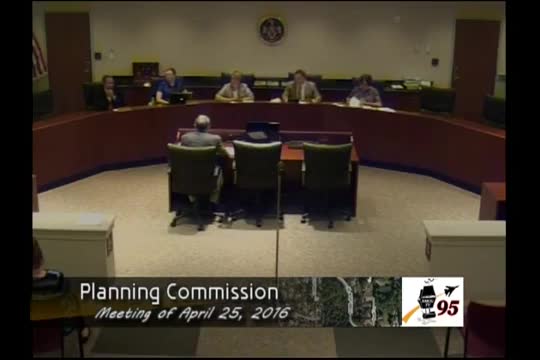
Summary
St. Mary's County Planning Commission members heard a staff introduction to an ordinance that would translate the 2015 Lexington Park Development District plan into new zoning categories, incorporate Navy compatibility tables and noise maps into the county zoning ordinance, and adopt a schedule of work sessions and a June public hearing.
St. Mary's County Planning Commission members heard a staff introduction to an ordinance intended to implement the Lexington Park Development District plan and to insert Navy compatibility tables and a noise map into the county's comprehensive zoning ordinance. Planning staff presented an implementation schedule that would lead to a public hearing on June 27 and transmission to the Board of County Commissioners in late August.
The introduction explained that the 2015 Lexington Park plan divides the development district into subareas — north, central and south — and identified a central focus area where staff and the consultant recommended more-detailed mixed-use, limited commercial-industrial and neighborhood design guidance. Phil Shire, a county planning staff member, told commissioners the draft maps replace the existing DMX (downtown mixed-use) and CC (community commercial) categories with a mixed-use regime and a limited commercial-industrial classification to better reflect underlying uses and Air Installation Compatibility Use (ACU) restrictions tied to the adjacent naval facility.
Shire said the proposal co-locates Navy guidance tables (noise and accident potential zones) into chapter 43 of the county zoning text and adds a map that will let staff and applicants apply those standards in one place. He said the county has used Navy guidance informally for years, and the ordinance would formalize that guidance in the zoning ordinance as compatibility guidelines, not as automatic prohibitions. Staff emphasized that the Navy would continue to review projects that fall within Approach/Accident Potential Zone (APZ) or ACU areas and make recommendations, but that the county retains final authority on land-use decisions.
Commissioners and staff discussed the boundaries of the Lexington Park district, noting the commission had restored certain growth-area boundaries that staff and the consultant had earlier recommended removing. Shire said the commission favored keeping those lands in the growth area so property owners could plan for future development. Jeff Jackman, a planning staff member, pointed to map details showing where the downtown ends and the Great Mills Road corridor begins, and he identified several focus corridors and “pearls” where more intense mixed use or corridor upgrades are intended.
Staff gave a draft schedule for the next month of work: an initial work session on May 2, a second work session on May 16, introduction of the second set of articles (maps and remaining text) on May 9, a June 8 deadline for final language to release to the public, and a public hearing targeted for June 27. Shire cautioned that the schedule could shift if additional work sessions are needed, but said staff intends to finish the rezoning and supporting zoning text by the end of the calendar year if the schedule holds.
Why it matters: Lexington Park is the county’s largest growth area and includes neighborhoods, commercial corridors and properties affected by naval flight zones. Formalizing the Navy compatibility tables and adding a noise map into the zoning text will change how staff and developers locate uses inside APZ/ACU areas and how the county presents that guidance to the public.
Details commissioners asked staff to provide included a written timeline for the 2007 and later Navy–county encroachment agreements and copies of the agreement the commissioners previously signed with the Navy. Staff said they will provide the timeline and related material at a future work session. The commission requested that the zoning intensities for the new Lexington Park categories be incorporated into the countywide capacity model so the housing-yield analysis will reflect the new zones.
The introduction concluded with no formal vote on the ordinance itself; staff said subsequent work sessions and the public hearing would be the next opportunities for formal action.