Get Full Government Meeting Transcripts, Videos, & Alerts Forever!
Get email alerts on the Pfas Drinking Water topic
No spam. Unsubscribe anytime.
DEQ presents statewide PFAS testing, treatment options and federal compliance timeline to Senate Health and Welfare Committee
Summary
Tyler Fortunati, chief of the Drinking Water Bureau at the Idaho Department of Environmental Quality, told the Senate Health and Welfare Committee that the state is preparing to adopt the U.S. Environmental Protection Agency's recent drinking-water rule for PFAS and that monitoring has already identified detections statewide.
Tyler Fortunati, chief of the Drinking Water Bureau at the Idaho Department of Environmental Quality, told the Senate Health and Welfare Committee that the state is preparing to adopt the U.S. Environmental Protection Agency's recent drinking-water rule for PFAS and that monitoring has already identified detections statewide.
The presentation focused on what PFAS are, EPA's April 2024 national drinking-water regulation for several PFAS compounds, and what the state's sampling and funding picture looks like as Idaho prepares to incorporate the federal rule by reference (docket 58-0108-2401). "PFOS is a group of upwards of 15,000 man made chemicals," Fortunati said, and the EPA rule sets maximum contaminant levels in parts per trillion for six PFAS analytes.
Why it matters: Fortunati told the committee that detections have been found in both military and civilian public water systems and that the federal rule sets monitoring and compliance deadlines that will affect community and nontransient noncommunity public water systems across Idaho.
What DEQ told the committee
Fortunati said EPA's rule requires initial monitoring to be completed by April 2027; that monitoring will determine the frequency of ongoing sampling beginning May 2027; that systems must include PFAS information in consumer confidence reports starting in April 2027; and that public notification and enforceable compliance with the maximum contaminant levels begin in 2029. "The initial monitoring will then dictate the frequency of their routine monitoring going forward," he said.
On Idaho sampling and findings, Fortunati said DEQ and other entities have undertaken multiple efforts: - Department of Defense sampling found PFAS at Mountain Home Air Force Base and at Gowen Field; Mountain Home had detections in multiple public-water-system sources in 2016. A treatment system was installed on well number 4 in 2018; that well produced about 1,300 gallons per minute, installation cost about $1,360,000 with ongoing operation and maintenance costs cited at $100,000, and the source was taken offline in 2020. - Under EPA's fifth Unregulated Contaminant Monitoring Rule cycle (2023—25), 61 Idaho systems were selected for monitoring; 41 systems had reported results to date and seven systems had detections under that effort, with one system in the Boise region returning results that would exceed EPA's maximum contaminant level. - DEQ's voluntary PFAS sampling project (started April 2021) has sampled 381 of Idaho's 3,219 active public-water sources (about 12%). That project found 66 detections at the source level (about a 17% detection rate). On the system level, DEQ sampled 203 of Idaho's 2,016 regulated public water systems (about 10%); 58 systems had detections (about 28%). Fortunati cited a highest measured concentration to date of 42.2 parts per trillion in the state.
Fortunati outlined how systems may respond if monitoring indicates concentrations at or above the federal maximum contaminant level: additional confirmatory sampling; consultation with engineers or consultants; and feasible mitigation options that include installing treatment (as at Mountain Home AFB), developing new sources and abandoning contaminated sources, or interconnecting with nearby systems to consolidate supply.
Funding and technical support
Fortunati said DEQ offers State Revolving Fund (SRF) financing and has used EPA emerging-contaminant funding to pay for voluntary sampling. He said SRF capitalization grants covering fiscal years 2023 through 2027 provide roughly $7.6 million annually for drinking-water projects and about $1.0 million for wastewater projects for Idaho; systems must submit a letter of interest and document the PFAS issue to be considered for the funding list.
Questions from committee members
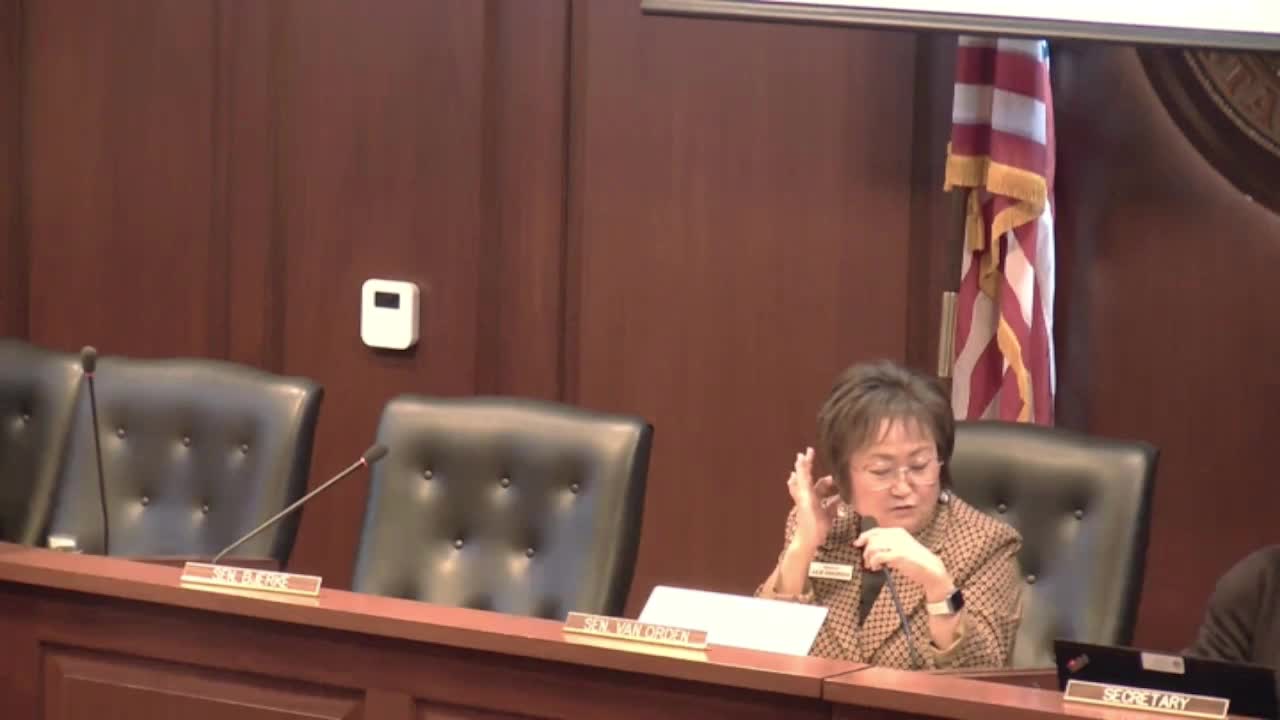
Senator Wintrow, a member of the committee, asked how soil contamination might be addressed and how rural communities lacking municipal systems would be impacted. Fortunati said DEQ would refer soil-remediation questions to the waste management remediation division and that rural systems have the same response options but that consolidation or interconnection may be logistically harder depending on proximity. On public notification, Fortunati said that under the EPA-based rule, public water systems will be required to deliver public notification beginning in 2029; before federal notification requirements begin, DEQ provides templates and materials and notifies the local health district and regional DEQ offices when detections occur.
Next steps
Chairman Bierke told the committee that the pending Idaho rule was not before the committee that day and that the committee would vote on the rule next week. Fortunati had asked for the committee's support to adopt docket 58-0108-2401.
Ending: The presentation illustrated that DEQ and EPA sampling have identified PFAS at multiple sources in Idaho, that some detections approach or exceed the EPA maximum contaminant levels, and that adoption of EPA's rule will trigger monitoring, reporting and compliance deadlines for public water systems statewide. The committee scheduled a vote on the pending Idaho rule at a subsequent meeting.