Get Full Government Meeting Transcripts, Videos, & Alerts Forever!
Get email alerts on the Climate Plan topic
No spam. Unsubscribe anytime.
Bozeman updates climate plan progress, seeks board input on two‑year sustainability work plan
Summary
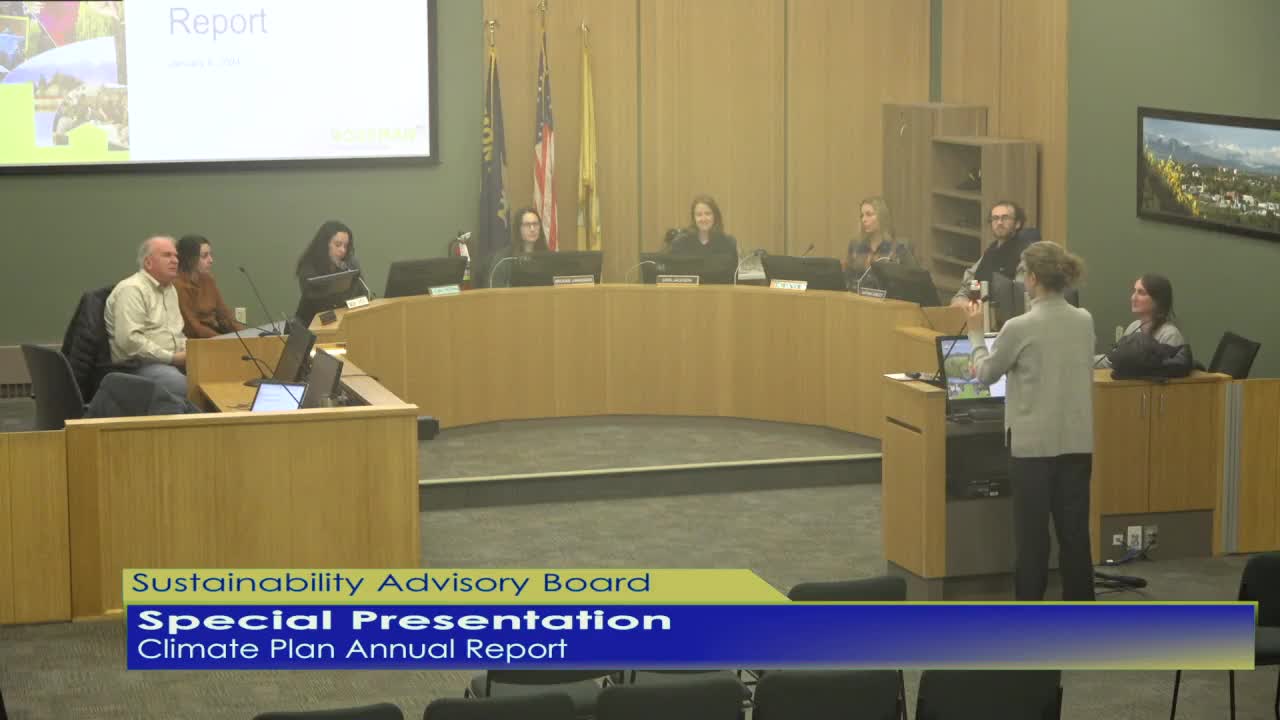
Natalie Meyer, sustainability division staff for the City of Bozeman, presented the city’s annual Bozeman Climate Plan report and a proposed two‑year Sustainability Division work plan to the Sustainability Advisory Board on Jan. 8, highlighting municipal net‑zero construction, an EPA $1.6 million curbside‑compost grant and ongoing work on renewable energy, building electrification and transportation.
Natalie Meyer, sustainability division staff for the City of Bozeman, presented the city’s annual report on the Bozeman Climate Plan and a proposed two‑year Sustainability Division work plan to the Sustainability Advisory Board on Jan. 8. The presentation reviewed progress toward the plan’s reduction and resiliency targets and asked the board for feedback on priorities such as the Unified Development Code, water conservation and electric mobility planning.
Meyer told the board, “The Bozeman Climate Plan was adopted in 2020. So we’re four years into implementation of that plan.” She summarized the plan’s numeric mitigation goals — reduce greenhouse gas emissions 26% by 2025 (below a 2008 baseline), achieve 100% net clean electricity by 2030, and reach carbon neutrality by 2050 — and reviewed the city’s inventory through 2022.
The report showed buildings as the largest local emission source (about 52% of community emissions: roughly 29% commercial, 23% residential), transportation at about 37% (including roughly 27% from on‑road and off‑road vehicles and about 10% from aviation), and waste at about 10%. Meyer noted the challenge posed by growth: Bozeman’s population rose about 57% between 2008 and 2022, while per‑person emissions fell roughly 17% during the same period.
City highlights cited in the presentation included municipal projects and community programs. Meyers described Fire Station 2 on Kagy Boulevard as the city’s first “net‑zero energy ready” building with about 53 kilowatts of solar, variable‑refrigerant‑flow heat pumps, heat‑pump water heaters, solar‑preheating walls and EV charging provision for fire apparatus. The water reclamation facility reduced electricity use by about 5%, producing roughly $34,000 in annual utility savings, Meyer said.
On community electrification and efficiency, Meyer described a local heat‑pump water‑heater rebate that helped install 27 units last year; she said the installations reduced emissions by about 650 metric tons of CO2 and that contractors received roughly 225 hours of continuing education tied to the program. Meyer noted the city rebate is $500 and can be paired with Northwestern Energy’s $3,000 rebate for eligible conversions.
Renewable energy actions included expanded solar on municipal buildings (the public safety center and planned library array increases) and ongoing negotiations with Northwestern Energy on a green‑power program that would allow customers to opt in to local renewable supply and support a new Montana project. Meyer said the library array could be expanded to roughly 43–50 kilowatts.
Transportation and street planning updates described the city’s Streets Are Safe for Everyone plan and several near‑term actions: a buffered bike lane on Ferguson Avenue, 12 seasonal traffic‑calming projects, three rapid‑flashing beacons, and lowering speed limits on certain city streets to 35 mph. The city fleet now includes about 25 hybrid or plug‑in vehicles and three battery electric F‑150 trucks, staff said.
Waste reduction and organics were emphasized: Meyer said the city received a $1,600,000 EPA grant to expand municipal composting to include household curbside composting, a program the presenter described as a likely first in Montana. Staff said the board would discuss the program rollout at a future meeting and that a rate study and communication materials are in development.
Meyer also summarized resiliency and natural‑systems work: low‑impact development for stormwater permitting, maintenance of 11 stormwater features, replacement of about 600 feet of undersized pipe, and a completed local food system mapping project. The Branch Out Bozeman tree‑canopy mapping collaboration and a turf‑removal rebate were cited as related efforts.
After the presentation the board discussed priorities and constraints. Mayor Cunningham (Mayor) and board members emphasized limited staff capacity — “the sustainability department contains three people,” Cunningham said — and state‑level constraints on local mandates. Cunningham and staff described the city’s preference for incentives and voluntary measures given Montana legislative limitations on local authority.
Board members suggested candidate long‑term projects: sustained engagement on the Unified Development Code (UDC) update, deeper work on water conservation and integrated water resources planning, and an electric‑mobility plan that addresses public charging, transit and micromobility. Nathan (Sustainability Advisory Board member) urged a formal advisory role on the UDC update; Isabelle (Board member) and others suggested the board undertake a focused, multi‑month project such as water or a prioritization analysis to identify “highest bang for the buck” actions.
Public comment included a resident’s concern about urban tree equity. Daniel Carty (Bozeman resident) said the city is losing mature trees faster than planting can replace them and cited a local affordable housing project that will remove most mature trees on its site as an example where UDC protections could matter.
Board and staff next steps noted during the meeting: staff will bring more detailed materials on the curbside compost rollout (including outreach and rate‑study considerations) at the next meeting; the stormwater facilities plan will return in March; and the city intends to present a draft Lehi community agreement supporting a green‑power filing to commission and then to the Public Service Commission as appropriate. No formal policy votes related to the climate plan or work plan were taken at the meeting; the only recorded board action was approval of the Dec. 11 minutes.
The meeting closed with an FYI: the local plastics ordinance is scheduled for a court hearing on Feb. 6, a proceeding staff said could affect single‑use‑plastic restrictions across Montana.