Get Full Government Meeting Transcripts, Videos, & Alerts Forever!
Get email alerts on the Pedestrian Bicycle Gap Analysis topic
No spam. Unsubscribe anytime.
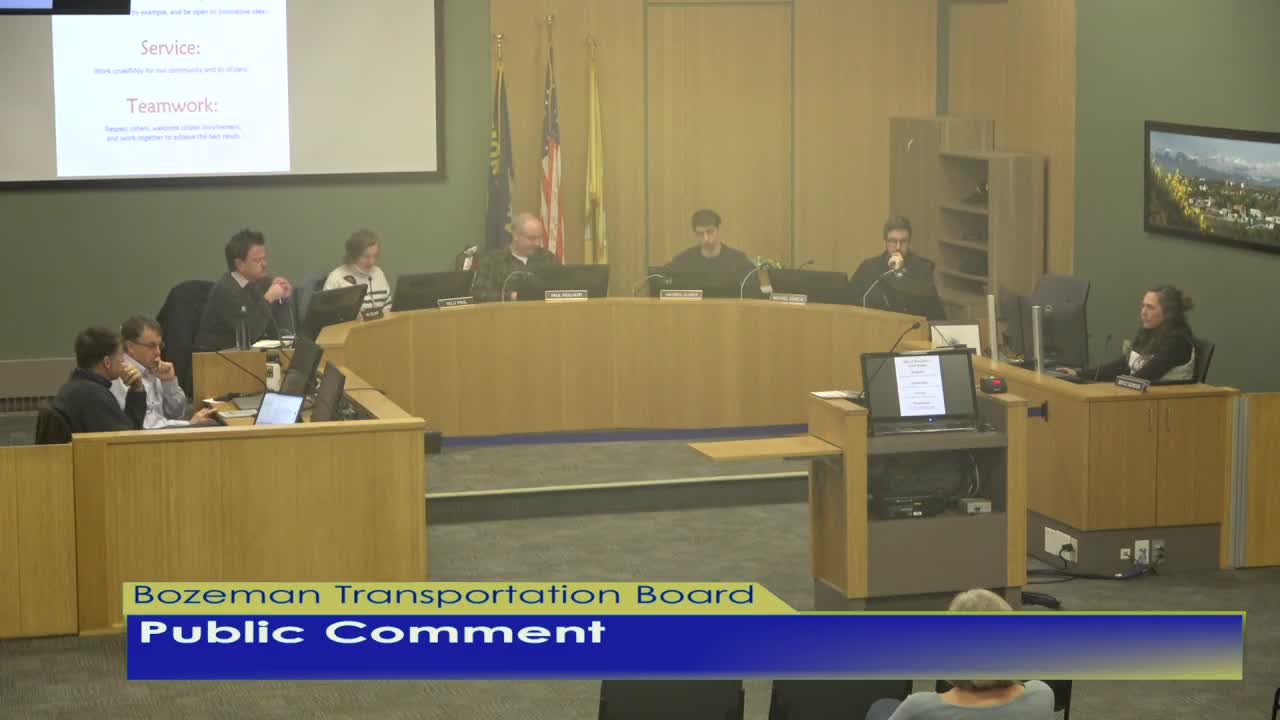
Bozeman board reviews GIS-based pedestrian and bicycle ‘gap analysis’ tool; safety weighted highest
Summary
At its Jan. 22 meeting the Bozeman Transportation Board reviewed a draft GIS prioritization tool for pedestrian and bicycle network gaps. Staff and consultants said safety and comfort were assigned the greatest weight; the tool will be finalized in spring 2025 and maintained in-house with continued public input via EngageBozeman.
The Bozeman Transportation Board on Jan. 22 reviewed a draft GIS-based prioritization tool designed to identify and rank gaps in the city’s pedestrian and bicycle network, staff said. The discussion focused on the five scoring criteria and the numeric weights assigned to subcriteria that will feed a master list of prioritized gaps for future projects.
The tool, led by city staff with consultant input, uses objective measures such as level-of-traffic-stress, posted speed, crash history and proximity to activity centers to rank spot, linear and area gaps. Candice Mastel, the project lead, told the board the completion target for the tool and associated report is May 2025 and that the dataset will be managed by the city’s GIS team and updated on an annual or semiannual basis.
Why it matters: Board members and the public told staff the tool could shape which sidewalk, crossing and shared-use path projects the city pursues and which projects are put forward for grant programs such as Transportation Alternatives. Board members repeatedly emphasized that safety for children and school access should influence prioritization.
Staff and consultants said safety and comfort received the largest token-weighting in a stakeholder exercise to allocate importance across five categories: safety and comfort; connections to activity centers; equity; public input/consistency with adopted plans; and ease of implementation. Mastel said the panel gave a zero weight to “ease of implementation” within the automated ranking, explaining the city can judge implementation feasibility separately when converting gaps into deliverable projects.
Board members asked technical questions about several inputs, including how level-of-traffic-stress is measured (the tool uses a 1–4 LTS scale updated from the city’s 2017 Transportation Master Plan evaluation), how crash data are counted, and whether buffers around linear gaps are measured along entire segment lengths or at endpoints. Mastel and Taylor Lonsdale, city transportation engineer, said the project team will return with clarifications; Mastel invited continued feedback on the Live EngageBozeman map, which gathered roughly 75–100 public submissions during the outreach period.
Public commenters and several board members urged staff to prioritize missing links with no reasonable alternative routes — Frontage Road and Hagerty Lane were cited repeatedly — and to ensure the tool surface obvious safety needs in winter months. Merilee Brown, a longtime local pedestrian-safety advocate, told the board the Frontage Road pathway is a long-standing priority and urged the city to ‘‘find a way to get it done.’’
Staff said the tool’s immediate output will be a GIS dataset of scored gaps. That dataset can be sorted or filtered by type (spot, linear, area) and by criteria, and staff said they expect to use it to inform CIP programming and grant applications. Mastel said the project team intends for the tool to remain adaptable — the GIS model can be updated with new metrics or changed weights if the board directs it.
Board next steps: staff will finalize the analysis with the consultant, run additional validity checks and return with a recommended approach for translating prioritized gaps into projects and candidate grant packages.
Ending note: Mastel closed the work session by reminding the public that the EngageBozeman page remains open for comment while the team finalizes the report, and she provided a direct contact for follow-up.