Get Full Government Meeting Transcripts, Videos, & Alerts Forever!
Get email alerts on the Charter Bylaws topic
No spam. Unsubscribe anytime.
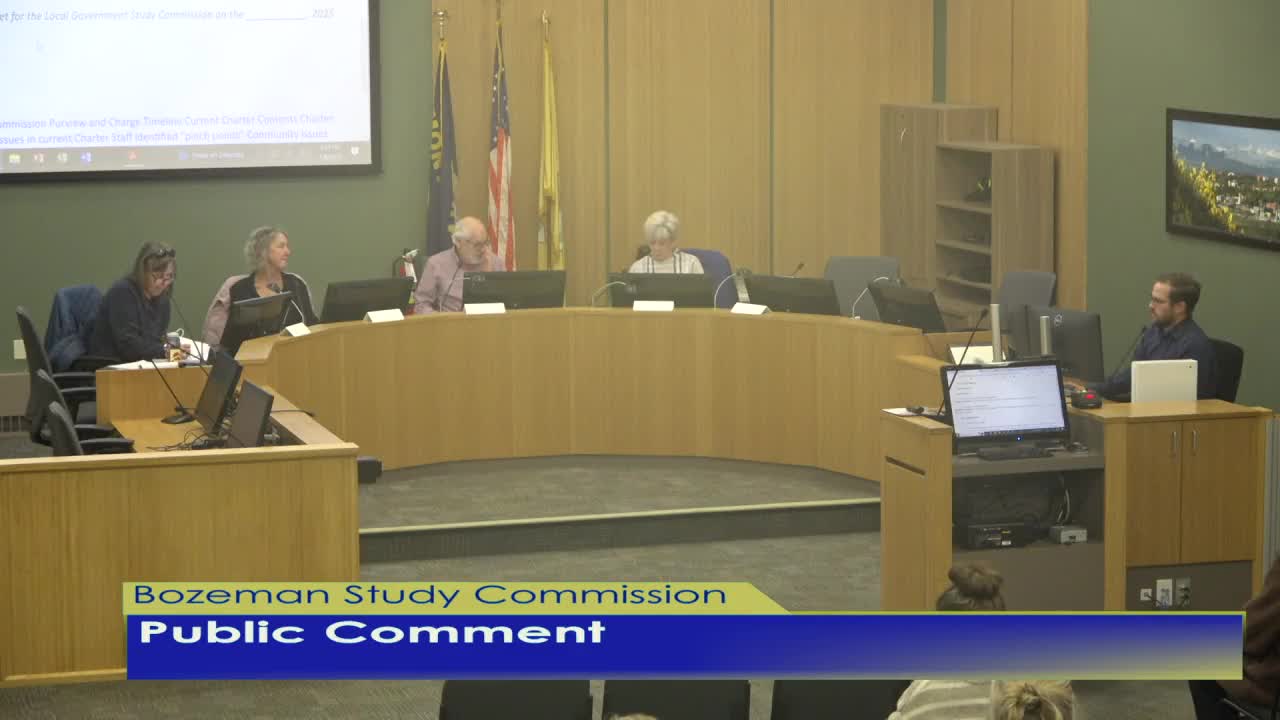
Bozeman study commission adopts bylaws, sets rules for remote participation and public comment
Summary
The Bozeman City Study Commission voted unanimously Jan. 8 to adopt bylaws that set procedures for meeting agendas, public comment, remote participation and public hearings; commissioners also approved remote participation for one commissioner and directed staff to pursue a temporary recording‑secretary solution.
The Bozeman City Study Commission voted unanimously on Jan. 8 to adopt bylaws that govern how the panel will operate while it reviews the city charter and other city processes.
The vote followed roughly two hours of discussion and multiple section-by-section motions to amend the draft bylaws. The commission approved changes that clarify how and when the public may comment, allow remote participation where technically possible, and require the commission to hold public hearings “as required by law.” The panel also directed city staff to pursue a short‑term contracted recording secretary while staff explores longer-term options.
Why it matters: The bylaws establish the study commission’s operating rules for a two‑year review of Bozeman’s charter, including when public input will be heard, how final recommendations must be adopted and the timeline the commission must publish within 90 days of its organizational meeting.
Key changes approved
- Public comment: The bylaws require that meetings include opportunities for public comment on matters within the commission’s jurisdiction, and the commission agreed to add a clear agenda notice that members of the public may comment once on a given topic and that individual agenda items will allow public comment at the time the item is discussed. Commissioners stressed the need for flexibility — for example, permitting shorter or longer comment periods depending on meeting size — and agreed that the agenda will explain the one‑comment rule.
- Remote participation: Commissioners approved language allowing members to participate electronically when they can both be heard and seen; the measure passed by unanimous vote. The commission also confirmed a process for approving audio‑only participation when technical problems occur.
- Public hearings: The bylaws were edited to state the commission “shall conduct at least two public hearings as required by law” (statutory citation noted in commission materials). Commissioners removed overly formal legislative language from the draft and left the commission able to set the detailed procedures for those hearings consistent with state law.
- Recording secretary and minutes: Commissioners asked staff to pursue a short‑term contracted recording secretary classification (estimated by staff to be in the roughly $20–$25/hour range) while the city evaluates longer options. City staff said a short‑term classification would be capped at work on roughly 90 days before an alternative staffing approach would be required.
What commissioners said
Becky Franks, a study commissioner who drafted the initial bylaws from a template, said the draft was based on the Model City Government resources and state law and added local clarifications so the new commission would know how to run meetings: “Most of it was taken out of the MCA and I tried to not only put in the connection but also an actual link to the MCA in places where it was, to that.”
Jan Stroud, a study commissioner participating remotely, urged a mix of resources for training and public education: “There will be some tools and resources from the center that some will find more helpful and more important to our work. All of us can have that access, and at the same time, I too am interested in other resources that we might be able to add.”
Anna Savory, the City of Bozeman’s chief civil attorney, cautioned commissioners about social media use and public‑meeting rules: “You don't give up your First Amendment rights when you become elected officials,” she said, but advised that if multiple commissioners interact on the same thread that could create a public‑meeting record and should be memorialized.
Votes at a glance
- Motion to allow Jan Stroud to participate by Zoom for the Jan. 8 meeting — approved unanimously (Ayes: Barb Sestero; Becky Franks; Carson; Deanna Campbell; Jan Stroud). Notes: motion moved and seconded on the record; roll‑call style confirmation followed.
- Series of motions to adopt the bylaws in sections (parts 1–8), as amended during the meeting — each part passed unanimously. Final motion to adopt the bylaws “as previously amended and discussed” — approved unanimously (Ayes: Barb Sestero; Becky Franks; Carson; Deanna Campbell; Jan Stroud).
Discussion, next steps and scheduling
Commissioners agreed to reconvene in two weeks (Jan. 22) to continue organizational work. For the Jan. 22 meeting the commission listed approval of minutes, further budget discussion and a scheduling/timeline conversation to work back from the statutory 90‑day requirement to publish a timetable for the commission’s deliberations. The commission asked the city clerk’s office to circulate digital reference materials and for individual members to send suggested resources to staff ahead of the next meeting.
Ending
Commission leaders said they expect the commission will hold a mix of formal public hearings and more informal outreach or town‑hall style meetings while preparing the timeline and final report. City staff will return with cost and staffing options for the recording secretary and a draft timeline to support the commission’s next meeting.