Get Full Government Meeting Transcripts, Videos, & Alerts Forever!
Get email alerts on the Public Engagement topic
No spam. Unsubscribe anytime.
Study commission sets digital binder, public-comment email and social media guidance
Summary
The Bozeman Study Commission directed staff to create a digital repository for agenda reference materials and a dedicated public-comment email address, removed two non-core articles from the agenda packet, and issued guidance that commissioners should not speak on behalf of the commission on social media.
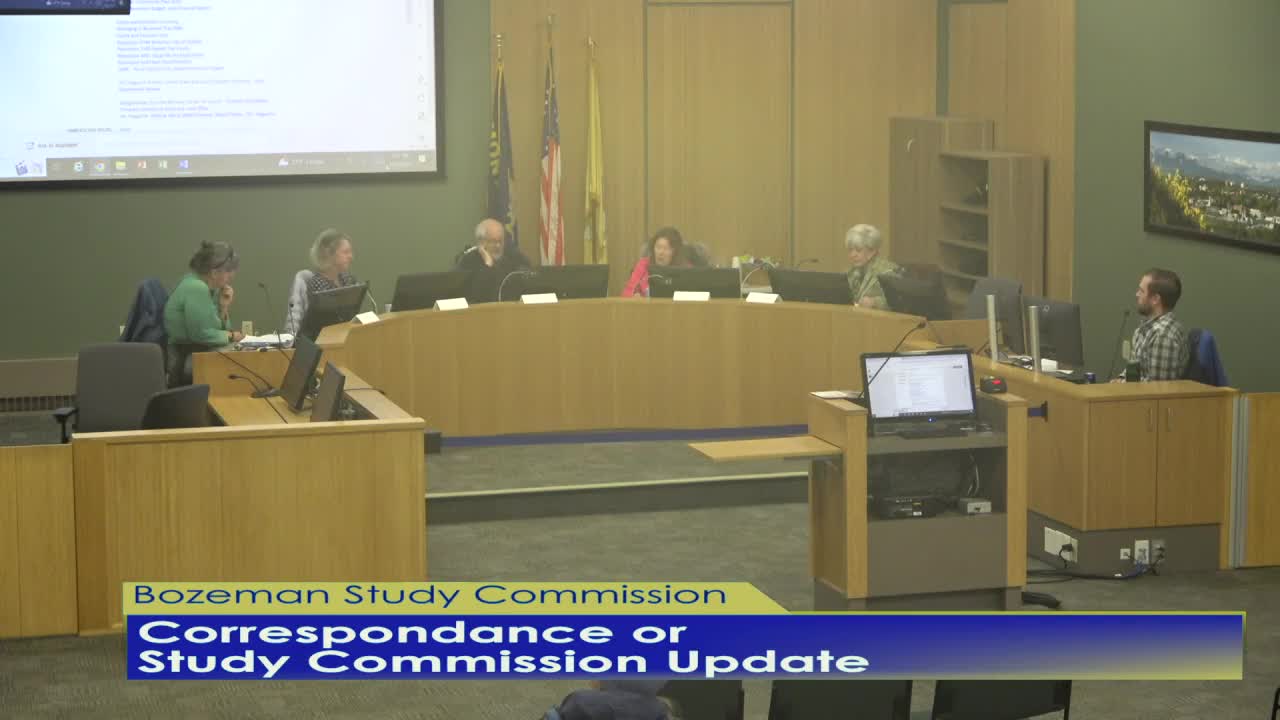
The Bozeman Study Commission on Jan. 22 directed staff to maintain a digital repository for reference materials and to use a dedicated email address for public comments to the commission, steps intended to improve transparency and public access to meeting materials.
City staff described the public-comment workflow and the digital archive. Michael (Mike) (City staff/ex officio) said the commission now has a dedicated address for comments — govreviewbozeman.net — that will forward submissions to commissioners’ city email accounts and into a Laserfiche public repository. "That will automatically send to all 5 of your newly created ... addresses," Mike said, and he added that members must meet with IT to set up two-factor authentication for access.
Why it matters: Centralizing reference materials and public comments streamlines record-keeping and ensures citizens can view documents in the city’s records system. The commission also clarified how items are attached to agendas and who decides what background material is distributed publicly.
Members discussed the set of items attached to the agenda. Commissioner Jan Stroud said she had recommended adding a short "positive meeting environment" discussion to the next agenda and requested the continued presence of a curated list of city policies and reference materials on each agenda. Another commissioner objected to two articles attached to a previous agenda — materials from the Brennan Center for Justice and an article in Ms. Magazine — saying they "fall way outside the scope of our work as a study commission" and risk politicizing the commission’s work. The group agreed to remove those two non-core articles from the public packet for now and to consider proposed supplemental materials at a future meeting.
On social media, Becky Franks, Study Commissioner, asked the group to adopt a practice that commissioners not speak on behalf of the study commission on personal social platforms. "If I have thoughts I wanna share on my social media ... I can do it as Becky Franks, but I can't say what the study commission says," Franks said. Commissioners expressed general agreement that the commission should not have an unofficial social-media presence until a communication strategy is adopted.
Staff also briefed the commission on website options. Mike said IT could build a subpage linked off the city site that would be visually branded for the commission and would contain agendas, background materials and links. The example used was the Metropolitan Planning Organization page; staff noted that a subpage can make it clear the commission operates adjacent to — but not within — the city’s permanent administrative structure.
The commission confirmed a public-comment folder in Laserfiche and asked staff to ensure all incoming comments are added to that repository and distributed to commissioners' city and private emails for the public record. Staff noted that some public records may be large and that links are an acceptable way to provide voluminous reference materials.
The commission scheduled future agenda planning to include a short, facilitated discussion of a "positive meeting environment" and to consider a formal communication strategy at a later meeting.