Get Full Government Meeting Transcripts, Videos, & Alerts Forever!
Get email alerts on the Historic Preservation Landmark Program topic
No spam. Unsubscribe anytime.
Bozeman preservation board presses for landmark program, staffing and demolition review triggers
Summary
At its Jan. 15 meeting the Bozeman Historic Preservation Advisory Board reviewed priorities for a proposed local landmark program, urged a permanent preservation staff position, and asked to be notified earlier on projects — especially potential demolitions — while also discussing outreach, surveys and coordination with city policy updates.
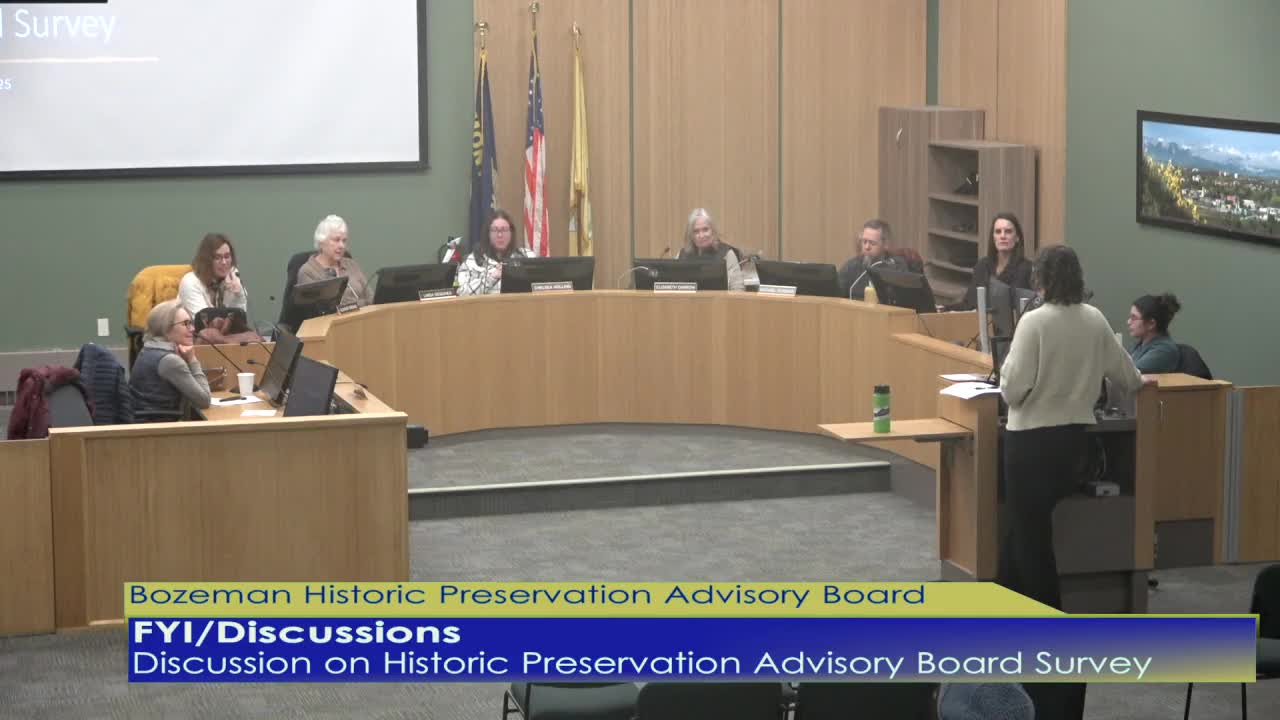
The Bozeman Historic Preservation Advisory Board on Jan. 15 reviewed priorities for a proposed local landmark program, urged the city to fund a dedicated preservation staff position and pressed for early notification and advisory review — particularly for demolition proposals affecting identified historic resources.
Board members opened a lengthy discussion around four directives that will shape the local landmark program: (1) the city’s local preservation program, (2) integrating preservation into local, state and federal planning, (3) identifying and evaluating resources, and (4) public education. The meeting included neighborhood comments about the Guthrie redevelopment application and a public call for the board to be pulled into related reviews earlier.
The discussion matters because the city is drafting a local landmark program (phase 1) and expects a code amendment phase (phase 2). Board members said early involvement on planning and policy changes — including the Unified Development Code update and the city’s forthcoming affordable housing ordinance — is essential to protect historic resources and to preserve community knowledge about buildings that are at risk from redevelopment.
Multiple members argued the board should remain advisory, not assume binding design-review authority. "I don't think we should be doing design review or have that authority because we're not accountable to anyone," said one board member who spoke during the meeting. Instead, board members described a role where HPAB provides an expert, nonbinding opinion about historical impacts and is "tapped" by staff or neighborhood groups for projects that appear likely to affect historically important properties.
Demolition review surfaced repeatedly as the clearest trigger for board involvement. "I wanna circle back. I think we should look at all demolitions of an identified historic resource. Period," a board member said, arguing that the board could be brought in to review demolition proposals for properties already on a local inventory. Staff noted existing director-level discretion allows the director of community development to request advisory review; several board members asked for a more systematic notification process so advisory boards are aware of rising projects earlier than the legal public‑notice window.
Board members and staff flagged staffing as a central obstacle. Participants said historic‑preservation work has been carried by a single staff person in addition to other planning duties and that turnover in community development leadership has hampered continuity. "If you wanna commit toward this, then let's put some resources there to support it," a board member said. City staff confirmed creating a dedicated historic preservation officer would require a budget addition and that the community development department could propose it during budget planning.
Surveying and inventory work was discussed at length. Staff and consultants reported many inventory forms still date from the 1980s; one staff speaker cited an estimate of roughly 2,000 properties that may need updated documentation. Cost estimates for professional survey work varied in examples given at the meeting (one quoted roughly $900 per property versus another consultant’s estimate near $120 per property for simplified field surveys). Board members proposed volunteer-assisted photographic surveys and simplified inventory forms to increase capacity.
Public education and outreach were also priorities. Board members suggested tabling at farmers markets, producing short informational handouts for homeowners (for example, "resources about owning a historic house"), partnering with local organizations such as Montana State University’s Extreme History Project and Preserve Montana, and tying events to Historic Preservation Month. A neighborhood representative, Emily Tollego of the Midtown Neighborhood Association, thanked the board for a recent comment letter on the Guthrie project and urged more advisory engagement on adaptive‑reuse issues.
Staff update and next steps: the preservation program consultant’s phase 1 draft report will be posted for public review before the board’s February meeting; staff said that review period will also include a Community Development Board review and, later, City Commission consideration. Board members were asked to review the draft and prepare comments for the February meeting.
The only formal action recorded early in the meeting was approval of minutes from the Dec. 18 meeting, which passed on a motion and second. The board scheduled follow‑up items including ideas for Preservation Month outreach and further work on notification and demolition triggers.
The board’s discussion highlighted the practical limits of an advisory board with limited staff support and underscored members’ requests for clearer, earlier channels of notification from the city so HPAB can provide timely historic‑resource advice as zoning and development proposals advance.