Get Full Government Meeting Transcripts, Videos, & Alerts Forever!
Bozeman commission holds wide-ranging public hearing on rewrite of affordable housing ordinance; no final vote recorded
Summary
City staff and housing advocates presented a revised Affordable Housing Ordinance (Division 38.380/UDC Chapter 38.380) that reduces some incentives, extends affordability periods and revises parking and height rules; staff amendments were adopted but the full ordinance remained under debate at the end of the meeting.
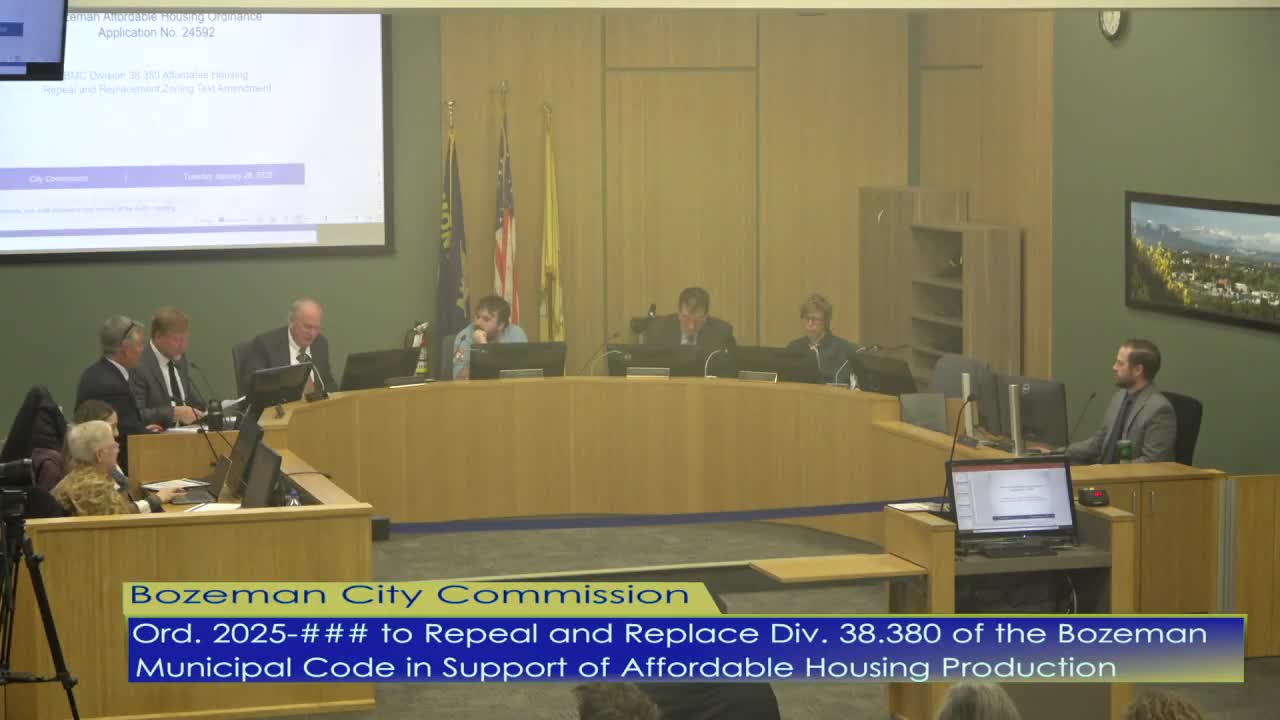
Bozeman City staff presented proposed revisions to the city’s Affordable Housing Ordinance (Division 38.380 of the Bozeman Municipal Code) on Jan. 28, asking the City Commission to repeal and replace the current chapter of the Unified Development Code and adopt a new package of voluntary zoning incentives aimed at producing long‑term income‑restricted housing.
The draft ordinance would lower some development incentives compared with the current ordinance, lengthen required affordability covenants from 30 to 50 years, and narrow the income target for deeply affordable units from 80% to 60% of area median income (AMI). The proposal also reorganizes the incentives into three tiers (Type A, B and C) that differ by expected affordability depth, parking relief and allowable height bonuses.
Why it matters: City staff and outside housing developers said incentives remain one of the few local tools available after the Montana Legislature limited mandatory inclusionary zoning in 2021. Supporters say the package, combined with low‑income housing tax credits (LIHTC) and other subsidies, can deliver units that otherwise would not be financially feasible. Opponents countered at the hearing that the incentives can produce large, out‑of‑scale projects, shift burdens (parking, traffic, neighborhood character) onto nearby residents, and that cash‑in‑lieu or land‑donation options could let developers avoid building affordable units on site.
What staff proposed and why: Susana Montana of the Community Development Department and David Fine, the city’s housing and urban renewal program manager, said staff modeled prototype development pro formas with outside consultants (Root Policy Research) to estimate how height bonuses, parking reductions and lot‑size changes convert to subsidy that can be used to keep units affordable. Fine summarized the basic mechanics: increasing permitted density or reducing parking spreads the same land cost across more units and so creates a subsidy that can be captured for long‑term affordability. In staff’s examples, modest changes generate small subsidies—Type A incentives would typically yield about 5% of units at 60% AMI (or 8% at 80%…
Already have an account? Log in
Subscribe to keep reading
Unlock the rest of this article — and every article on Citizen Portal.
- Unlimited articles
- AI-powered breakdowns of topics, speakers, decisions, and budgets
- Instant alerts when your location has a new meeting
- Follow topics and more locations
- 1,000 AI Insights / month, plus AI Chat