Get Full Government Meeting Transcripts, Videos, & Alerts Forever!
Get email alerts on the Affordable Housing topic
No spam. Unsubscribe anytime.
Bozeman commission holds wide-ranging public hearing on rewrite of affordable housing ordinance; no final vote recorded
Summary
City staff and housing advocates presented a revised Affordable Housing Ordinance (Division 38.380/UDC Chapter 38.380) that reduces some incentives, extends affordability periods and revises parking and height rules; staff amendments were adopted but the full ordinance remained under debate at the end of the meeting.
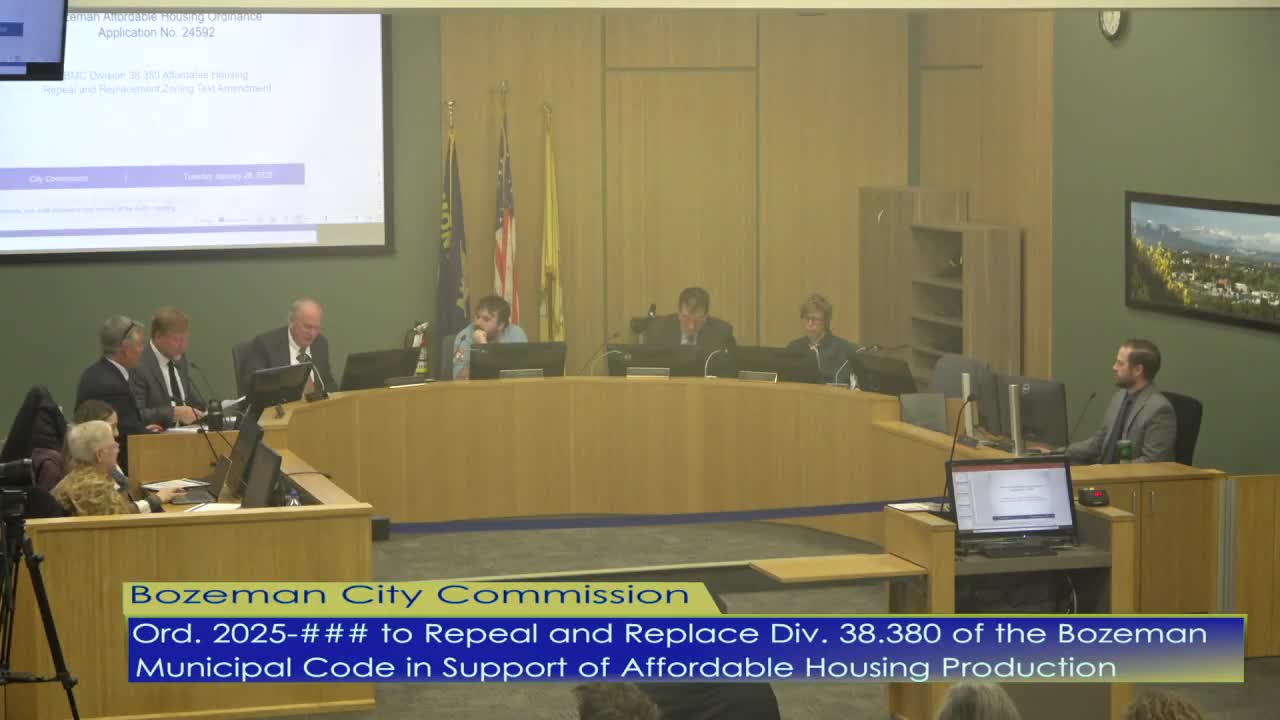
Bozeman City staff presented proposed revisions to the city’s Affordable Housing Ordinance (Division 38.380 of the Bozeman Municipal Code) on Jan. 28, asking the City Commission to repeal and replace the current chapter of the Unified Development Code and adopt a new package of voluntary zoning incentives aimed at producing long‑term income‑restricted housing.
The draft ordinance would lower some development incentives compared with the current ordinance, lengthen required affordability covenants from 30 to 50 years, and narrow the income target for deeply affordable units from 80% to 60% of area median income (AMI). The proposal also reorganizes the incentives into three tiers (Type A, B and C) that differ by expected affordability depth, parking relief and allowable height bonuses.
Why it matters: City staff and outside housing developers said incentives remain one of the few local tools available after the Montana Legislature limited mandatory inclusionary zoning in 2021. Supporters say the package, combined with low‑income housing tax credits (LIHTC) and other subsidies, can deliver units that otherwise would not be financially feasible. Opponents countered at the hearing that the incentives can produce large, out‑of‑scale projects, shift burdens (parking, traffic, neighborhood character) onto nearby residents, and that cash‑in‑lieu or land‑donation options could let developers avoid building affordable units on site.
What staff proposed and why: Susana Montana of the Community Development Department and David Fine, the city’s housing and urban renewal program manager, said staff modeled prototype development pro formas with outside consultants (Root Policy Research) to estimate how height bonuses, parking reductions and lot‑size changes convert to subsidy that can be used to keep units affordable. Fine summarized the basic mechanics: increasing permitted density or reducing parking spreads the same land cost across more units and so creates a subsidy that can be captured for long‑term affordability. In staff’s examples, modest changes generate small subsidies—Type A incentives would typically yield about 5% of units at 60% AMI (or 8% at 80% AMI) for multi‑family rental projects; parking relief can be nearly as powerful a subsidy as adding a story under some scenarios. Staff said the ordinance has produced a pipeline of projects since 2021: roughly a dozen projects are in the pipeline accounting for about 1,000 “affordable” units overall (some projects are LIHTC or otherwise subsidized).
Key proposed changes included: - Affordability terms: extend covenant length from 30 to 50 years and, for deeper affordability, target 60% AMI rather than 80% AMI; staff said this was responsive to public comment requesting longer‑term affordability. - Incentive tiers: Type A (shallow incentives) geared to modest affordability on multi‑family rentals (5% at 60% AMI or 8% at 80% AMI); Type B aimed at legalizing historic downtown patterns and smaller conversions; Type C (deeper incentives) intended for projects that typically include additional subsidies (LIHTC, nonprofits) and would require higher shares of income‑restricted units (staff described scenarios requiring roughly 50% affordable in these projects). - Parking and transit: reduced parking allowances were proposed in exchange for affordability; staff noted a concern about local transit coverage and left open mitigation measures such as parking districts if congestion materializes. - Design and review: the draft removes some prior blanket design exemptions and keeps existing UDC design review (including Neighborhood Conservation Overlay District certificate of appropriateness) in place for developments that remain inside those zones.
Public comment and advisory boards: The commission heard more than two dozen oral comments and received extensive written comment. Speakers split broadly: housing advocates, local housing nonprofits and some developers supported keeping and strengthening incentives (including maintaining cash‑in‑lieu and land donation options); neighborhood groups, longtime residents and some property owners urged repeal or substantial limits, saying incentives encourage large infill projects that change neighborhood character and worsen parking/traffic. The Community Development Board and Economic Vitality Board both reviewed drafts; staff recorded multiple recommendations and concerns in the packet and said they incorporated several changes in the current draft.
Staff amendments adopted at the meeting: City staff proposed five clarifying amendments and the commission voted to adopt a subset of those changes. The commission approved staff amendments that: (1) explicitly allow projects using the AHO to proceed through the sketch‑plan process where appropriate; (2) reduce the possible height bonus in certain mixed‑use commercial zoning districts from four stories to three; (3) limit an additional height bonus in R‑4 zoning to a single story (rather than a larger bonus); and (4) increase the minimum parking requirement for some deep‑incentive projects from 0.5 to 0.75 spaces per dwelling (staff presented these as amendments 1–4). The staff‑sponsored package of amendments was approved by the Commission during the meeting (vote recorded as unanimous among commissioners present; one commissioner was excused/absent).
Outstanding decisions and next steps: A motion to adopt the full revised ordinance was made and seconded during the meeting, but discussion and additional amendment proposals continued and the commission had not completed a final roll‑call vote on the replacement ordinance by the end of the public meeting period captured in the transcript. Commissioners debated a series of additional potential changes including neighborhood pre‑application meetings, caps on maximum height bonuses in lower‑density zoning (RS, R‑1, R‑2, RMH), a possible requirement for nonprofit partnership on deep‑incentive (Type C) projects, and the precise rules for cash‑in‑lieu accounting and whether the commission should retain approval authority over land‑donation or cash‑in‑lieu deals.
Voices in the record: Speakers included Susana Montana (Community Development Department), David Fine (housing and urban renewal program manager), City Manager Chuck Wynne; commissioners who questioned staff included Emma Bodie and Douglas Fisher; many residents testified, including Daniel Carty, Natsuki Nakamura, Roger Blank and others. Local housing‑sector speakers included Nathan Stein (executive director, Headwaters Community Housing Trust) and Tyson O’Connell (United Housing Partners). Ability Montana’s accessibility specialist Kristen Newman provided testimony on parking and access concerns for people with disabilities, urging on‑site parking for multi‑family buildings to preserve access.
What the ordinance would not do (as presented): staff emphasized the package is a voluntary incentive program (not a mandatory inclusionary requirement), consistent with state law; design review processes and other UDC standards remain in effect except where an explicit incentive modifies a single standard (for example, a parking reduction tied to an incentive would only apply where the developer elects that incentive).
Budget and financing notes: staff explained cash‑in‑lieu remains an option and can be aggregated to seed LIHTC or other subsidy programs; staff cited examples where cash in‑lieu previously produced a modest local pool that leveraged substantially larger state/federal financing to produce many rental units. Staff also emphasized that most deep‑affordability projects still require multiple funding sources beyond zoning incentives.
Community next steps: Commissioners asked staff to draft specific amendment language for items raised during comments: (1) a neighborhood pre‑application meeting framework (notification radius/NEighborhood Association notice rules and documentation); (2) tighter limits on height increases in low‑density zones and how zone‑edge transitions would be handled; and (3) clearer formulas for cash‑in‑lieu valuations and whether commission approval is required when applicants donate land or pay in lieu. Staff said they would return with refined language for the commission to consider prior to final adoption.
Ending: The hearing produced no immediate final adoption as of the close of the transcript; staff amendments were adopted and the commission left the ordinance under further consideration with specific directions back to staff. The commission’s next formal vote on a replacement ordinance is expected after staff returns with tightened language reflecting the amendments and the additional directions requested during the Jan. 28 session.