Get Full Government Meeting Transcripts, Videos, & Alerts Forever!
Get email alerts on the Land Use Public Engagement topic
No spam. Unsubscribe anytime.
Residents, sustainability board ask for clearer public engagement and role in UDC and affordable-housing rules
Summary
Residents and a member of the Sustainability Board urged clearer public engagement and a stronger advisory role for boards as the city updates its Unified Development Code and prepares an affordable-housing ordinance.
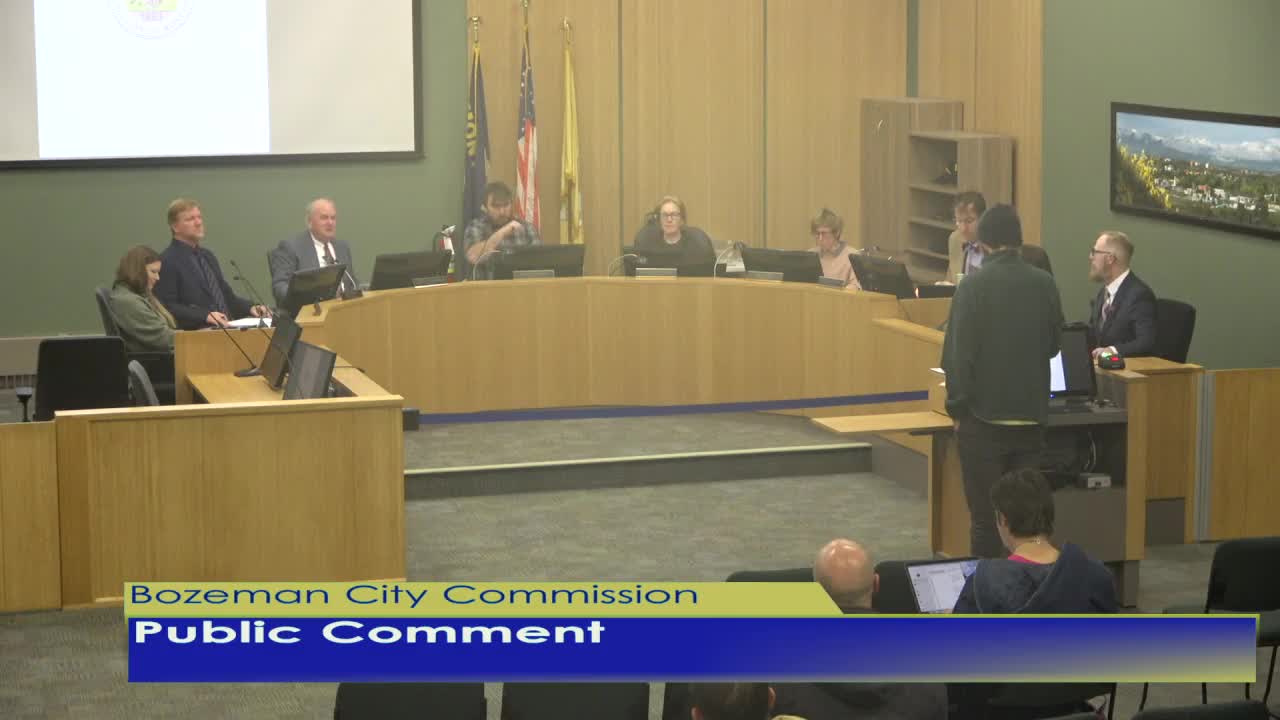
During the Jan. 14 public-comment period, several residents and one member of the Sustainability Board urged clearer staff guidance and a larger advisory role for boards as the city updates its Unified Development Code and prepares an affordable-housing ordinance.
Nathan Gracie, who introduced himself as vice chair of the Sustainability Board but speaking on his own behalf, said the board established by Resolution 5327 is well positioned to advise on UDC updates and affordable-housing work and asked that the board be given a more prominent role.
"Few factors influence these livelihoods more than our built environment," Gracie said, adding that the sustainability board could provide "relevant and practical advisory recommendations" on code updates tied to climate and development goals.
Bozeman resident Daniel Carty asked staff to clarify at the Jan. 28 commission meeting how the proposed affordable-housing ordinance (to live under BMC Division 38,380, as referenced in the meeting) will interact with overlay standards and historic-preservation guidelines (mentioned as BMC Division 38340 and BMC Division 3811010B in public remarks). Carty said staff did not fully explain those interactions at a recent Community Development Advisory Board meeting and requested that the commission direct staff to provide specific clarifications on Jan. 28.
Why it matters: The UDC and affordable-housing ordinance changes affect notice requirements, neighborhood-conservation overlay district (NCOD) rules and landmark-preservation criteria; several speakers said they want clear, robust public engagement before rule changes are finalized. Commissioners noted that the Historic Preservation Advisory Board will review NCOD issues following an earlier work session and encouraged public participation.
Other public comments during the period raised development and community-notice concerns; commissioners and staff noted the upcoming schedule of neighborhood engagement and the Jan. 28 follow-up will address technical interactions between ordinances and overlay standards.
Ending: Staff were asked to provide clarifications at the Jan. 28 meeting; speakers identified the Historic Preservation Advisory Board and other advisory bodies as appropriate fora for further review and public discussion.