Get Full Government Meeting Transcripts, Videos, & Alerts Forever!
Get email alerts on the Utilities Sales Tax Exemption topic
No spam. Unsubscribe anytime.
Revenue committee hears bill to exempt state sales tax on residential utilities
Summary
Senators and witnesses debated LB 117 and AM 100, which would exempt the 5.5% state sales tax on residential electricity, natural gas, propane and sewer service while leaving local option sales taxes intact; proponents argued it eases household costs, opponents warned of a large fiscal impact on municipalities and the state budget.
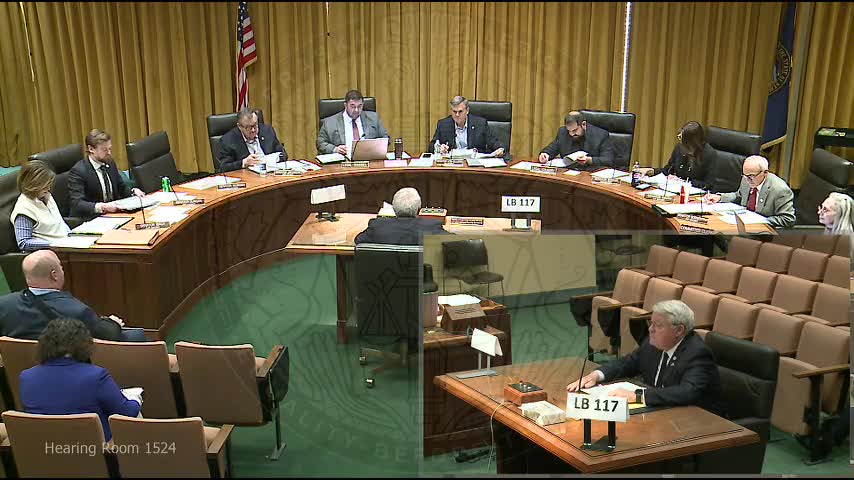
Senators in the Nebraska Legislature’s Revenue Committee heard testimony on LB 117 and AM 100, a bill that would exempt the 5.5% state sales tax on residential utilities such as electricity, natural gas, propane and sewer service at a primary residence or at commercial properties primarily made up of residential units. Senator Rick Holcroft introduced the bill and asked the committee for a timely vote to advance it to the full Legislature.
The bill’s supporters told the committee that exempting state sales tax on utilities would reduce household costs and protect low-income families from spikes in energy prices. “Utilities are a necessity and not a luxury,” Senator Rick Holcroft said in his opening remarks. Proponent witnesses — including Nebraska’s Public Advocate for natural gas ratepayers, industry representatives and Senator LuAnn Linehan — said the exemption is consistent with other exemptions the state already allows for essential goods and that many neighboring states exempt residential utilities at the state level.
Opponents and questioning senators pressed on the bill’s fiscal effects and local impacts. Lynn Rex, appearing for the League of Nebraska Municipalities, warned that 265 municipalities in the state use a voter-approved local option sales tax and said removing the state portion would still leave a sizable local revenue change to manage. Rex urged the committee to advance AM 100, which the introducer described as language that “tidies up” the bill and clarifies it applies only to the state portion, not local option sales taxes.
Committee discussion focused on two core tensions: how to pay for the exemption and whether to leave local option taxes intact. Senator Jacobson and other members said constituents consistently cite property tax as their top concern and questioned whether the state can afford a large new exemption. Holcroft and proponents acknowledged a large fiscal note — discussed in the hearing as roughly $130 million to $140 million to the state — and suggested phased approaches (for example, exempting one utility at a time) or identifying offsetting changes to the tax base.
Proponents argued additional policy benefits beyond immediate relief: promoting energy efficiency, buffering households against weather-driven price spikes and aligning Nebraska with many other states that exempt residential utilities. Chris Dibbern, the Nebraska Public Advocate for natural gas ratepayers, told the committee that more than 30 states exempt some utility services for residential customers and framed the bill as an affordability measure, particularly for elderly and low-income households.
Committee members also raised administrative and interstate concerns: whether phasing or partial exemptions would create issues under interstate tax agreements and whether the Department of Revenue could implement changes cleanly. Several senators suggested working to repeal or revise other exemptions to create offsets rather than adding net new tax cuts into a budget already under strain.
At the close of testimony the committee recorded 11 proponent letters, seven opponent letters and one neutral written comment. No formal committee vote occurred during the hearing. The committee did not make a final decision; staff and members indicated willingness to work with the introducer on the amendment language and possible phase-in or offsets.
The bill record shows the introducer offered AM 100 to limit the exemption to the state’s 5.5% sales tax rate and preserve local option sales taxes; proponents urged adoption of AM 100 and asked the committee to advance the bill to the floor.