Get Full Government Meeting Transcripts, Videos, & Alerts Forever!
Get email alerts on the Permanent Daylight Time topic
No spam. Unsubscribe anytime.
Committee also hears rival proposal to keep Nebraska on daylight saving time year‑round; proponents point to evening economy, opponents cite health and morning‑
Summary
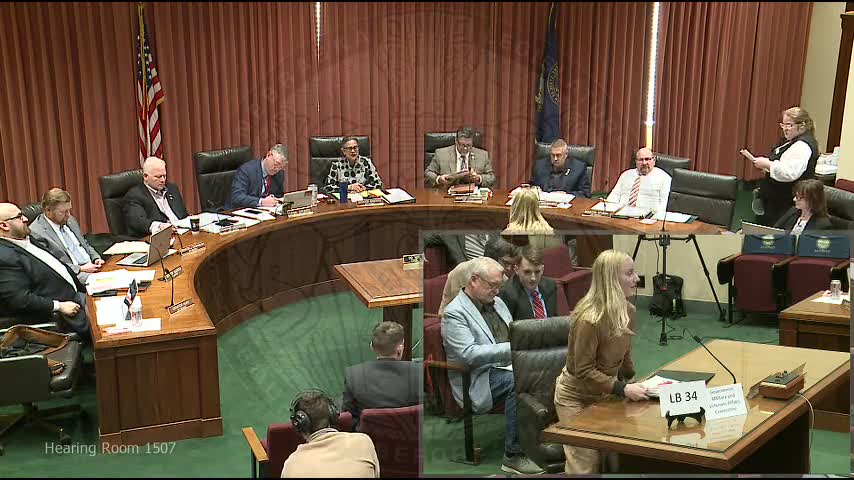
The Government, Military and Veterans Affairs Committee heard LB34, a bill to make daylight saving time permanent in Nebraska contingent on federal action and regional alignment.
The Government, Military and Veterans Affairs Committee heard LB34, a proposal to keep Nebraska on daylight saving time year‑round if federal authorization and a regional trigger are satisfied.
Senator Megan Hunt (District 8), introducing LB34, said her goal was to end the twice‑yearly clock change and that she favored permanent daylight saving time because she prefers ‘‘more hours of daylight after work.’’ She described studies that link the clock changes themselves to short‑term increases in seizures, heart attacks, workplace injuries and lost productivity, and she cited research and a private sector analysis (JPMorgan Chase) suggesting more evening daylight can raise consumer spending.
Proponents who testified in favor included the Nebraska Golf Alliance, which reversed its position from the earlier hearing and told the committee permanent daylight time would benefit golf by expanding evening play. Joseph Kohout, the alliance’s registered lobbyist, repeated earlier data from courses that reported municipal‑course summer participation that produced roughly $700,000 in revenue and said evening leagues and instruction rely heavily on post‑4 p.m. hours. Jason Jackson, who had opposed LB302, testified in favor of LB34 because he said permanent daylight saving time would preserve after‑school recreational opportunities and youth sports that often take place in the evening.
Opponents included public‑health advocates and the nonprofit Safe Standard Time. JP, president of that group, testified that year‑round daylight saving time is ‘‘a government mandate to wake an hour early’’ and warned that in western or geographically‑wide states sunrise could fall after typical school start times for several months. Patrick Greenwood, who had supported LB302, also testified against LB34, arguing it ‘‘upsets the balance of available sunlight’’ and said federal action is not a requirement for Nebraska to avoid being left behind if Congress acts.
Senator Hunt’s bill includes a contingency: it would become effective only after federal law or an authorization by the U.S. Secretary of Transportation and after a required number of neighboring states adopt compatible changes. Hunt said supporters sought to avoid the twice‑yearly changes and that some economic research supports more evening daylight for consumer activity.
For the hearing record the committee reported 32 proponents, 124 opponents and 1 neutral position. No final vote was taken during the hearing.