Get Full Government Meeting Transcripts, Videos, & Alerts Forever!
Get email alerts on the Housing Permitting topic
No spam. Unsubscribe anytime.
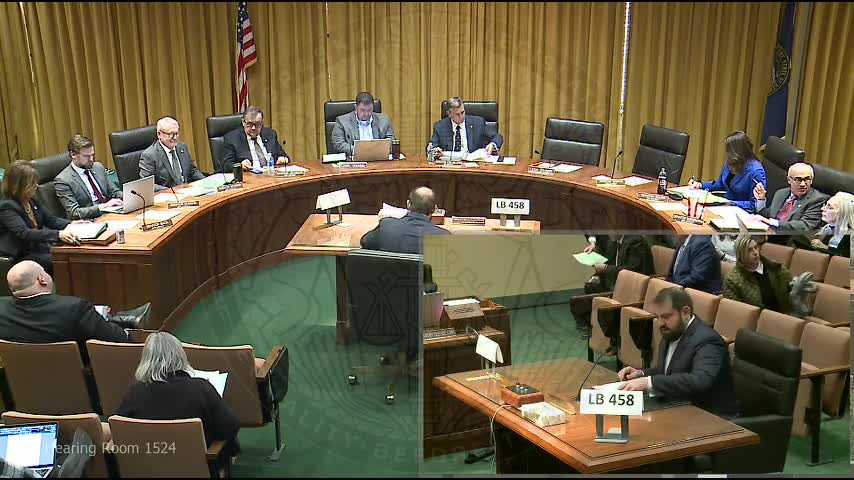
Revenue committee hears LB 458 to speed housing permits, expand ADUs and shorten tax-cert redemption
Summary
Senator Elliot Bostar introduced LB 458 in the Revenue Committee, calling for a 60‑day shot clock on housing permits, by‑right approval for certain duplexes and ADUs, and a shortened redemption period for tax‑certificate properties to return vacant homes to use.
Senator Elliot Bostar, sponsor of Legislative Bill 458, told the Revenue Committee that the bill would streamline permitting and zoning to increase the supply of housing across Nebraska and speed the return of vacant, tax‑delinquent homes to productive use. "LB 458 is aimed at removing bureaucratic bottlenecks that are restricting the total supply of homes available to Nebraska families," Senator Elliot Bostar said during his opening remarks.
The bill combines three principal changes: a permitting timeliness provision that requires permitting authorities to approve, conditionally approve, or deny permits within 60 days (after which a permit would be automatically approved); a “By Right Housing Development” framework that allows duplexes and accessory dwelling units (ADUs) where the proposal complies with existing zoning standards; and amendments to the tax‑certificate and land‑bank process that shorten the redemption period for vacant, abandoned properties and alter notice and administrative‑fee procedures.
Supporters told the committee they see regulatory reform as a necessary tool to increase housing stock and affordability. Nicole Fox of the Platt Institute said the bill’s regulatory sections address what her group found when touring Nebraska communities: zoning and permitting can restrict housing supply. "When local land use restrictions and regulations interfere with the ability to meet significant urgent housing needs, we feel a proposal such as LB 458 is reasonable," Fox said.
Developers and housing advocates echoed that point. Fred Hoppe, who represents multiple homebuilder groups, told senators that permitting timelines vary widely and that allowing two units on many single‑family lots could reduce per‑unit land and infrastructure costs. "If I can put two units in that building envelope, then it's going to be allowed 'by right,' and that increases density and lowers cost," Hoppe said.
State housing and economic development officials who testified in support emphasized both land‑use and carrying‑cost impacts. Emma Craig of the Nebraska Investment Finance Authority said duplexes and ADUs can lower lot‑per‑unit cost and that speeding approvals reduces carry costs such as construction interest and insurance. "Allowing duplexes on a single lot or being able to add ADUs to existing lots increases the density of housing per acre and lessens the lot per unit cost of housing," Craig said.
The bill would also change tax‑certificate procedures. Proponents including tax‑lien investors and attorneys said current statutory notice and reimbursement rules impose inconsistent administrative burdens on sheriffs’ offices, county treasurers and certificate holders. Mark Odgaard, general counsel for Tax Partners, told the committee that repeated attempts at personal service required by current law take county staff time and produce uneven results; he supported replacing repetitive personal service requirements with residential or certified mail and an upfront administrative fee to reduce county review burdens.
Opponents—principally municipal planners, city administrators and statewide municipal organizations—urged caution and said the bill as drafted raises legal and process concerns. Eric Englund, assistant planning director for the City of Omaha, said key phrases in the bill are unclear and that a 60‑day deadline could apply to different steps (building permit versus entitlement), which have different statutory processes. "If it is in regard to the planning process, Omaha has major concerns as this would not allow for the ability to comply with the authority given by existing Nebraska State statutes for the entitlement and platting process," Englund said.
City representatives also argued that the bill could undercut local public‑input processes. Mark Stursma, deputy city administrator for Papillion, said an automatic deadline can backfire: "In other states where this has been adopted, permit applications are often denied to meet the deadline, forcing the applicant to start over and reapply," he said, adding that the bill also routes appeals to the courts and could lengthen review times.
County officials and the League of Nebraska Municipalities raised overlapping concerns about definitional clarity (which permit types are covered), infrastructure impacts (water, sewer, parking) and the practical effects of by‑right approvals in historically single‑family neighborhoods. Lynn Rex, representing the League of Nebraska Municipalities, said municipalities have worked on housing strategies and that targeted, locally informed reforms are already underway in many cities.
On the tax‑certificate provisions, county treasurers and tax‑lien stakeholders generally supported changes that reduce repetitive personal‑service burdens and allow an upfront administrative fee. Several testifiers asked for specific drafting clarifications, including who may serve as a treasurer’s ‘‘designee’’ and how attorney fees are recovered in foreclosures under the statute.
Senators on the Revenue Committee asked technical and jurisdictional questions throughout the hearing, noting the bill straddles zoning (normally handled by Urban Affairs) and revenue issues (tax certificates and land banks). Senator Bostar acknowledged the bill’s breadth and said he expected further stakeholder work. "There are things we can look at within that to make a reasonable accommodation to both ensure that local governments can function effectively and folks aren't getting inappropriately hindered from making decisions about their own property," Bostar said.
Supporters recommended working with cities and counties to refine timelines and definitions; opponents asked that the committee delay or substantially amend the permitting and by‑right sections so local governments can complete ongoing zoning and housing‑plan work. The hearing closed with the sponsor saying he would continue to work with municipalities, housing advocates and county officials to reconcile differences and clarify statutory language.
Why it matters: LB 458 links land‑use reform, permitting timelines and tax‑certificate changes in a single bill. If reworked and passed, its provisions could change how Nebraska municipalities review residential projects, broaden where ADUs and duplexes can be built, and speed land‑bank acquisition of vacant parcels—each of which has fiscal, infrastructure and neighborhood impacts that local governments and developers disagree about.
Provenance: The committee hearing transcript contains testimony and discussion beginning with Senator Elliot Bostar’s introductory remarks (transcript segment starting at 260.365) through the bill’s close (transcript segment around 9102.385).