Get Full Government Meeting Transcripts, Videos, & Alerts Forever!
Get email alerts on the Electoral Vote Allocation topic
No spam. Unsubscribe anytime.
Nebraska committee hears hours of testimony on bills to end split electoral votes; no vote taken
Summary
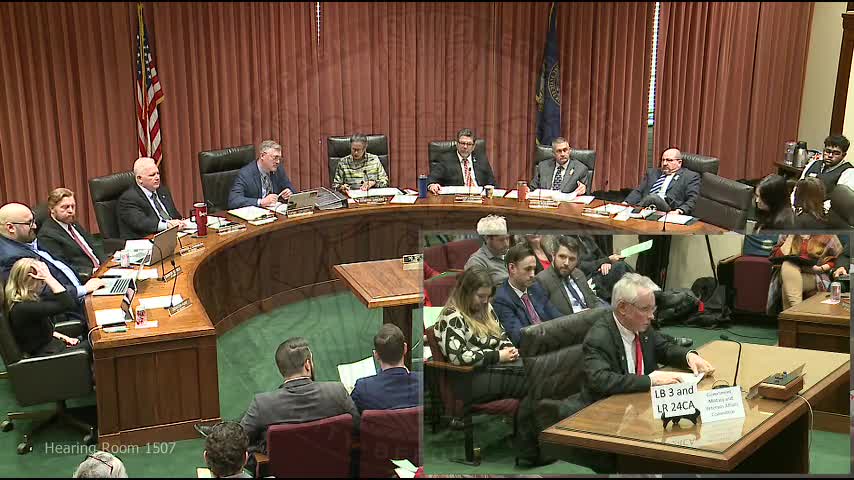
The Government, Military and Veterans Affairs Committee heard more than five hours of public testimony Thursday on two measures that would end Nebraska's congressional‑district allocation of presidential electors and return the state to a statewide, winner‑take‑all system.
The Government, Military and Veterans Affairs Committee heard more than five hours of public testimony Thursday on two measures that would end Nebraska's congressional‑district allocation of presidential electors and return the state to a statewide, winner‑take‑all system. Sponsors said the change would treat Nebraska like other states and increase fairness; opponents said it would silence large numbers of Nebraskans and reduce civic engagement. The committee did not take a vote at the hearing.
Supporters framed the bills as an effort to treat Nebraska the same as other states and to reduce outside spending and the risk of gerrymandering. Sen. Loring Lippincott, the introducer of LB 3, told the committee that the district method has not delivered the promised benefits and that maintaining winner‑take‑all preserves geographic representation. "We know that Nebraska has 5 electoral votes. We have 2 that are allotted for our US Senate, and then 3 that are allotted for our US Representatives," Lippincott said, arguing the current system dilutes the state's overall voice.
The governor's policy office testified in support of LB 3. Kenny Zoeller, director of the governor's policy research office, described the congressional‑district method as a "30 year experiment" the governor wants to end and said independent analyses find the current allocation has not produced sustained campaign attention or major economic benefit to the state. "As Governor Pylin has stated multiple times, it's time that we end the 30 year experiment of allocating our electoral college votes by congressional district," Zoeller said.
Sen. Myron Dorn, sponsor of LR 24 CA, told the committee his resolution would place a constitutional amendment on the ballot so voters could decide whether Nebraska should require a statewide winner‑take‑all allocation. Dorn said, if approved by the Legislature, the amendment would go to the 2026 general election ballot.
Opponents — including civic organizations, county officials, scholars and hundreds of individual Nebraskans who signed into the hearing record — said the split system gives voters in each congressional district a meaningful voice and increases turnout. Several testifiers said the congressional‑district method brought national attention, campaign spending and local civic engagement. "Listen to a segment of your community, of your state, a whole congressional district that saying give us a chance to let our votes count," said Preston Love Jr., a longtime Omaha community activist.
Multiple civic groups and research presenters said their data show strong public support in Nebraska for keeping the split allocation. Heather Nelson, founder and CEO of Ideologics Insights, reported the firm's focus group and poll of verified participants found roughly 92% of respondents in their sample wanted to keep Nebraska's current system. "91.83% said they wanna keep the electoral college voting system the same," Nelson told the committee.
Proponents countered with their own testimony that the split allocation has undercut the state's overall influence and invited outside dollars aimed at one congressional district. John Mark Rule, who identified himself as a proponent, called the district method a "failed 33 year experiment" and said it "divides and dilutes Nebraska's electoral college vote." Supporters also warned the split method could invite gerrymandering if adopted nationwide.
Committee members questioned sponsors and witnesses over turnout data, campaign visits and the legal mechanics of placing a constitutional amendment on the ballot. Several senators pressed both sides on whether changing the law would actually change campaign behavior and advertising patterns, and whether Maine — the other state that uses a district method historically — would respond by changing its system if Nebraska returned to winner‑take‑all.
No formal action was taken. The hearing included a committee roll introduction, opening remarks by the bill sponsors, roughly two hours of invited testimony from the governor's office and organized groups, and more than four hours of public comment. Committee chair Sen. Rita Sanders managed the hearing and said written testimony submitted through the legislature's website would be part of the official record. The committee did not set a date for further action.
The debate in Lincoln continued the longer national conversation over how states allocate electoral votes. Supporters say a statewide allocation is simpler and avoids incentives for targeted district spending; opponents say the district method preserves minority and local voices and encourages turnout by making some presidential races competitive within the state. The bills remain pending in committee.
Votes and formal motions: none (hearing only).