Get Full Government Meeting Transcripts, Videos, & Alerts Forever!
Get email alerts on the Public Funds Investment topic
No spam. Unsubscribe anytime.
Bill to let counties, schools and libraries seek higher CD rates draws mixed views; held for amendment
Summary
House Bill 1523 would remove territorial limits that now require many local units to place public deposits at financial institutions with a brick-and-mortar presence inside local boundaries. County treasurers and school officials said the change would allow them to seek higher CD rates and increase local revenue; banks and credit-union advocates
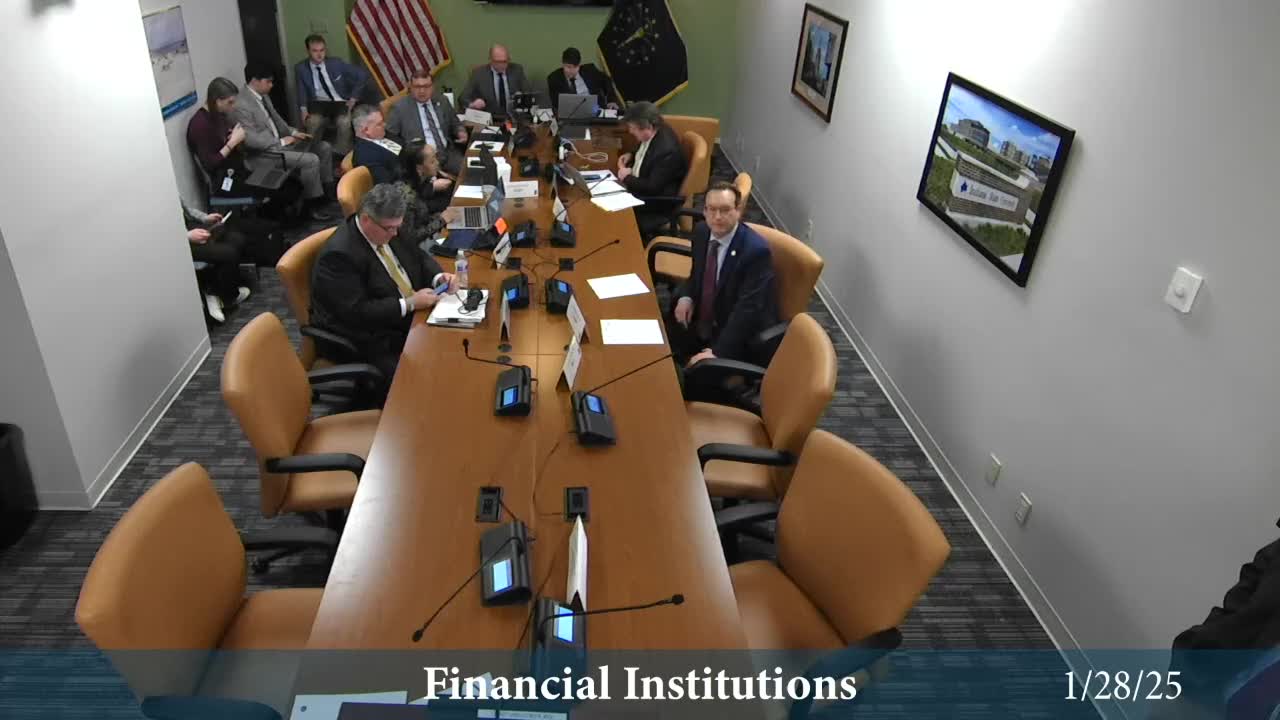
Representative Pierce presented House Bill 1523 to the House Financial Institutions Committee, proposing to remove territorial limits that require many local units of government (counties, school corporations and library districts) to invest certain public deposits only with financial institutions located inside the unit's geographic boundaries. The bill would also preserve a safe harbor for investments made since a 2018 statutory clarifying change; the committee heard mixed testimony and held the bill for further work.
Supporters including county treasurers, school finance officers and county associations argued the territorial rule is antiquated and, in many areas, reduces competition and yields lower returns for taxpayers. Brian Burdick, counsel for the Indiana County Treasurers Association, told the committee he supports the bill and said consolidation in the banking industry has reduced local options in many counties: "If somebody will offer us 5 percent and I can only get 2 percent at home, seems like we ought to get the extra 3 percent for the taxpayers," he said.
School finance representatives said their districts frequently face only a handful of bidders for certificates of deposit (CDs) and sometimes none within the local boundary that offer competitive rates. Scott Bowling of the Indiana Association of School Business Officials said some districts reported dollar impacts in the hundreds of thousands over multiple years when constrained to local rates.
Opponents, including the Indiana Credit Union League and the Indiana Bankers Association, urged retaining a territorial preference because local deposits support local lending and community investment. Chris Beaumont of the Credit Union League and Dax Denton of the Bankers Association said local deposit rules channel funds into local loans and economic development and keep capital circulating inside the community.
The treasurer's office said it was neutral and explained the Indiana Board for Depositories (BFD) insures public deposits beyond FDIC coverage under a unique state program. Mike Neil, special assistant to the treasurer and executive director of the Board for Depositories, said the board will continue to educate local officials about deposit rules and protections; the board took a neutral position at the hearing.
Witnesses recommended a compromise that balances competition with local reinvestment. Several testifiers said the bill should preserve local preference where robust local bank options exist while allowing officials in thin markets to solicit competitive statewide bids. Representative Pierce said he expects to work with stakeholders on amendments over the coming week.
The committee did not take a final vote; the bill was held for further amendment and negotiation. Supporters framed the change as one way to increase interest income for local taxpayers and reduce pressure on property-tax levies by modestly improving returns on invested public funds. Opponents said the territorial rule supports community lending and local economic development and that removing it could shift deposits away from local institutions.