Get Full Government Meeting Transcripts, Videos, & Alerts Forever!
Get email alerts on the Earned Wage Access topic
No spam. Unsubscribe anytime.
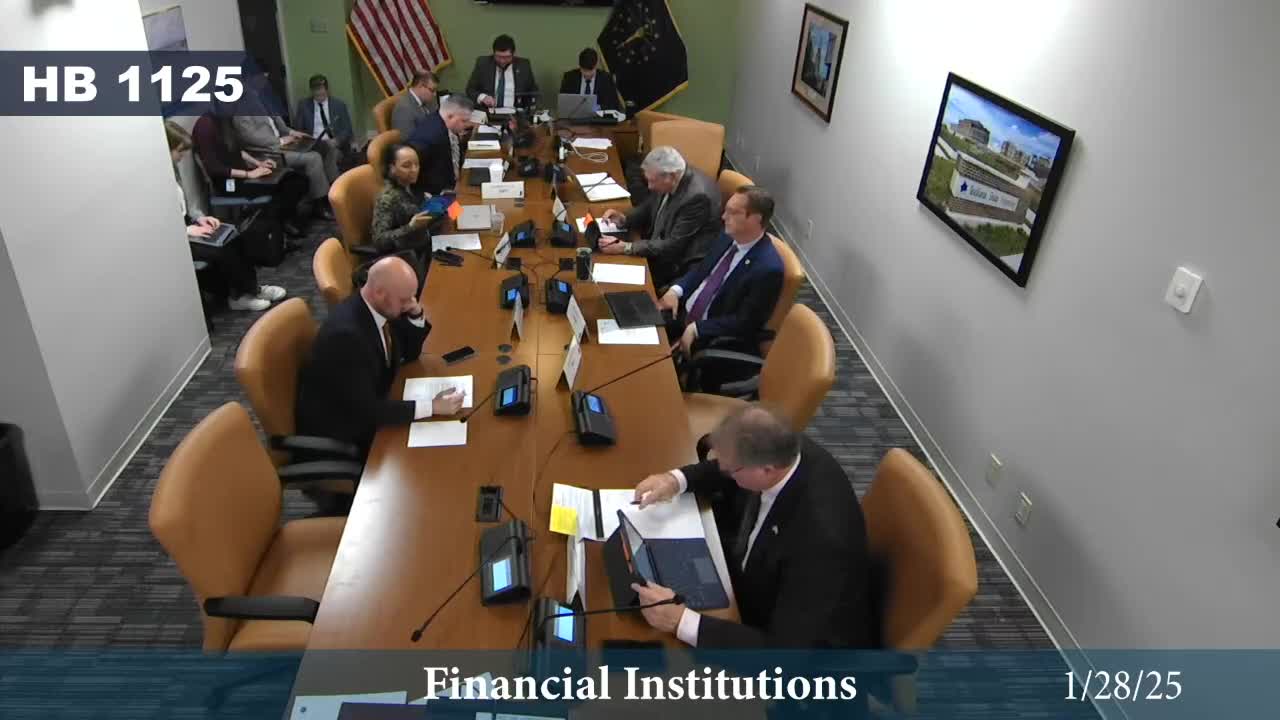
Committee hears competing views on earned-wage access bill; set to be held for amendment
Summary
The House Financial Institutions Committee heard competing testimony on House Bill 1125, a proposal to license earned-wage access providers and set consumer protections including a mandatory free option and a ban on credit reporting; the committee held the bill for further amendment.
The House Financial Institutions Committee heard testimony on House Bill 1125, which would create a licensing and oversight framework for earned-wage access (EWA) providers operating in Indiana. Proponents told the committee the bill offers consumer protections and regulatory certainty; advocates and some consumer groups urged tighter fee limits, mandatory APR disclosure and stronger data-sharing safeguards. The committee announced it will hold the bill for amendment and possible vote next week.
Representative (Chairman) Teschka opened the discussion by describing EWA as a modern re-creation of daily pay access: "This bill really just creates the licensing structure for those EWA providers. It also gives the Department of Financial Institutions some clear oversight over the product," he said. The bill, as drafted, bans late fees and interest, prohibits credit checks and credit reporting, requires a no-cost option and bars recourse for providers.
Consumer advocates raised several concerns. Erin Macy, director of the Indiana Community Action Poverty Institute and co-chair of Hoosiers for Responsible Lending, said the bill leaves a significant gap in price protections by not placing an overall cap on charges. Macy cited national analyses showing high APR equivalents for some EWA products and said the committee should consider minimum repayment terms to reduce the risk of repeat borrowing and debt traps. "Because we're classifying earned wage access products as outside of the scope of Indiana's lending laws, they are not subject to rate caps, fee limits, or our criminal loan sharking statute," Macy said, and asked the committee to require APR reporting, limit automated debit attempts to prevent NSF charges and require more robust disclosure and public data reporting from licensees.
John Barnes of Catalyst urged a centralized verification system so providers cannot inadvertently allow consumers to overextend across multiple apps that do not share real-time data. Barnes said a shared database is an established safeguard in other states.
EWA providers and fintech trade groups argued the bill creates a balanced, consumer-friendly framework that preserves free or low-cost options and prevents recourse or credit reporting. Ben LaRocco of EarnIn, a direct-to-consumer EWA provider, said the company offers both free ACH transfers and an instant fee option ($2.99'$4.99 range) and described a voluntary tip model used by some providers. "About a third of the people don't pay anything at all for our service," LaRocco said. He testified the company bears the risk of nonpayment and that incentives align to avoid repeat borrowing that would be bad for the provider.
Andrew Welch of DailyPay, which integrates with employer payroll systems, said his firm charges about $3.49 for instant access and offers a no-cost transfer that takes 1'3 business days. DailyPay said the product reduces late fees and overdraft costs for users and that roughly one-third of the employees at participating employers download the app while about half of those who download never access funds early. Welch said DailyPay will provide re-borrowing statistics to the committee.
Industry associations including the American Fintech Council, Financial Technology Association and Chamber of Progress testified in support, saying the bill ensures workers retain access to earned wages with consumer protections in place. Supporters argued the product is not a loan, has no interest and does not affect credit scores when used as intended.
Committee members asked about re-borrowing, APR reporting, and the voluntary tip model. Advocates pressed for APR disclosures and limits on ACH deduction attempts; providers said they already offer free ACH transfers and that market competition keeps fees low. Chairman Teschka and members agreed to hold the bill for amendment and invited follow-up discussions on data reporting, fee caps and verification databases.
The committee did not take a final vote. Staff and stakeholders will continue negotiations on fee caps, mandatory data reporting, minimum repayment terms and the role of a centralized verification system before the next committee action.