Get Full Government Meeting Transcripts, Videos, & Alerts Forever!
Get email alerts on the Housing Down Payment Assistance topic
No spam. Unsubscribe anytime.
House committee advances bill to expand down payment assistance, raise AMI to 160%
Summary
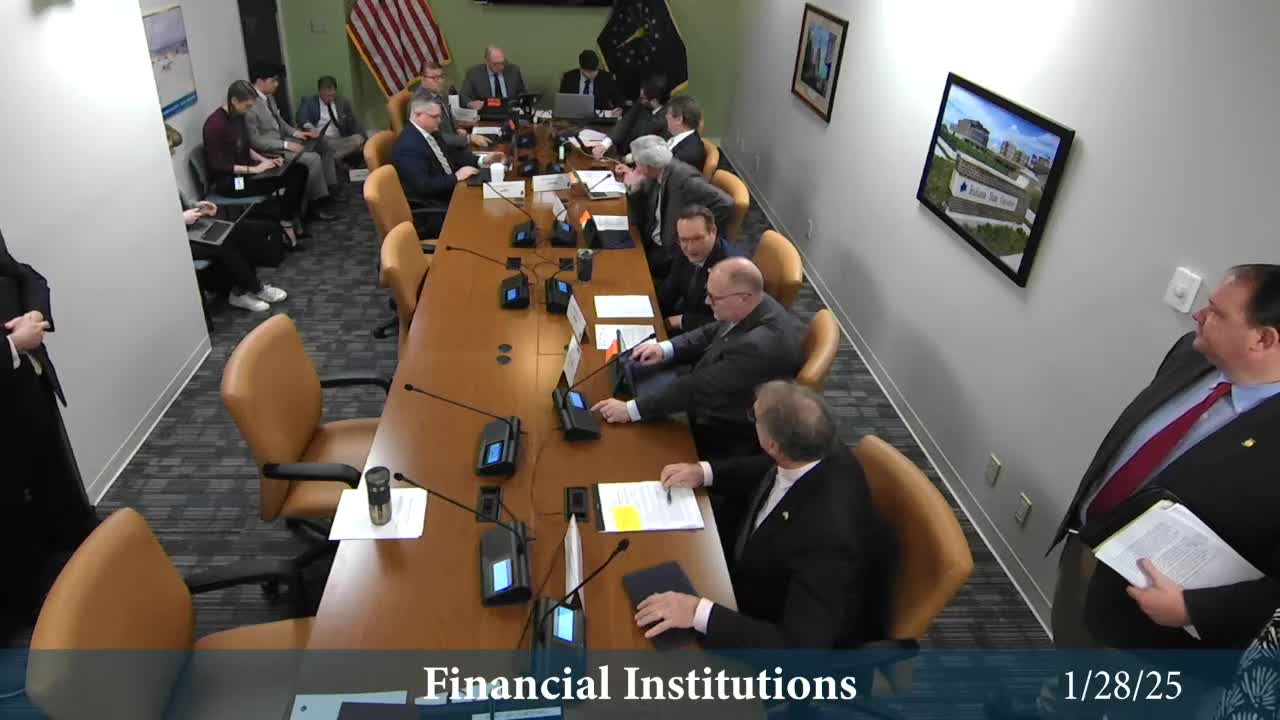
The House Financial Institutions Committee voted 11-1 to advance House Bill 1519, a measure to continue Indiana's down payment assistance program, raise eligibility to 160 percent of area median income and authorize a revolving loan fund intended to broaden access to homeownership and free bond allocation for more multifamily affordable housing.
Representative Rosemary Miller introduced House Bill 1519 to the House Financial Institutions Committee as a measure to continue and expand Indiana's down payment assistance programs and create new financing tools to spur workforce and multifamily housing production. The committee adopted two amendments by consent and voted to advance the bill to the next stage, 11-1.
The bill would continue the existing down payment assistance program, increase the AMI eligibility threshold to 160 percent and authorize a revolving loan fund intended to make down payment assistance repayable and sustainable over time. Representative Miller told the committee the change in AMI moves the effective price point for assistance from about $200,000 to roughly $300,000 in many markets, widening the pool of buyers who could use the program.
A range of housing industry witnesses supported the bill or described it as a useful tool while flagging concerns about funding. Maggie McShane, senior vice president of government affairs at the Indiana Association of Realtors, testified in a neutral position and urged lawmakers not to dilute the existing Indiana Housing and Community Development Authority (IHCDA) down payment assistance program. "We do have a really good program ... it is the only program that's directed for new home buyers right now through the IHCDA," McShane said, noting IHCDA issued about $32,000,000 in down payment assistance in 2024.
Builders, advocates and lenders described how the bill would work in practice. Carly Hopper of the Indiana Builders Association said the bill targets barriers for first-time homebuyers including down payments, closing costs, rehabilitation and interest-rate buy-downs. Ryan Myers of United Way of Central Indiana said workforce households often earn too little to save for upfront homebuying costs and that access to down payment assistance helps households build wealth. Mark Schublak of the Indiana Affordable Housing Council described the bill as a mechanism to reallocate bond volume and create a revolving fund that would require a state appropriation to seed and then repay itself over time.
Lenders and syndicators who work with the Low-Income Housing Tax Credit (LIHTC) system testified about how reallocating bond volume could increase multifamily affordable housing production. Mike Petrie, chairman and CEO of Merchants Bancorp, described a proposal that would free up bond allocation now used for down payment assistance so that local volume could be shifted to support tax-credit projects that build multifamily units. Petrie gave a breakdown during testimony: the state's annual bond volume cap is about $820,000,000; by statute roughly 28 percent goes to IHCDA for mortgage programs and down payment assistance, and roughly 20 percent to local issuers that support the Section 42 LIHTC program.
Committee members asked about default rates and program safeguards. Witnesses said down payment assistance is usually a subordinate loan handled by mortgage servicers and counseling programs and that default rates are typically low; witnesses offered to provide precise default statistics to the committee. Representative Lucas asked for fiscal numbers; supporters said the current bond allocation effectively supports about $30,000,000 a year in down payment assistance and said larger funding levels would require multi-year appropriations.
After discussion, the committee adopted two technical amendments by consent that struck an appropriation language and added language to allow the fund to work with low-income housing providers. The committee then voted to report the bill out of committee. The roll call recorded 11 ayes and one no (Representative Lucas voted no; Representative Cleary was excused). The committee record shows the bill will proceed to Ways and Means for further fiscal consideration.
If enacted as described in committee, HB 1519 would change program eligibility and create an appropriation-dependent revolving loan fund; it does not itself appropriate the full financing. Supporters urged follow-up during the budget process to seed the revolving fund and said the change is intended to be revenue-neutral over time if the revolving fund repays and frees bond allocation for LIHTC projects.
Votes at a glance: The committee adopted two amendments by unanimous consent and reported HB 1519 by roll call, 11 yes, 1 no. The recorded no vote was Representative Lucas; Representative Cleary was excused.
The committee discussion and witness testimony signaled broad industry support for expanded down payment assistance while several witnesses and the Realtor association urged lawmakers to protect the existing IHCDA program and to identify a state appropriation to seed the revolving fund so the expanded eligibility does not reduce current assistance for first-time buyers.