Get Full Government Meeting Transcripts, Videos, & Alerts Forever!
Get email alerts on the Public Investments topic
No spam. Unsubscribe anytime.
Committee hears bill to let counties, schools and libraries seek CD rates statewide; supporters cite higher returns, opponents stress local reinvestment
Summary
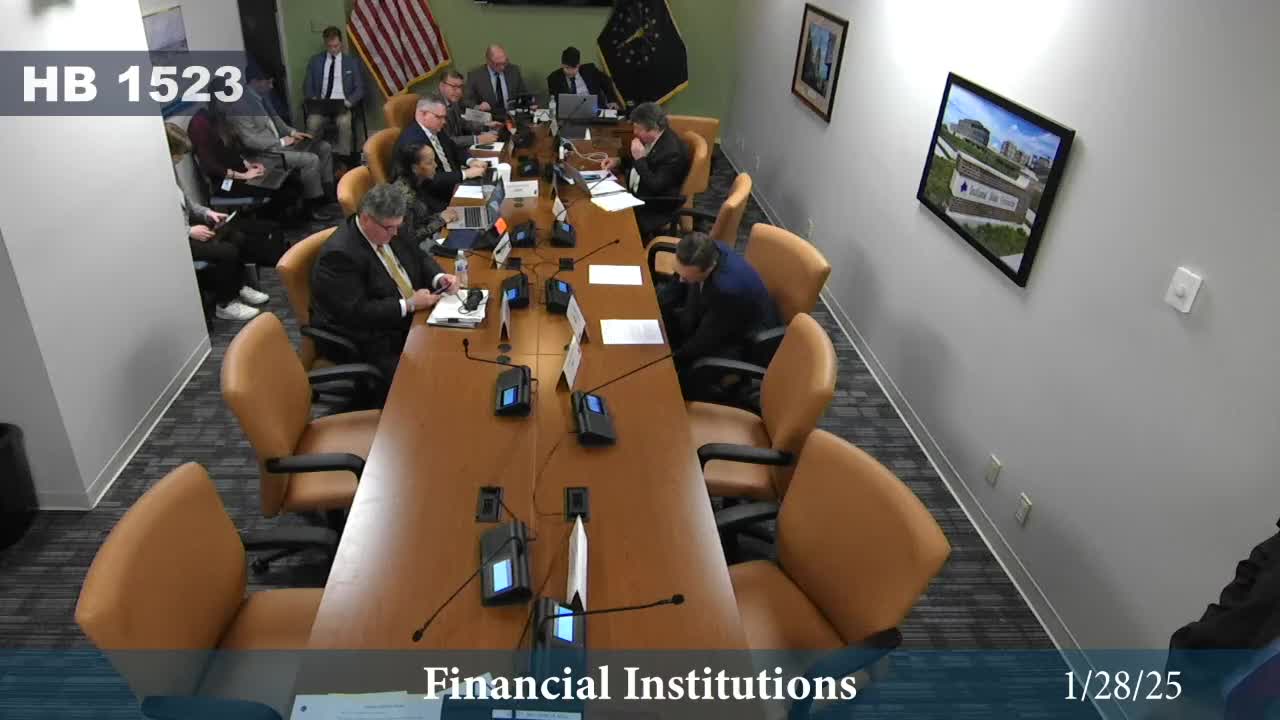
House Bill 1523, heard by the House Financial Institutions Committee, would let counties, school corporations and libraries place public CDs with any state‑approved depository rather than only institutions with a brick‑and‑mortar presence inside their jurisdiction.
Lawmakers heard House Bill 1523, which would expand where counties, school corporations and libraries may place public deposits by removing territorial limits that now require preference for brick‑and‑mortar institutions inside a unit’s boundaries. The committee took testimony from county treasurers, school officials, local government associations, bankers and credit unions and left the measure open for amendment and further negotiation.
Proponents’ view: County treasurers, school business officials and county associations urged the change as a way to secure higher yields for taxpayer funds in a banking market that has consolidated since the territorial rule first took effect. Brian Burdick of the Indiana County Treasurers Association said the rule is “antiquated” and can leave local governments stuck with low local CD rates: "If somebody will offer us 5% and I can only get 2% at home, seems like we ought to get the extra 3% for the taxpayers," he said.
School officials said higher yields can translate to material budgetary benefits; the Indiana Association of School Business Officials noted districts have reported dollar‑level impacts, in some cases representing hundreds of thousands of dollars over multiple years. Perry Township Schools’ treasurer said the district often has only one competitive local bidder despite many state‑approved depositories.
Opponents’ view: The Indiana Credit Union League and the Indiana Bankers Association opposed the bill as drafted, arguing territorial preferences support local lending and reinvestment. "When those funds remain local, those funds are reinvested in the form of loans into those communities," said Dax Denton of the Indiana Bankers Association. Credit unions added that local deposits fund community lending and that the statute intentionally preserves that local‑to‑local mechanism.
Neutral body and insurer: The Indiana Board for Depositories (BFD), which insures public deposits beyond FDIC coverage, said it was neutral and will continue to educate units and financial institutions about how changes affect deposit insurance and compliance. The BFD noted it is the only such state‑level insurer in the country and that protections apply except in cases of fraud by the institution.
Compromise language and status: Representative Pierce, sponsor of the bill, said the final form will seek a balance between market competition and preserving local investment value; he also proposed a safe‑harbor provision to protect prior investments made since a statutory change in 2018. Several witnesses said a compromise that preserves a local preference where robust local options exist while allowing statewide bids when local options are thin could be a workable path.
Ending: Committee members asked parties to continue negotiations; supporters argued the change could yield material additional revenue to local taxpayers and reduce future property‑tax pressure, while opponents emphasized the public‑policy value of keeping deposits in‑community to support local lending.