Get Full Government Meeting Transcripts, Videos, & Alerts Forever!
Get email alerts on the Public Funds Investment topic
No spam. Unsubscribe anytime.
Bill to give local governments wider pool for CD investments draws mixed reactions; held for changes
Summary
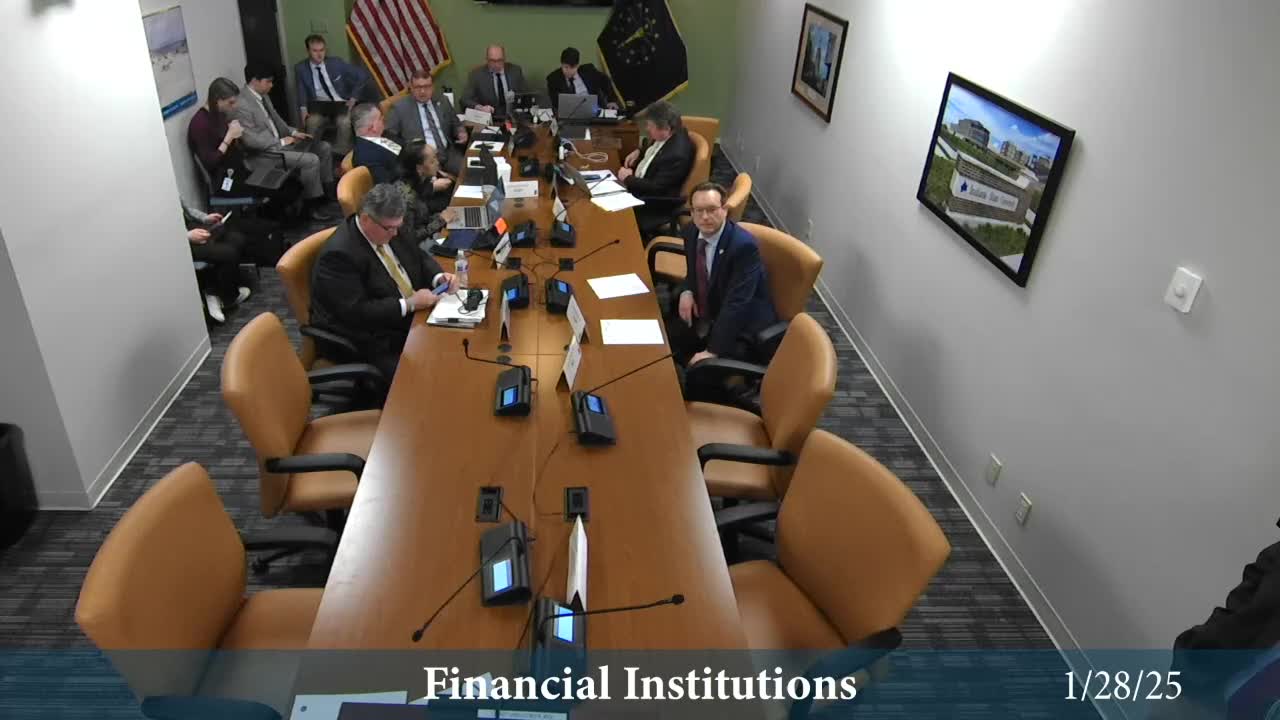
Indianapolis — The House Financial Institutions Committee on Wednesday heard testimony for House Bill 1523, which would remove territorial limits that in many cases require counties, school districts and libraries to invest public deposits at local, brick-and-mortar depositories, but the measure was held for further negotiation.
Indianapolis — The committee heard competing testimony on House Bill 1523, which would allow some local units of government to invest public deposits outside the current territorial limits that favor brick-and-mortar depositories within a unit's boundaries. The bill was held for more negotiation.
Representative Pierce introduced the measure by describing it as an effort to "allow local units of government more flexibility in their investment opportunities, resulting in higher potential financial returns that can help result in stronger financial positions for communities and less dependency on Hoosier tax dollars." He said cities and towns are already exempt and the bill would apply principally to counties, school corporations and libraries.
Supporters argued that consolidation in the banking industry and a shrinking number of local options limit competition and hurt returns on CDs and short-term deposits. Brian Burdick, representing the Indiana County Treasurer Association, said the existing territorial restrictions can leave treasurers collecting lower rates than those available elsewhere: "If somebody will offer us 5% and I can only get 2% at home, seems like we ought to get the extra 3% for the taxpayers."
School officials and associations also supported the change. Scott Bowling of the Indiana Association of School Business Officials told the committee the bill would both prevent certain audit exceptions and allow school corporations to "seek the best return for their taxpayer dollars, just like cities and towns, businesses and individuals can." Multiple witnesses said higher returns on invested tax receipts could reduce the need for property-tax increases by generating additional interest income for operations.
Opponents said the territorial requirement intentionally routes public deposits back into local communities where those funds are lent and invested. Chris Beaumont of the Indiana Credit Union League said state-chartered credit unions and locally headquartered banks use public deposits to make loans in their home communities and that the current statute balances return with a local-investment policy. Dax Denton of the Indiana Bankers Association urged preserving local reinvestment because "when those funds remain local . . . those funds are reinvested in the form of loans into those communities."
The treasurer's office said it is neutral and noted the Indiana Board for Depositories insures public deposits beyond FDIC coverage; Mike Neil of the treasurer's office said the fund exists to protect public deposits up to 100% in the event of a bank failure and the board's role includes education so units understand the statute and insurance conditions.
Why it matters: Local officials said the change would create immediate yield improvements for taxpayer funds and that higher earned interest can lower pressure on property taxes or provide new revenue for services. Financial-industry witnesses warned the measure could reduce local lending capacity and local institutions' ability to support the community.
Next steps: The committee held HB 1523 for further amendment discussions. Sponsors said they want to find a compromise that preserves the value of local banking relationships while allowing competitive access that raises returns for taxpayers.