Get Full Government Meeting Transcripts, Videos, & Alerts Forever!
Get email alerts on the Consumer Finance Ewa topic
No spam. Unsubscribe anytime.
House committee hears bill to license earned‑wage access providers amid debate over fees and safeguards
Summary
Lawmakers heard hours of testimony on House Bill 1125, a proposal to create a licensing and oversight framework for earned‑wage access (EWA) services. Supporters said the bill protects access to wages with a mandatory no‑cost option; critics urged fee caps, APR disclosures, limits on ACH attempts and a centralized verification database to prevent
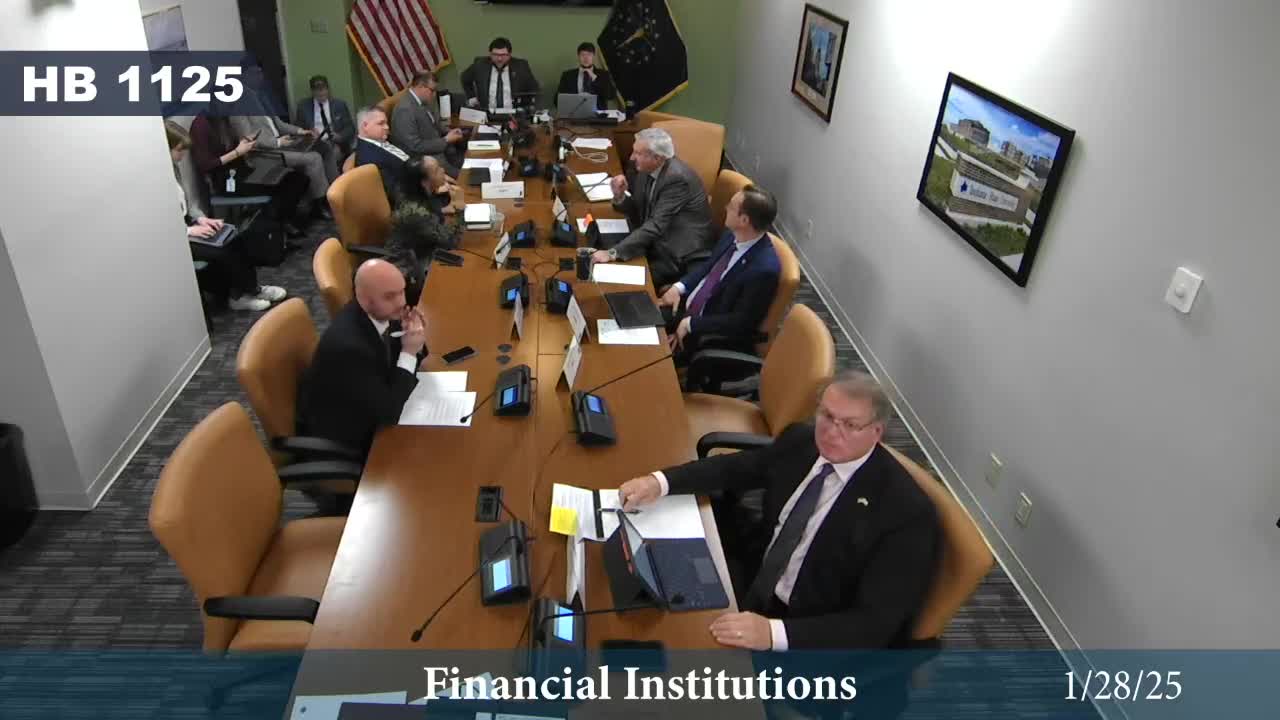
The House Financial Institutions Committee heard extensive testimony on House Bill 1125, legislation to license and regulate earned‑wage access (EWA) providers that let workers draw pay earned before a scheduled payday.
Representative (Chairman) Teschka, who presented the bill, said it seeks to create regulatory certainty and consumer protections for a product already used by hundreds of thousands of Hoosiers. The draft bill sets rules banning late fees and interest, forbids credit checks and credit reporting, requires transparency and mandates at least one no‑cost delivery option.
Supporters described EWA as a tool that helps workers avoid late fees and overdrafts. Ben LaRocco, senior director of government relations for EarnIn, said his company has served more than 100,000 Indiana users and that many customers use the service at no cost; he described the fee for instant delivery as typically $2.99–$4.99 and said tips are voluntary. "A third of the people don't pay anything at all for our service," LaRocco said. Andrew Welch of DailyPay, an employer‑integrated provider, said about a third of employees who download the app never access funds early and that average advances are about $150; DailyPay's instant delivery fee was described as roughly $3.49.
Industry trade groups including the American Fintech Council and Financial Technology Association urged passage, saying the bill preserves a no‑cost option and provides clarity for employers and providers.
Consumer advocates and community organizations urged stronger statutory limits. Erin Macy, director of the Indiana Community Action Poverty Institute and co‑chair of Hoosiers for Responsible Lending, said HB 1125 leaves important omissions: no cap on total charges, no required APR disclosure, no minimum reasonable repayment term, and too much agency discretion to waive requirements. Macy cited research showing intensive repeat usage in some markets and urged measures to prevent debt traps, including a floor on repayment period and limits on repeated ACH debit attempts. "Because there are no limits on charges, nothing would hold current providers to their current fee structure ... and nothing would prevent more predatory providers from entering the marketplace," Macy said.
Other witnesses recommended technical safeguards that would let regulators spot consumers using multiple providers. John Barnes of Catalyst and other witnesses proposed a centralized verification database so providers can see in real time whether a worker is already overextended across several apps.
Lawmakers asked detailed operational questions about how employer‑integrated and direct‑to‑consumer models work, how repayment occurs, and whether reborrowing cycles are possible. Supporters said EWA is not credit and argued the product differs from payday lending because it gives access to already‑earned wages rather than a loan against future pay; opponents said similar behavioral patterns and rapid reborrowing could still create harm without statutory guardrails such as APR disclosure and limits on reborrowing.
Disposition: The committee did not vote on HB 1125 and indicated it will hold the bill for amendment and further work next week. Sponsors and stakeholders agreed to continue technical conversations about tip disclosure, fee caps, APR reporting, data reporting frequency and a centralized verification system.
— End —