Get Full Government Meeting Transcripts, Videos, & Alerts Forever!
Get email alerts on the Housing Down Payment Assistance topic
No spam. Unsubscribe anytime.
House committee advances bill to expand down-payment assistance, raise income eligibility to 160% AMI
Summary
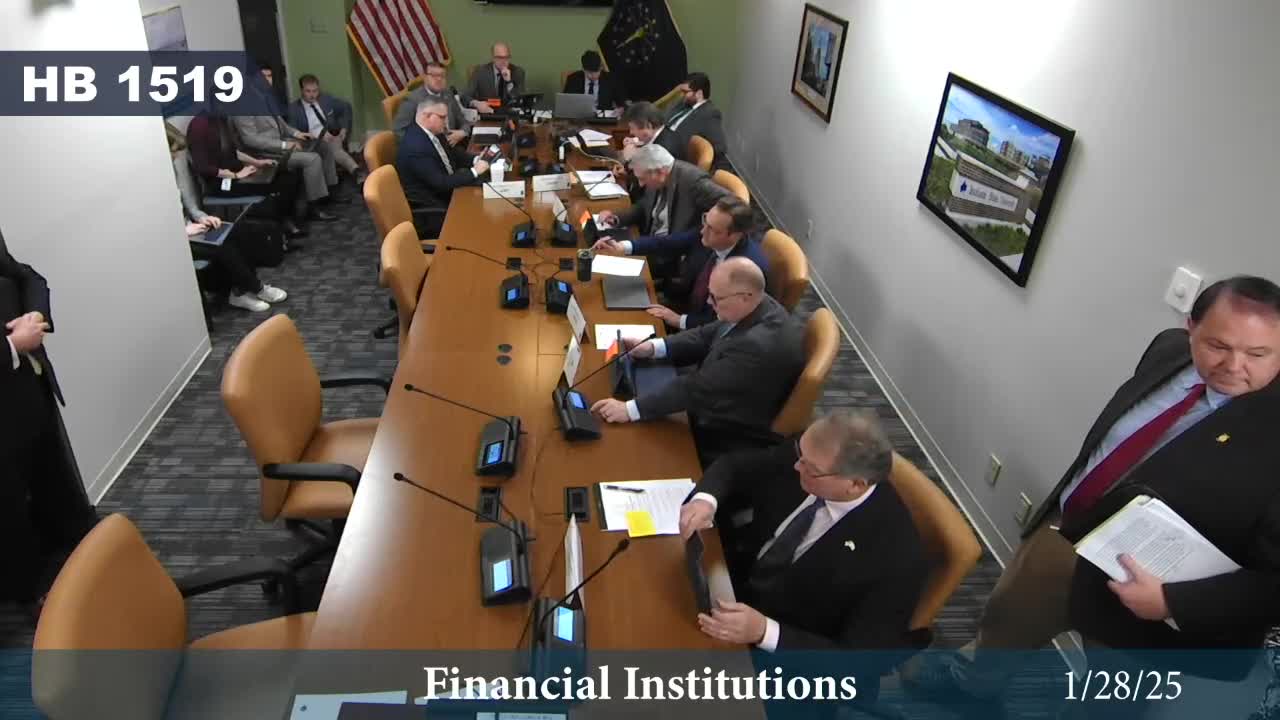
The House Financial Institutions Committee voted 11–1 to advance House Bill 1519 after testimony from housing groups, lenders and developers supporting a plan to expand down-payment assistance and shift bond volume to create more multifamily tax-credit development.
The House Financial Institutions Committee on [date not specified] voted to advance House Bill 1519, a measure that would expand the state’s down‑payment assistance program and create a path to move bond volume toward multifamily low‑income housing tax credits. The committee approved the bill as amended by an 11–1 roll call.
The bill’s author, Representative Rosemary (Rhett) Miller, told the committee the proposal has two primary aims: continue and broaden the state’s down‑payment assistance program and increase the area median income (AMI) eligibility cap to 160 percent. "There’s really two things going on in this bill," Miller said, adding that raising AMI would move price points "from say $200,000 up to $300,000 for those providers."
Why it matters: Supporters said the change would make down‑payment assistance usable in higher‑cost and rural markets and would allow some bond allocation to be redirected to the federal Section 42 low‑income housing tax credit program to finance additional multifamily units. Housing advocates and developers testified that the state currently lacks supply across the housing spectrum and that the proposal would create a more sustainable, revolving down‑payment fund if paired with an appropriation.
Testimony and key details: Maggie McShane, senior vice president of government affairs for the Indiana Association of Realtors, testified she was taking a neutral position while urging caution about funding. "I rise before the committee today with a neutral position," McShane said, noting the Indiana Housing and Community Development Authority (IHCDA) issued about $32,000,000 in down‑payment assistance in 2024 and that supporters should avoid diluting that existing program.
Industry witnesses broadly supported the bill. Carly Hopper of the Indiana Builders Association said the bill targets barriers such as down payments, closing costs, renovations and interest‑rate buy‑downs. Ryan Myers of United Way of Central Indiana said the measure would help "asset‑limited, income‑constrained, employed" families save for homeownership. Mark Schublak of the Indiana Affordable Housing Council described the bill as optimizing two existing programs — the down‑payment assistance program and tax credits — and said the proposal creates a revolving loan fund that would require an appropriation to sustain it.
Lenders and syndicators described how re‑allocating bond volume could expand multifamily production. Mike Petrie of Merchants Bancorp said local programs that provide only $5,000–$7,000 per household are no longer sufficient for today’s home prices and said the bank’s internal down‑payment assistance provides $10,000 per loan. "Our default rate is 0," Petrie told the committee when describing his institution’s down‑payment assistance underwriting.
Questions and concerns: Committee members asked about default rates, rural access and whether the bill would create unintended consequences for the existing IHCDA program. Representative Lucas pressed witnesses on whether the bill would create a separate program and on fiscal exposure after the bill’s appropriation language was removed; witnesses said the program would require an appropriation to create a revolving fund but that existing IHCDA bond allocations could continue down‑payment assistance if funding was not approved. Witnesses estimated current annual bond allocation for down‑payment assistance is about $30,000,000 and said demand likely exceeds available funds.
Outcome and next steps: The committee adopted two technical amendments by consent; the amended bill advanced on a roll call of 11 yes, 1 no (Representative Lucas voting no; Representative Cleary excused). Committee members said they expect the bill to move to Ways and Means for consideration of any appropriation and that additional fiscal detail will follow.
The measure’s proponents said they intend to pursue an appropriation to seed a revolving fund that would repay and sustain future down‑payment assistance disbursements while freeing existing bond allocation to expand multifamily tax‑credit development across the state.
Ending: With broad support from industry groups, nonprofits and some lenders, HB 1519 cleared the committee with a clear path to consider funding. Fiscal details and any appropriation requests will be central as the bill moves to the next stage of review.