Get Full Government Meeting Transcripts, Videos, & Alerts Forever!
Get email alerts on the Housing topic
No spam. Unsubscribe anytime.
House committee advances bill to expand down payment assistance, increase AMI to 160%
Summary
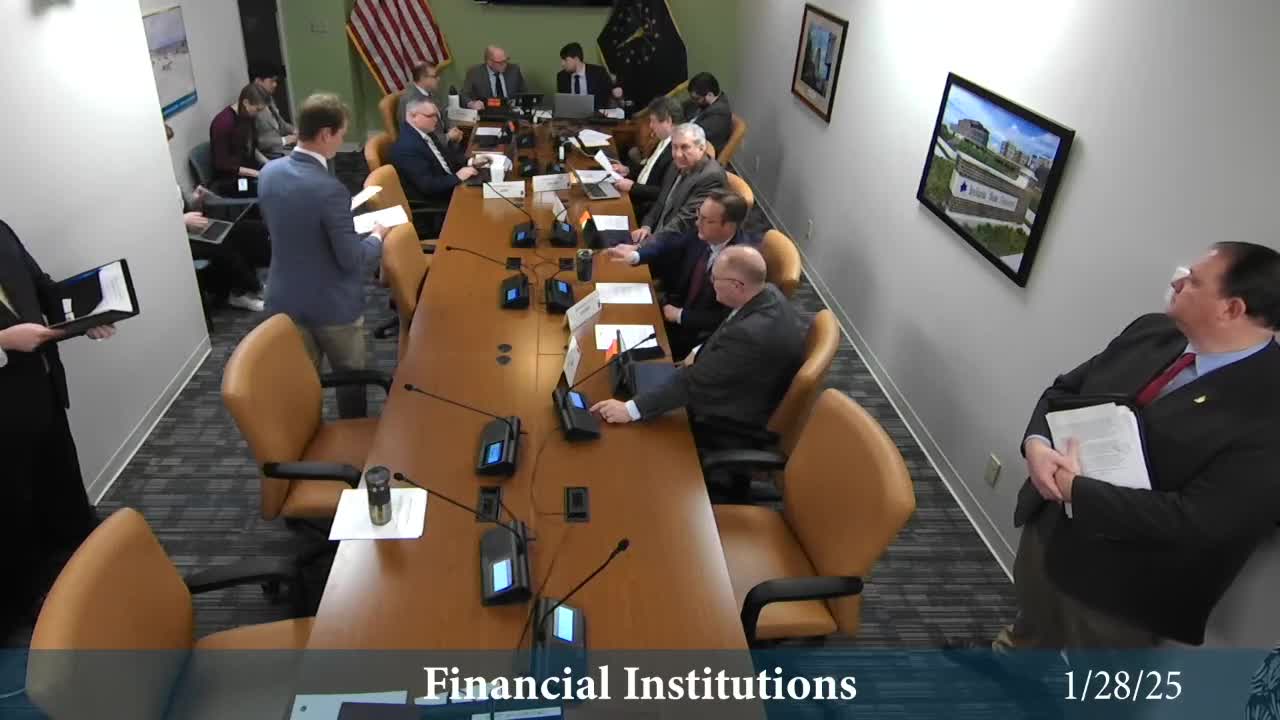
The House Financial Institutions Committee amended and approved House Bill 1519 to continue and broaden a down payment assistance program, raise the area median income (AMI) eligibility to 160% and create mechanisms intended to free up bond volume for low-income housing tax credit projects. The bill passed the committee 11-1.
The House Financial Institutions Committee voted to advance House Bill 1519 on a voice/roll call, approving the bill as amended by an 11-1 vote. The committee adopted two amendments by consent before moving the bill forward.
Representative Rosemary Miller, sponsor of House Bill 1519, told the committee the measure has two parts: continuing and expanding the state's down payment assistance program and creating a mechanism to allow bond volume to be redirected to tax credit projects that support multifamily housing. "There's really two things going on in this bill," Representative Miller said in opening remarks, describing an increase in AMI eligibility and an effort to optimize existing tax-credit finance tools.
The bill's first amendment, offered by Miller and adopted by consent, struck an appropriation in the introduced bill and removed a drafting error. A second amendment, also adopted by consent, added explicit authority for the new fund to work with low-income housing providers in administering down payment assistance.
Why it matters: supporters said HB 1519 aims to expand paths to homeownership while producing more affordable multifamily rental units. Testimony from housing and development stakeholders emphasized three linked goals—make down payment assistance large enough to be effective at today's prices, preserve and grow assistance for first-time buyers, and shift sufficient bond volume into tax-credit-financed multifamily development to increase housing supply.
Witnesses described current financing arrangements: the Indiana Housing and Community Development Authority (IHCDA) currently operates a down payment assistance program that, witnesses said, issues about $32 million a year. Under the bill, the AMI threshold for down payment assistance would rise to 160%, which supporters said increases the price points served (an illustrative example from testimony: moving eligibility from roughly $200,000 to $300,000 in purchase price for some areas). The bill also contemplates creating a revolving loan fund for down payment assistance so that bond volume now used for down payment loans could be shifted to the Low Income Housing Tax Credit program to finance multifamily development.
Supporters and technical details: testimony came from the Indiana Association of Realtors, Indiana Builders Association, United Way of Central Indiana, Indiana Affordable Housing Council, syndicators and lenders. Maggie McShane, senior vice president of government affairs for the Indiana Association of Realtors, said the association took a neutral position to flag concerns about preserving IHCDA's existing single-family program even as the bill creates new options. "Without the new source of funding in it moving forward, we have one program that exists in the state right now for down payment assistance through the IHCDA and do have some concerns that, somehow we might inadvertently diminish the impact of that fund," McShane said.
Industry witnesses described how a funding swap might operate: lenders and developers testified that an initial state appropriation to create a $30 million revolving loan fund would allow the existing $30 million of bond volume used for down payment assistance to be moved to tax-credit financing for multifamily housing, creating substantially more equity for new rental projects. Merchants Bancorp's chairman and CEO, Mike Petrie, said his bank's own down payment assistance products have produced near-zero default rates and argued the scale and eligibility changes in HB 1519 would spur new construction and more affordable rental units statewide.
Committee action and next steps: committee members asked about geographic distribution, default rates and the bill's fiscal implications. Witnesses and the sponsor said current demand greatly exceeds available funding and that appropriations decisions would be addressed in budget committees. The committee approved the bill and its amendments and sent it on to the next stage of the legislative process.
Votes at a glance: the committee recorded 11 ayes and 1 no on advancing House Bill 1519 as amended.
Ending: The bill now moves to additional fiscal and budgetary review where appropriation decisions would be made. Supporters asked Ways and Means and budget writers to consider funding a revolving loan appropriation to implement the program changes authorized by HB 1519.