Get Full Government Meeting Transcripts, Videos, & Alerts Forever!
Get email alerts on the Housing Down Payment topic
No spam. Unsubscribe anytime.
House committee advances bill to expand down-payment assistance, boost workforce housing
Summary
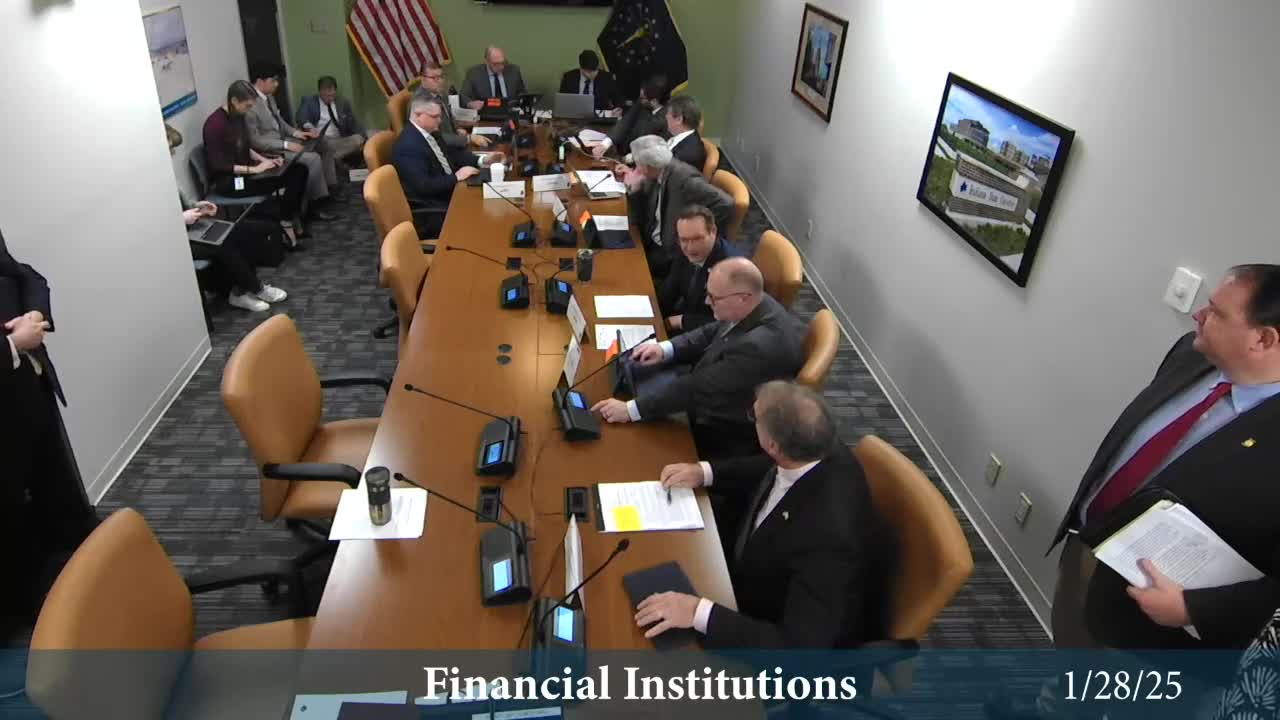
The House Financial Institutions Committee on Tuesday voted to advance House Bill 1519, a proposal to expand down‑payment assistance and create new financing tools aimed at bringing more workforce housing to Indiana.
The House Financial Institutions Committee on Tuesday voted to advance House Bill 1519, a proposal to expand down‑payment assistance and create new financing tools aimed at bringing more workforce housing to Indiana.
Representative Rosemary Miller, the bill sponsor, told the committee the measure has two principal pieces: continuing the state's down‑payment assistance program while increasing eligibility to 160% of area median income (AMI), and creating an option to shift bond volume to support low‑income housing tax credit projects. "There are really two things going on in this bill," Miller said in her presentation.
Why it matters: Supporters say the AMI increase would let down‑payment assistance reach buyers at higher price points and that shifting bond volume could free tax credit capacity to finance more multifamily affordable units. "If we get an appropriation of $30,000,000 this year, then we just move $30,000,000 of the bond allocation to the tax credit program," Mark Schublak of the Indiana Affordable Housing Council said, describing how the policy could create a revolving loan fund to sustain assistance over time.
Testimony from housing groups, builders and lenders emphasized both demand for homeownership and the need for more rental inventory. Maggie McShane, senior vice president of government affairs at the Indiana Association of Realtors, said the association was neutral on the bill and urged caution about preserving the existing Indiana Housing and Community Development Authority (IHCDA) down‑payment program, which she said issued about "$32,000,000 in assistance" last year. "Let's not throw the baby out with the bathwater," McShane said, arguing the state should not inadvertently weaken a successful program while expanding eligibility.
Industry and nonprofit witnesses highlighted how the two parts of the bill fit together. Carly Hopper of the Indiana Builders Association said the measure targets barriers for first‑time buyers such as down payments and closing costs. Ryan Myers of United Way of Central Indiana said earned‑wage and cost pressures make saving for a down payment difficult and described down‑payment assistance and interest rate buydowns as tools that could help working families. Mike Petrie, chairman and CEO of Merchants Bancorp, described mechanics of volume cap and tax credit financing and said current down‑payment assistance at 80% AMI is often insufficient at today's prices. "On the prices of homes today, $5,000 to $7,000 of down payment assistance ... is not very effective," Petrie said.
Several committee members asked about default rates and geographic distribution. Witnesses said program loans are underwritten to conventional or government mortgage standards and that default rates are low; witnesses agreed to follow up with more precise figures. Members also discussed how the tax credit allocation and qualified allocation plans can prioritize rural projects or other local priorities.
Committee action and next steps: Two amendments offered by Miller were adopted by consent: Amendment 1 removed an appropriation in the introduced bill and corrected a drafting word, and Amendment 2 added language to coordinate the fund with low‑income housing providers. The committee then voted to advance the bill; the clerk announced the result as "Bill passes 11 yeses, 1 no." The measure will go next to Ways and Means for budget consideration.
What remained unresolved: Several witnesses and members said funding levels and the budget allocation remain to be determined, and advocates urged follow‑up on how any new appropriation would be structured to preserve current down‑payment assistance while expanding long‑term affordable housing supply.
Votes at a glance: The committee recorded the bill as passing with a tally of 11 yeses and 1 no; Representative Lucas cast the lone no vote. The bill was advanced as amended to Ways and Means.
— End —