Get Full Government Meeting Transcripts, Videos, & Alerts Forever!
Get email alerts on the Housing Down Payment Assistance topic
No spam. Unsubscribe anytime.
House committee advances bill to broaden down-payment assistance, raise AMI to 160%
Summary
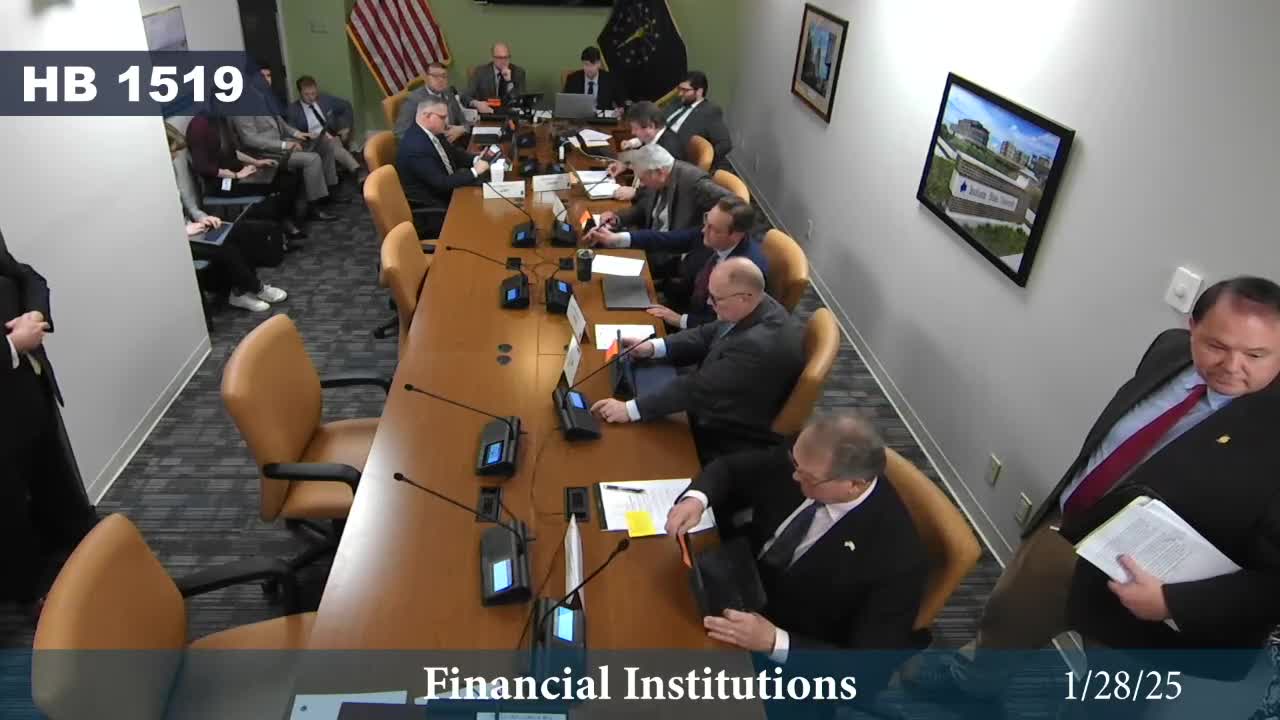
House Financial Institutions Committee — The House Financial Institutions Committee on Wednesday voted 11'1 to advance House Bill 1519, a package that would expand the state's down-payment assistance program and create a financing path intended to spur more multifamily affordable housing.
House Financial Institutions Committee — The House Financial Institutions Committee on Wednesday voted 11–1 to advance House Bill 1519, a package that would expand the state's down-payment assistance program and create a financing path intended to spur more multifamily affordable housing.
Representative Rosemary Miller, the bill's author, told the committee the measure has two parts: continuing a repayable down-payment assistance fund and'"growing the available market through that by increasing the AMI to 160%." She said that change "in today's housing market . . . simply takes that price point from say 200,000 up to 300,000" for participating builders and developers.
The measure also would allow the state to optimize existing federal and state financing tools by shifting some bond volume toward low-income housing tax credits to encourage new multifamily construction. "If we get an appropriation of 30,000,000 this year, then we just move 30,000,000 of the bond allocation to the tax credit program," Mark Schublak of the Indiana Affordable Housing Council said, describing the bill's mechanics.
Why it matters: Supporters said the bill would help working families overcome upfront costs such as down payments, closing costs and interest-rate buydowns, while also directing more equity toward building affordable rental units that serve households at lower incomes. Opponents and neutral witnesses urged caution that existing successful programs not be diluted and pressed for clear funding decisions during the budget process.
Who testified: The Indiana Association of Realtors took a neutral position. Maggie McShane, senior vice president of government affairs for the association, said the state's current IHCDA down-payment program is "the only program that's directed for new home buyers right now at IHCDA" and noted the authority issued about "$32,000,000 in assistance" last year. She said the association supports expanding eligibility but wants assurances the current program would not be weakened without new funding.
Industry and nonprofit groups broadly supported the bill as drafted. Carly Hopper of the Indiana Builders Association said HB 1519 "targets expenses that are a barrier for first time homebuyers," including down payments and closing costs. Ryan Myers, public policy manager at United Way of Central Indiana, said the bill would help the "ALICE" population (asset-limited, income-constrained, employed) better save toward homeownership. Jeffrey Whiting of CREA LLC and Mike Petrie of Merchants Bancorp described how shifting bond allocation to tax-credit-backed multifamily funding could leverage private equity and expand affordable rental supply.
Committee discussion and vote: After testimony and questions, committee members moved the bill. The roll call produced 11 yes votes and 1 no. Representative Lucas voted no; Representative Cleary was excused. The clerk announced, "Bill passes 11 yeses, 1 no." The committee advanced HB 1519 to the next chamber process for fiscal consideration and potential appropriation.
Details and clarifications: Witnesses described the down-payment assistance fund as a repayable second-lien loan program administered through IHCDA and said the program historically has been paired with a bond-volume allocation mechanism; proponents said the proposal would create a revolving loan fund and eventually free bond volume to support low-income tax-credit projects. Witnesses gave examples of typical down-payment assistance amounts (current program payments of roughly "$5,000 to $7,000" were cited in testimony) and said expanding eligibility to 160% AMI would bring higher-priced starter homes and new construction within reach for more buyers in many parts of the state.
What's next: By advancing out of committee, HB 1519 will move to ways and means and other budget processes to determine whether the state will provide the appropriation supporters say is necessary to make the revolving fund sustainable.