
Bill to expand where local governments may invest public funds draws split testimony; committee to continue work
Get AI-powered insights, summaries, and transcripts
Sign Up Free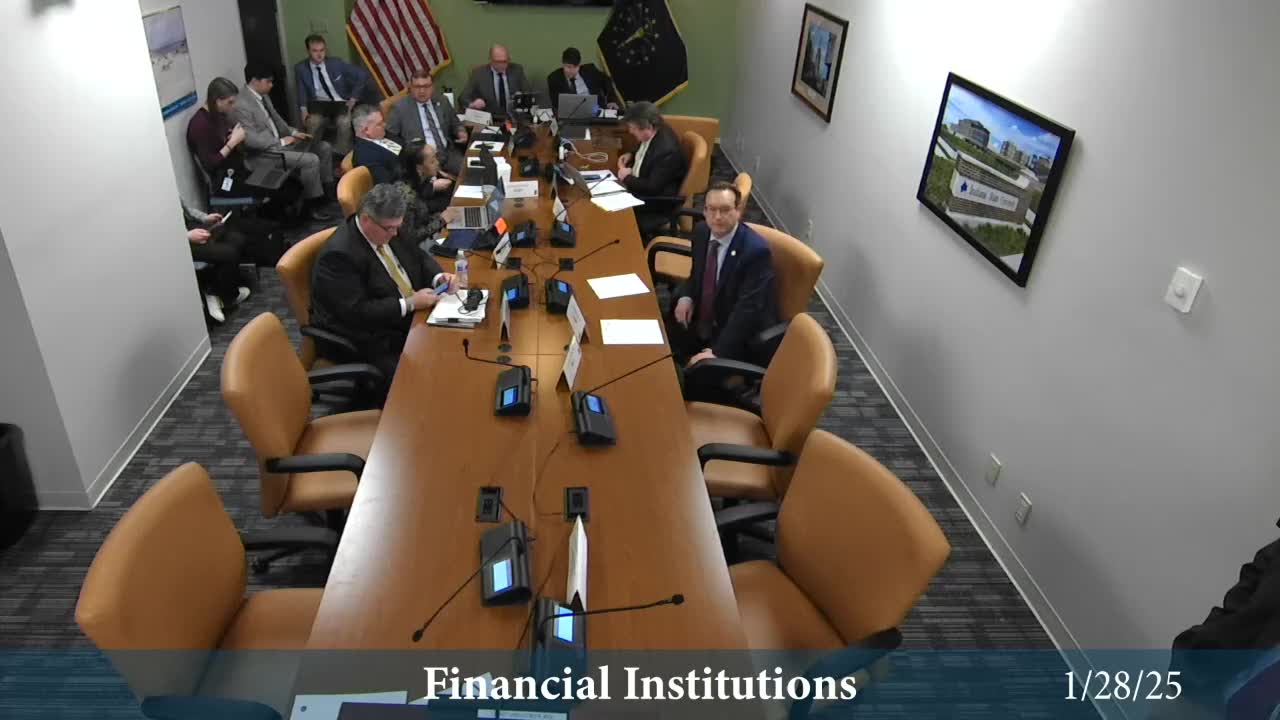
Summary
House Bill 1523 would allow eligible local units of government to seek time-deposit and CD rates beyond current territorial limits; county treasurers and school financial officers supported the change while bankers and credit unions opposed it.
House Bill 1523, a proposal to relax territorial restrictions on where some Indiana local governments may place certificate-of-deposit (CD) and time-deposit investments, drew sharply split testimony at the House Financial Institutions Committee.
Representative Pierce presented the bill as a means to increase competition for public deposits and improve returns for taxpayer dollars. The bill would remove a statutory requirement that, when local units have adequate local options, deposits be placed only with financial institutions that maintain a brick-and-mortar presence in the jurisdiction. Proponents said the current rule can leave public entities beholden to a small number of local institutions and that broader competition would increase interest income available for public services and reduce pressure to raise property taxes.
County treasurers, school financial officers and associations representing counties, libraries and school business officials testified in favor. Brian Burdick (Indiana County Treasurers Association), Ryan Hoff (Association of Indiana Counties), Kent Hatcher (Perry Township Schools) and Scott Bowling (Indiana Association of School Business Officials) said fewer banks and changing banking markets have reduced local options in many jurisdictions and that allowing broader state competition would generate material additional interest income for local operations. Burdick characterized the statutory limits as "antiquated" given modern banking consolidation and argued fiduciary duty favors getting the best rate for taxpayers.
Opposition testimony came from the Indiana Bankers Association and the Indiana Credit Union League. Dax Denton of the bankers association said the territorial restrictions preserve local deposit flows that banks turn into loans for the same communities; he argued the restriction helps drive local lending and community economic development. Chris Beaumont of the Credit Union League urged keeping the local-preference rule to preserve the local economic benefits of deposits placed within the home community.
Mike Neil of the Treasurer of State's Office said the Indiana Board for Depositories (BFD) is neutral; the BFD insures public deposits beyond FDIC coverage and educates local officials on deposit rules. Witnesses also discussed a 2018 statutory change that clarified how CDs are treated; the bill includes language to protect investments made under the current code from audit exceptions.
Committee members asked technical questions about the bank consolidation pattern, audit and insurance protections, and whether the bill would replicate the current exception that applies to cities and towns (cities and towns have been exempt from the rule for many years). Representative Pierce said the language is expected to be amended next week to reach a compromise balancing local reinvestment with enhanced yield opportunities.
No vote was taken; sponsors and stakeholders said they would continue negotiations and bring amendment language back to committee next week.