Get Full Government Meeting Transcripts, Videos, & Alerts Forever!
Get email alerts on the Earned Wage Access topic
No spam. Unsubscribe anytime.
Committee hears competing views on earned-wage access; bill held for amendment
Summary
House Bill 1125, which would create a licensing and oversight framework for earned-wage-access (EWA) providers, drew mixed testimony from consumer advocates and industry; the committee held the bill for amendment and further conversation.
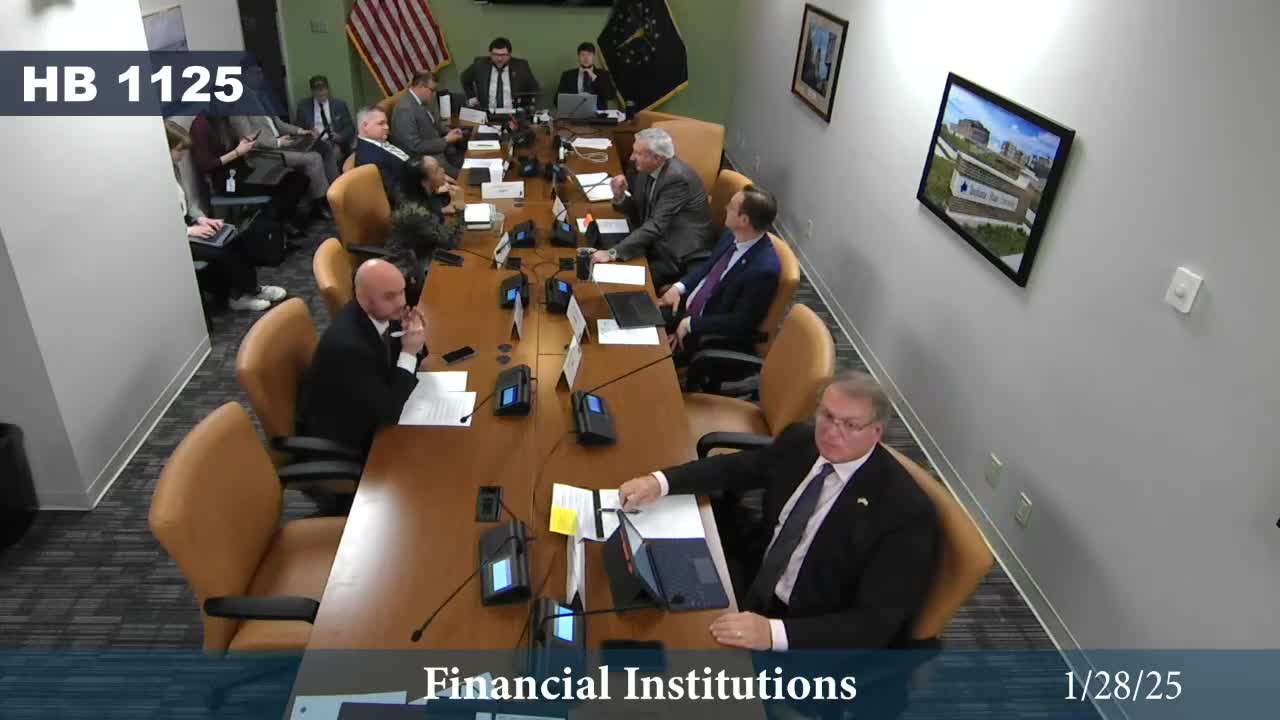
The House Financial Institutions Committee heard testimony on House Bill 1125, a bill to license and regulate earned-wage-access (EWA) providers that allow workers to access wages they have already earned before scheduled payday. The committee deferred action and will hold the bill for amendment next week.
Sponsor remarks and bill summary: Chairman Teschka (presenting) described HB 1125 as a measure to create a regulatory structure around a product already in use by hundreds of thousands of Hoosiers. The bill would require licensing of providers, ban credit checks and credit reporting for EWA transactions, prohibit late fees and interest, require at least one cost-free delivery option (typically ACH), and give the Department of Financial Institutions oversight and reporting authority.
Supporters: Industry witnesses including Ben LaRocco of EarnIn, Andrew Welch of DailyPay, and Andrew (Andy) Welch (DailyPay) and other fintech representatives testified in support. EarnIn and DailyPay representatives said EWA products are not loans: users access wages they have already earned, there is no interest, and providers often take repayment risk. They described consumer benefits such as avoiding overdraft fees, paying bills on time, and modest average transaction sizes (DailyPay said average user access is about $150 per transaction). Industry witnesses also emphasized that a no-cost ACH option is standard and that fees for instant transfers typically range between roughly $2.99 and $5.99.
Opponents and concerns: Erin Macy of the Indiana Community Action Poverty Institute—testifying on behalf of a coalition of consumer, faith and anti-poverty groups—said the bill leaves several omissions that could permit high-cost offerings or repeat borrowing. She urged statutory fee limits or at least APR disclosure, caps on ACH retry attempts (to prevent overdraft/NSF fees), public reporting requirements, limits on reborrowing practices, and minimum repayment terms that would mitigate rapid reborrowing. Catalyst (John Barnes) urged the committee to require a centralized verification system or database so providers cannot continually advance funds to the same employee across multiple apps.
Regulatory issues discussed: Committee members questioned whether EWA could create a debt trap similar to payday lending. Witnesses and the sponsor emphasized distinctions: EWA provides access to wages already earned, typically offers a free ACH-delivery option, and lacks interest and late fees; consumer advocates noted that repeat short-term advances and tips could still result in high effective costs and urged APR-style transparency and stronger reporting.
Next steps: Chairman Teschka said the committee would hold HB 1125 for amendment and invited continued stakeholder discussions. Members asked for more data—especially on repeat borrowing and default rates—and for consideration of mandatory public reporting and a centralized verification system.