Get Full Government Meeting Transcripts, Videos, & Alerts Forever!
Get email alerts on the Consumer Finance topic
No spam. Unsubscribe anytime.
Committee hears bill to regulate earned-wage-access apps; advocates urge caps, data reporting
Summary
House Bill 1125 would create a licensing and oversight framework for earned-wage-access (EWA) providers in Indiana. Supporters—including major providers—say the bill protects workers and provides regulatory certainty; consumer advocates urged fee caps, APR disclosure and stronger data reporting to prevent repeat borrowing and harms.
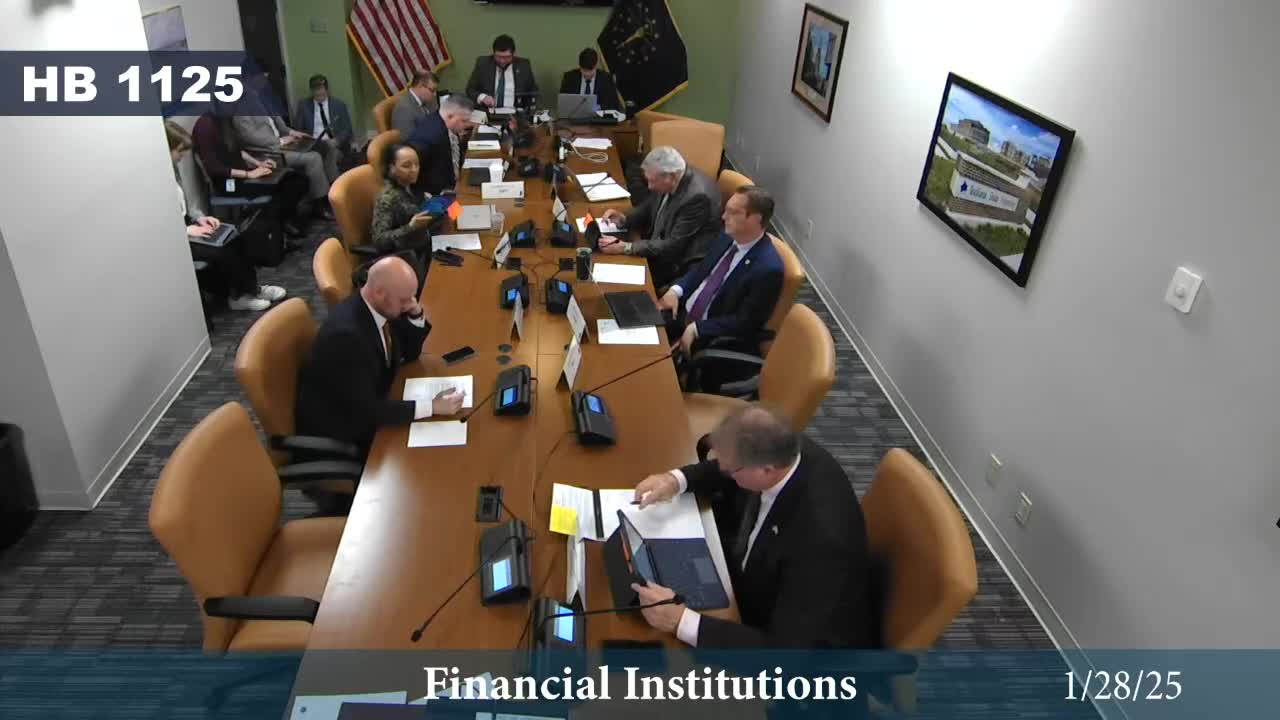
Representative Tescha (presenting the bill to the committee) described House Bill 1125 as a regulatory framework for earned-wage-access (EWA) services, which let workers access wages they have already earned before payday. The bill would require licensing, ban interest and late fees, prohibit credit checks and negative credit reporting, require a free transfer option (typically ACH) and allow the Department of Financial Institutions oversight of providers.
Major EWA providers and fintech trade groups testified in favor. Ben LaRocco of EarnIn and Andrew Welch of DailyPay described how their platforms verify wages and provide low- or no-cost transfers; both said the products reduce overdraft, late fees and reliance on higher-cost credit options. Witnesses said many users access modest amounts (testimony cited an average DailyPay advance of about $150) and that a substantial share of app users never take an advance but use wage-tracking and financial-wellness features.
Industry witnesses argued the bill would create needed regulatory certainty and enshrine consumer protections such as nonrecourse access (providers cannot pursue users for unpaid advance), mandatory free transfer options and disclosure of fees. Trade groups including the American Fintech Council and Financial Technology Association said the bill balances consumer protections and market access; they noted the product differs from payday or small-dollar loans because it is an advance on wages already earned rather than a loan against future pay.
Consumer advocates and nonprofit groups offered a neutral stance with substantive concerns. Erin Macy of the Indiana Community Action Poverty Institute and coalition partners said the bill omits limits on overall charges and APR-like disclosure that would make costs comparable with other credit products. Macy cited national analyses showing high APR equivalents for some EWA models and urged: caps on charges (or at least that they be no higher than payday alternatives), APR disclosure, limits on ACH-retry attempts to avoid bank overdraft/NSF fees, minimum repayment windows to reduce repeat borrowing, and mandatory public reporting of violation and usage data (average loan size, cost, repeat borrowing, borrower income levels).
A separate witness from Catalyst recommended a centralized verification database to prevent consumers from taking multiple advances across different providers simultaneously and to give regulators data to monitor marketplace outcomes. Consumer groups asked that any director discretion to waive requirements be limited and that public reporting be mandated rather than optional.
Committee discussion focused on reborrowing and risks of a debt cycle, the role of tipping (voluntary fees) on some direct-to-consumer products, distinctions between employer-integrated and direct-to-consumer models, default/reborrowing data and whether APR disclosure would be meaningful for an advance on earned wages. Several committee members requested more data on reborrowing rates and APR equivalencies; industry witnesses offered to provide data as the bill is refined.
Why it matters: Hundreds of thousands of Hoosiers already use EWA tools; supporters say regulation will protect consumers while preserving low-cost alternatives to payday loans. Opponents/neutral witnesses urged stronger limits and public data to prevent consumer harm and ensure transparency.
Next steps: Committee members indicated they will hold the bill for amendment and requested follow-up data and potential language changes (centralized verification, APR reporting, ACH-return limits, public reporting requirements) for next week’s consideration.