Get Full Government Meeting Transcripts, Videos, & Alerts Forever!
Get email alerts on the Housing Down Payment topic
No spam. Unsubscribe anytime.
House committee advances bill to expand down-payment assistance, raise AMI to 160%
Summary
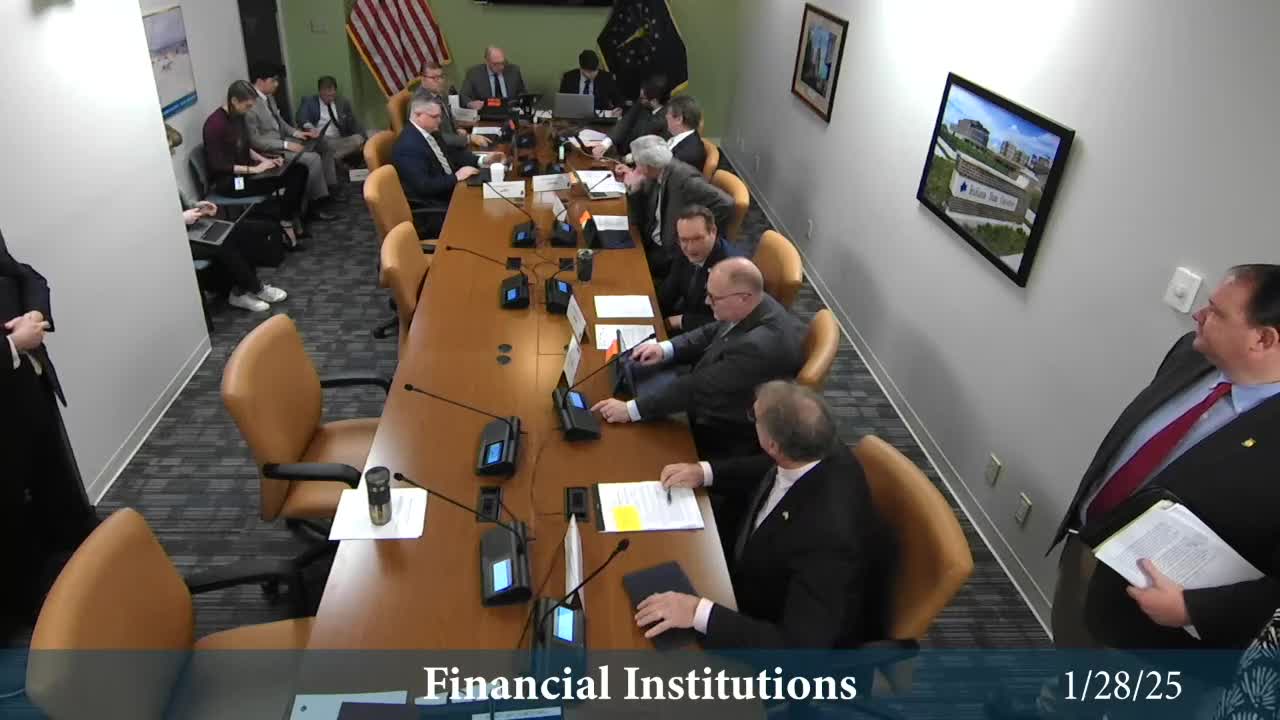
House Bill 1519, which would expand state down-payment assistance eligibility to households up to 160% of AMI and create a revolving loan fund to preserve bond volume for multifamily tax-credit production, was reported favorably by the House Financial Institutions Committee on a roll-call vote, 11–1.
House Bill 1519, which would expand state support for down-payment assistance and create a mechanism to reallocate bond volume toward multifamily tax-credit development, cleared the House Financial Institutions Committee on a roll-call vote Monday, 11–1.
The bill, presented by Representative Rosemary (Rhett) Miller, would raise the area median income (AMI) threshold for down-payment assistance eligibility to 160% and authorize a revolving loan fund intended to sustain down-payment assistance without repeatedly drawing new annual appropriations. Miller told the committee the changes would expand the market for homebuyers and allow more multifamily tax-credit projects to move forward by freeing up bond allocation currently used for down-payment assistance.
Supporters told the committee the bill aims to address statewide housing shortages by helping first-time buyers and increasing available multifamily inventory. Maggie McShane of the Indiana Association of Realtors testified the association took a neutral position because of concerns the change could dilute an existing Indiana Housing and Community Development Authority (IHCDA) down-payment program that currently issues roughly $32,000,000 a year. Carly Hopper of the Indiana Builders Association and Ryan Myers of United Way of Central Indiana testified in support, saying down-payment assistance and tools such as closing-cost help and interest-rate buy-downs make homeownership more attainable for working families.
Mark Schublak of the Indiana Affordable Housing Council and Jeff Whiting of CREA described how the bill would shift some bond volume into the Low Income Housing Tax Credit (LIHTC) pipeline to spur production of affordable multifamily units. Multiple witnesses—including Mike Petrie, CEO of Merchants Bancorp—told the panel the current down-payment assistance levels (often $5,000–$7,000 and tied to 80% AMI) are insufficient for many parts of the state and that larger, sustainable funding and a 160% AMI threshold would allow new construction and broader reach.
Representatives on the committee asked about default rates and the program’s mechanics. Witnesses said defaults on down-payment assistance administered through mortgage programs have historically been low; several providers offered anecdotal default rates at or below market norms and committed to providing more precise figures. Witnesses also said the proposal would require an appropriation to create the revolving fund and that an appropriation roughly equivalent to $30,000,000 could permit the existing bond allocation to be redirected toward tax-credit production.
Committee members who supported the bill cited its potential to expand both single-family starter home access and affordable multifamily construction. Representative Lucas was the lone “no” vote on the committee roll call. The committee adopted two technical amendments by consent before the final vote: one removed an appropriation provision from the introduced draft and corrected drafting errors; the other clarified participation by low-income housing providers.
What happened next: The committee reported HB 1519 with amendments and a favorable recommendation; the committee’s chair said the bill will move to Ways and Means for potential budget consideration of the revolving-fund appropriation.
Votes at a glance: The committee vote recorded 11 yes, 1 no; the transcript names committee members casting “yes” and “no” votes and lists one excused member.
Why it matters: Proponents say the bill could expand homeownership opportunities for working families and generate more affordable rental units by using tax-credit equity. Opponents and neutral witnesses asked for guardrails to ensure the existing IHCDA program is not weakened without a dedicated new funding source.
Outlook: Representative Miller urged the committee’s support and said he will continue to work with Ways and Means on potential funding. The bill will proceed to the next steps in the House process.