Get Full Government Meeting Transcripts, Videos, & Alerts Forever!
Get email alerts on the Affordable Housing topic
No spam. Unsubscribe anytime.
Committee advances bill to expand down-payment assistance, redirect bond volume to build more workforce housing
Summary
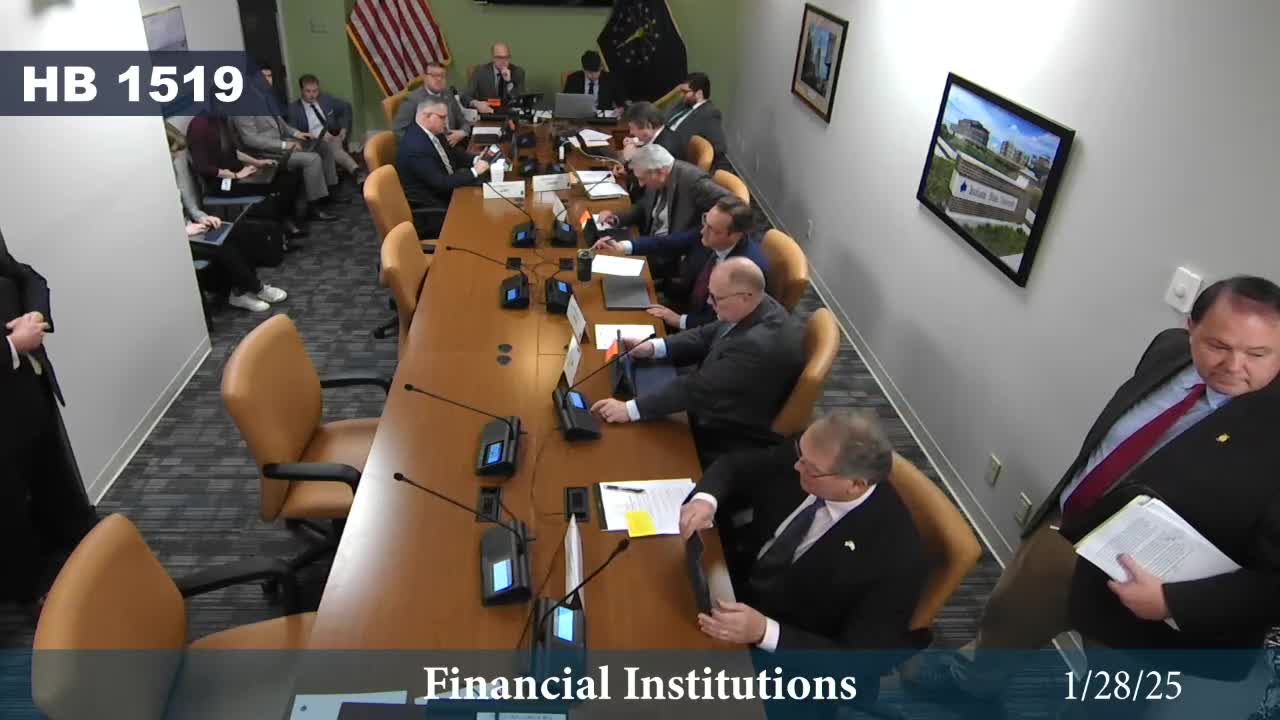
The House Financial Institutions Committee advanced House Bill 1519 after testimony from housing advocates, lenders and developers. The bill would raise eligibility to 160% of area median income for a down-payment assistance program and create a revolving loan fund intended to free up bond volume for Low-Income Housing Tax Credit projects.
Representative Rosemary Miller introduced House Bill 1519 to the House Financial Institutions Committee, proposing changes to the state’s down-payment assistance program and measures to increase development of multifamily workforce housing.
The bill would increase the area median income (AMI) threshold for down-payment assistance eligibility to 160 percent and create a structure for a revolving loan fund for down-payment assistance, with the intent of allowing the state to redirect bond volume currently used for down-payment assistance into the Low-Income Housing Tax Credit (LIHTC) program to finance multifamily projects. Miller offered two technical amendments at the start of the hearing that were accepted by consent.
Housing stakeholders and industry groups testified in support, while flagging funding and program-protection questions. Maggie McShane, senior vice president of government affairs at the Indiana Association of Realtors, said her organization took a neutral position because of concerns the changes could dilute the existing Indiana Housing and Community Development Authority (IHCDA) down-payment assistance program unless new funding was provided. “We really want to maintain that,” McShane said, noting IHCDA provided about $32,000,000 in down-payment assistance in 2024.
Builders, lenders and affordable-housing developers described how the bill would expand access and create more housing supply. Carly Hopper of the Indiana Builders Association said the measure targets upfront barriers such as down payments, closing costs and interest-rate buy downs. Ryan Myers of United Way of Central Indiana said the change would help working families who struggle to save for upfront homebuying costs. Mark Schublak, speaking for the Indiana Affordable Housing Council, described the mechanics: if the state appropriates funds to create a revolving loan fund for down-payment assistance, the existing bond allocation could be moved to LIHTC and used to finance multifamily development.
Lenders and syndicators described financial mechanics and the expected scale. Mike Petrie, chief executive of Merchants Bancorp, said the bill’s approach could broaden eligibility where current assistance (commonly $5,000–$7,000 and limited to about 80% AMI) no longer buys meaningful down payments at current prices. Petrie and others described a bond volume cap that supports IHCDA programs and local allocations for tax-credit projects; Petrie said roughly $820,000,000 in bond volume cap exists statewide, with about 28 percent flowing to IHCDA and 20 percent to local allocations. He also said private lenders often provide down-payment assistance in larger amounts — for example, his bank provides $10,000 — and reported very low default rates on such assistance when loans follow Fannie/Freddie underwriting.
Several lawmakers asked whether the plan would favor urban over rural areas or otherwise produce unintended consequences. Schublak and others said the tax-credit allocation process includes a competitive qualified allocation plan that can prioritize rural projects. Representative Lucas asked about the fiscal cost now that appropriation language had been removed from the bill; testimony estimated annual bond volume currently used for down-payment assistance at about $30,000,000 and suggested funding the revolving fund over multiple budget cycles.
Committee members then voted to advance the bill. On the roll call, the measure passed 11–1.
Why it matters: Supporters told the committee the bill would both help first-time and workforce buyers by increasing eligibility and create additional multifamily units by moving bond volume into LIHTC projects — a two-part approach supporters said would address Indiana’s housing shortage and reduce upward pressure on rents and prices. Skeptics urged caution that existing IHCDA programs not be inadvertently weakened without a committed funding source.
Next steps: The committee advanced the amended bill for further consideration by the full House; proponents and opponents indicated they expect further budget and policy work in the coming weeks.