Get Full Government Meeting Transcripts, Videos, & Alerts Forever!
Get email alerts on the Housing Down Payment Assistance topic
No spam. Unsubscribe anytime.
House panel advances bill to expand down-payment assistance, shift bond allocation toward affordable multifamily development
Summary
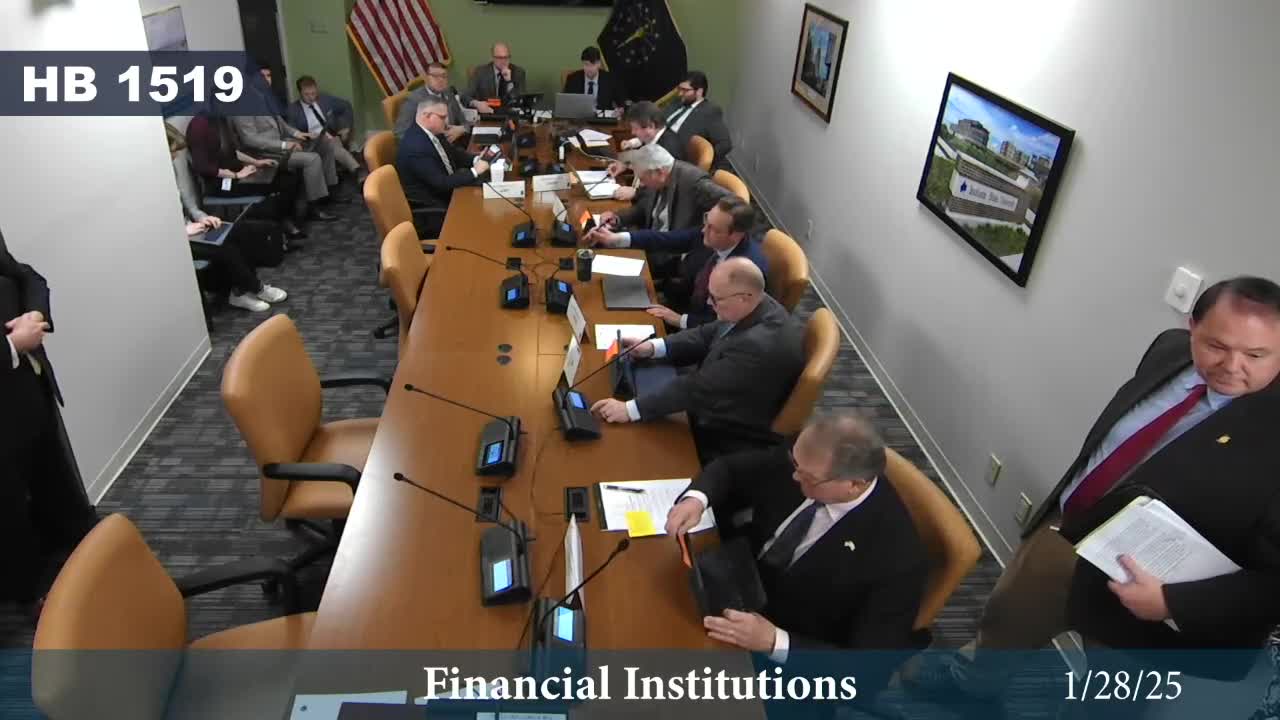
House Financial Institutions Committee members on Thursday advanced House Bill 1519 after the bill's author and several housing-sector witnesses described the measure as a way to expand down-payment assistance and channel more federal low-income housing tax credit resources into new multifamily construction.
House Financial Institutions Committee members on Thursday advanced House Bill 1519 after the bill's author and several housing-sector witnesses described the measure as a way to expand down-payment assistance and channel more federal low-income housing tax credit resources into new multifamily construction.
Representative Rosemary Miller, the bill's author, told the committee the measure would continue the state's down-payment assistance program while increasing the eligible area median income (AMI) ceiling to 160%. "What that really does in today's housing market is simply, takes that price point from say $200,000 up to $300,000 for those providers," Miller said, describing the change as critical for bringing more housing to market.
The bill was amended in committee to strike the original appropriation language and to add language allowing the down-payment fund to work with low-income housing providers, changes Miller said were technical and aligned with the bill's intent. Both amendments were accepted by unanimous consent.
Why it matters: Witnesses from trade groups, housing nonprofits and private lenders said the change could both help first-time buyers and increase the pool of federal low-income housing tax credits available for multifamily construction. Mark Schublak of the Indiana Affordable Housing Council said the bill is intended to "optimize two existing programs" — the down-payment assistance program and the federal/state tax credit program — by creating a revolving loan fund that requires a one-time appropriation rather than ongoing state funding.
Supporters and concerns: The Indiana Association of Realtors, represented by Maggie McShane, testified with a neutral position, saying she supports expanding the AMI eligibility but wants to ensure the existing Indiana Housing and Community Development Authority (IHCDA) down-payment program (which she said issued roughly $32 million last year) is not unintentionally diminished by any future appropriation reallocations. Builders, community development organizations and lenders including the Indiana Builders Association, United Way of Central Indiana, CREA LLC and Merchants Bancorp testified in support, citing the need for more starter homes, workforce housing and the ability to leverage bond and tax-credit mechanisms to build affordable multifamily units.
Implementation details: Multiple witnesses described the mechanics: today, bond volume cap allocations are used in part to support IHCDA down-payment assistance and in part to generate Low-Income Housing Tax Credits (IRC Section 42) that finance multifamily affordable housing. Proponents said a state appropriation to establish a $30 million revolving down-payment loan fund, for example, would allow the state to shift an equivalent amount of bond volume into tax-credit production and thereby increase multifamily development. Mike Petrie of Merchants Bancorp outlined how bond allocation and tax-credit equity interact and said current down-payment assistance levels (often $5,000–$7,000 per household at 80% AMI) are insufficient for today's prices.
Committee action: After testimony and committee discussion, the committee took a recorded vote. The roll call recorded 11 yes votes and 1 no vote; Representative Lucas voted no. The committee report notes that the bill will proceed to the next stage of the legislative process.
What’s next: The committee advanced an amended HB 1519; the measure will be available for further fiscal review and subsequent floor consideration.