Get Full Government Meeting Transcripts, Videos, & Alerts Forever!
Get email alerts on the Housing topic
No spam. Unsubscribe anytime.
House committee advances bill to expand down-payment assistance, raise AMI to 160%
Summary
The House Financial Institutions Committee amended and voted to advance House Bill 1519, which would continue and expand the state's down payment assistance program and create a revolving loan structure intended to free up federal tax credit volume for multifamily affordable housing development.
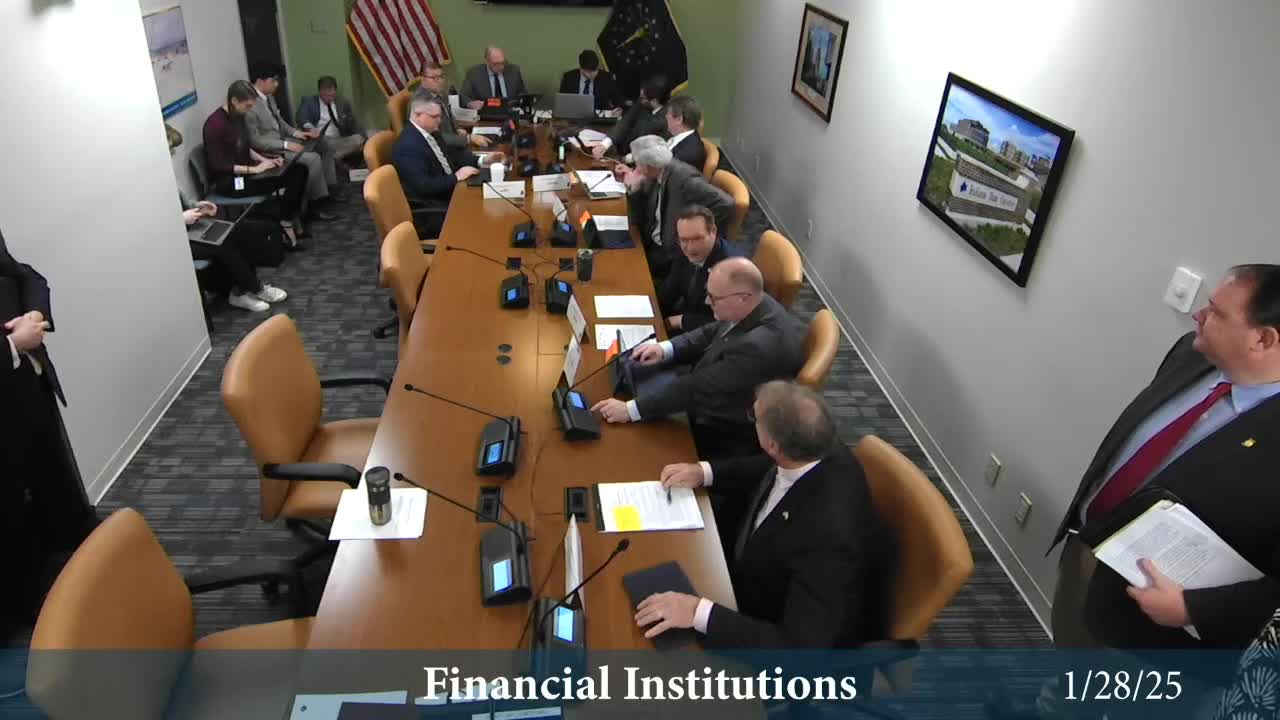
House Bill 1519, titled "Down Payment Assistance and Workforce Housing," advanced out of the House Financial Institutions Committee on a voice roll call after amendments and testimony from housing industry groups on both single-family down-payment aid and tax-credit financing for multifamily housing.
The bill, introduced in committee by Representative Rosemary Miller, would continue the state's down payment assistance program, raise the area median income (AMI) threshold to 160 percent for program eligibility, and create a mechanism to convert part of the state's bond volume allocation into a revolving loan fund intended to sustain down-payment assistance and direct previously used bond volume toward low-income housing tax credit projects.
Supporters told the committee the measure mixes two housing tools. The first preserves and expands access to down-payment assistance by increasing the AMI cap so the assistance can apply to higher-priced markets and new-construction homes. The second re-allocates bond volume to the Low Income Housing Tax Credit (LIHTC) pipeline to increase multifamily affordable housing supply.
Representatives from the Indiana Association of Realtors and the Indiana Builders Association described housing affordability challenges and voiced conditional support. Maggie McShane of the Indiana Association of Realtors said she was neutral on the bill because of concerns the new structure could dilute an existing Indiana Housing and Community Development Authority (IHCDA) program that issued roughly $32,000,000 in down-payment assistance in 2024. Carly Hopper of the Indiana Builders Association and Ryan Myers of United Way of Central Indiana urged support for targeted tools that help first-time and working families access homeownership.
Industry witnesses and affordable-housing developers described the mechanics the bill would enable. Mark Schublak of the Indiana Affordable Housing Council and Jeff Whiting of CREA LLC said shifting bond volume into LIHTC activity would increase multifamily inventory. Mike Petrie, chairman and CEO of Merchants Bancorp, described how a $30 million revolving loan fund for down-payment assistance could free up hundreds of millions in bond allocation to produce additional tax-credit-financed affordable housing. Petrie and other witnesses described current down-payment assistance awards as commonly $5,000'$10,000 under IHCDA rules and said that, at present, many rural markets cannot buy new construction under the 80% AMI eligibility that the existing program uses.
Community-development financial institutions (CDFIs) and local nonprofit providers testified they support the expanded eligibility and noted counseling and underwriting practices that, they said, keep default rates low. Trevor Meeks of INHP and other witnesses said many advances use FHA- or GSE-quality underwriting and that national FHA-era default rates for comparable programs are low; Meeks cited a roughly 4% national default statistic for FHA-related products and said most EWA-style or down-payment programs have much lower default rates in practice. Merchants Bancorp reported near-zero defaults for its in-house down-payment programs.
Committee discussion emphasized the need to preserve the existing IHCDA down-payment program while expanding tools to spur multifamily development. Representative Lucas pressed witnesses about default rates and whether expanding assistance would put borrowers at risk; witnesses repeatedly pointed to underwriting and counseling as safeguards. Several witnesses and lawmakers noted the proposal would require a future appropriation for a revolving loan fund and that the measure, as amended, removed a direct appropriation from the committee bill text for further budget consideration by Ways and Means.
The committee adopted two technical amendments by consent before testimony. After discussion the committee voted to advance HB 1519. A roll call recorded 11 yes votes and 1 no (Representative Lucas), and the measure was reported out of committee for further consideration.
If enacted and funded, proponents said the measure would expand eligibility for down-payment assistance to higher-priced markets and create a sustainable, repayable fund while redirecting bond volume toward low-income housing tax credits to increase multifamily affordable housing supply. Opponents and cautious witnesses urged safeguards to ensure existing successful programs at IHCDA are not unintentionally reduced.
Votes at a glance: HB 1519 was amended by consent and advanced out of committee on a roll call tallying 11 yes, 1 no; the committee did not include a House floor appropriation in the bill and expects budget action to follow in ways and means.