Get Full Government Meeting Transcripts, Videos, & Alerts Forever!
Get email alerts on the Boise State Budget Programs topic
No spam. Unsubscribe anytime.
Boise State presents FY2026 request; president defends LAUNCH enrollment gains, free-speech institute and says $1.5M used to defend lawsuit
Summary
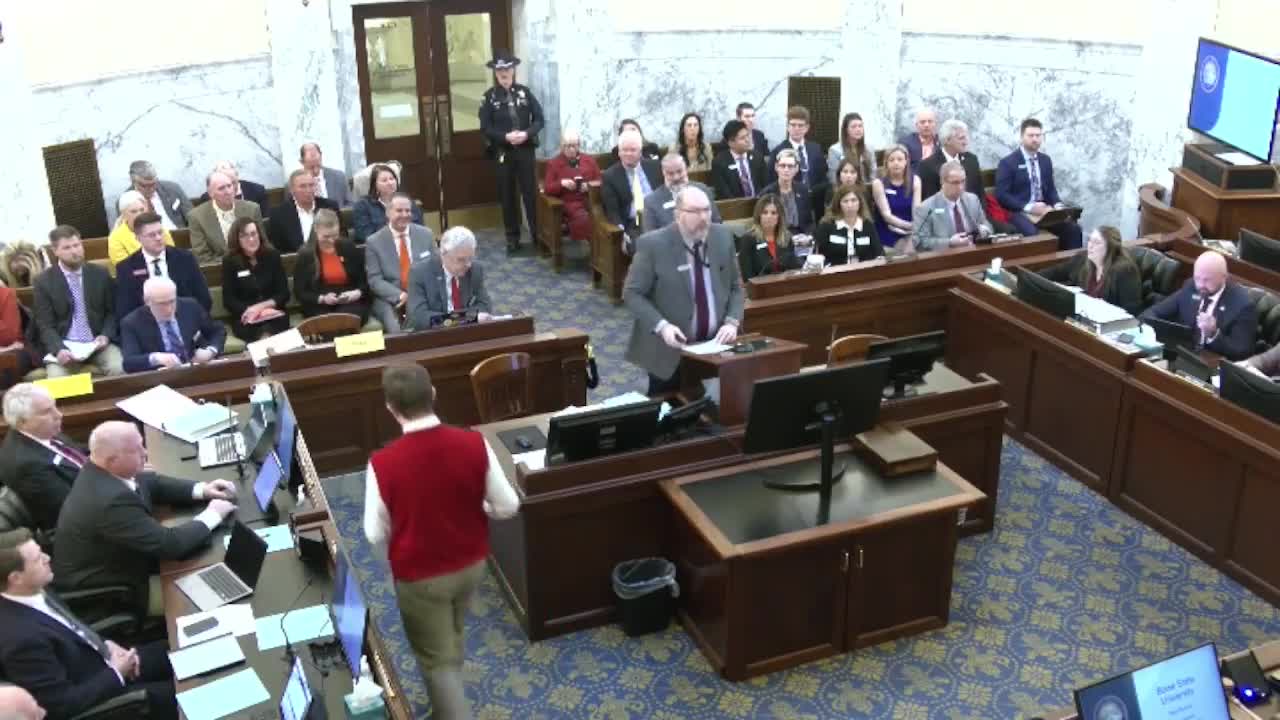
BOISE, Idaho — Boise State University leaders told the Joint Finance-Appropriations Committee on Wednesday that the university is seeking FY2026 enhancements to support faculty and staff compensation, highlighted growth in graduation rates tied to student-success reforms, and defended a set of campus changes and programs that have drawn legislative questions.
BOISE, Idaho — Boise State University leaders told the Joint Finance-Appropriations Committee on Wednesday that the university is seeking FY2026 enhancements to support faculty and staff compensation, highlighted growth in graduation rates tied to student-success reforms, and defended a set of campus changes and programs that have drawn legislative questions.
Kevin Campbell of the Legislative Services Office opened the university overview and reported Boise State has more than 27,000 students and a base budget of about $294.4 million. “This slide shows a five-year history of appropriations and expenditures,” Campbell said, noting the university’s mix of personnel and operating costs. Campbell identified recent state adjustments and enhancements, and said Boise State’s FY2026 request includes operational capacity enhancement funding and an enrollment workload adjustment.
Dr. Marlene Tromp, president of Boise State University, said the LAUNCH program enrolls roughly 1,300 students at Boise State and that 600 of those students use LAUNCH as their only financial support. “What we’re really excited about is the way that it’s going to give students access to critical areas like nursing, computer science ... mechanical engineering,” Tromp said, linking LAUNCH participation to workforce needs.
On campus programming and staff changes, Tromp described a reworked student-success model that reduced some staff positions associated with equity centers while creating broader student-success supports. She said Boise State examined more than 113 centers nationwide to design a model focused on academic success and that the net staff reduction related to those particular centers was five positions; she also noted the university had not disbanded its Veterans Services Center.
Tromp defended the Institute for Advancing American Values — an initiative that brings speakers and programming to campus intended to promote open discussion and civil dialogue — and said the university’s faculty senate and student government have adopted the Chicago Principles on free expression. “It was founded on the principle that people come to university with their own values,” she said of the institute, and she cited community programs such as Idaho Listens that bring people together across political divides.
Senators pressed Tromp about a lawsuit arising from a campus incident and legal fees. Tromp said Boise State used non-taxpayer funds to defend the university and its employees and that the legal defense cost about $1.5 million to date; she said she did not expect the appeal to add a significant amount at the time of the hearing.
Committee members probed campus course offerings and asked whether courses touching on gender or diversity remain available or required. Tromp and university staff said students are required to take general-education UF 100/200 courses but that sections cover many subject areas, so no student is required to take a gender class; Tromp said classes that discuss a range of topics remain available by academic freedom but are not mandatory. “No student is required to take one of those classes,” she said.
The committee asked about potential federal funding interruptions. Tromp and the committee noted a federal directive had caused temporary concern across institutions the previous day; Boise State said it was closely reviewing federally supported research and student-support grants and would comply with federal and state directives. Lawmakers also asked how the university would use additional capacity grants; Tromp said Boise State would prioritize nursing, cybersecurity support for rural businesses (Cyberdome), computer science and engineering programs.
What’s next: Boise State provided numbers and program descriptions during the hearing and told committee members it will supply requested breakdowns (for example, legal defense expenses and fund sources) in writing to the committee. Committee members requested written assurances that courses comply with Idaho law on nondiscrimination and dignity in public education as cited in the hearing.