Get Full Government Meeting Transcripts, Videos, & Alerts Forever!
Get email alerts on the Elections And Administration topic
No spam. Unsubscribe anytime.
Secretary of State seeks funding for voter guide, continued election technology and a deputy transition
Summary
Secretary of State Phil McGrane told the Joint Finance‑Appropriations Committee the office requests ongoing funding for a mailed voter guide, continued software subscriptions and a one‑time double‑fill to train a deputy business director; the office emphasized recent IT upgrades and the VoteIdaho site as major accomplishments.
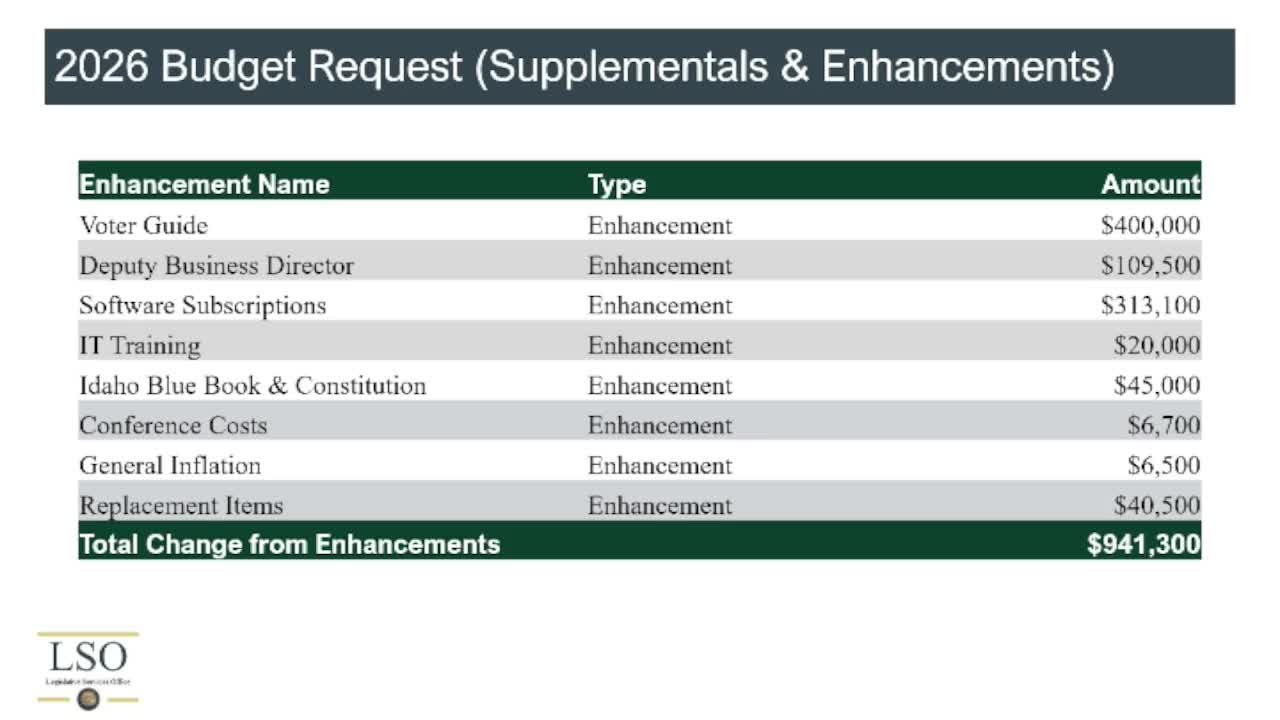
Secretary of State Phil McGrane and Legislative Services analyst Christopher Lahoset presented the Secretary of State’s fiscal requests, focusing on a voter guide, ongoing software costs and a one‑time double‑fill for a deputy transition.
Why it matters: The office administers elections, business filings and public records. The voter guide proposal would add candidate and ballot information to a mailed guide for primary and general elections; McGrane said voter guides enjoy broad public support and that the mailing schedule aligns with the state’s fiscal year and election calendar.
Key budget items: Lahoset described eight enhancement requests. The voter guide request is $400,000 ongoing (estimated $300,000 for mailing and $100,000 for printing). The office asked for one‑time funding to double‑fill the deputy business director position so a successor can train alongside the current deputy. Software subscription increases would add about $287,100 for campaign finance, lobbyist software and other cloud services; the office’s base software/cloud budget is about $775,000. A one‑time $26,000 fee was described as a federal system upgrade charge for access to a motor‑vehicle database used to validate voter registration information; the office will still pay routine subscription fees going forward.
Operational context and revenue: McGrane said the office handled more than 800,000 business filings in the prior year and about 70,000 phone calls, and that the office’s filings and fees generate revenue that is deposited to the general fund rather than held in a dedicated fund for the office. He described the successful rollout of three recent IT projects—the upgraded campaign finance system, a lobbyist reporting system and the VoteIdaho site—and said $2.9 million of the $10 million one‑time election systems appropriation has been spent to date with the remainder available for an election management system procurement currently under review.
Committee questions and follow‑ups: Legislators asked why the voter guide would be funded annually rather than only in election years (McGrane said the primary and general elections fall in different fiscal years and an ongoing appropriation stabilizes the budget). Members also asked about postage and whether DMV database access required one‑time funding (McGrane said federal upgrades triggered a one‑time fee but ongoing quarterly subscription fees remain). The committee asked about deputy succession risks and turnover; McGrane said the double‑fill is intended to ensure continuity and that long‑tenured staff typically remain in the office.