Get Full Government Meeting Transcripts, Videos, & Alerts Forever!
Get email alerts on the Environment topic
No spam. Unsubscribe anytime.
Planning commission recommends floodplain-code change to require permit-level mitigation assessments under FEMA/NOAA guidance
Summary
The Oregon City Planning Commission unanimously recommended amending the Flood Management Overlay District to require developers to provide mitigation assessments demonstrating "no net loss" of key floodplain functions in line with FEMA pre-implementation measures and the 2016 National Marine Fisheries Service biological opinion.
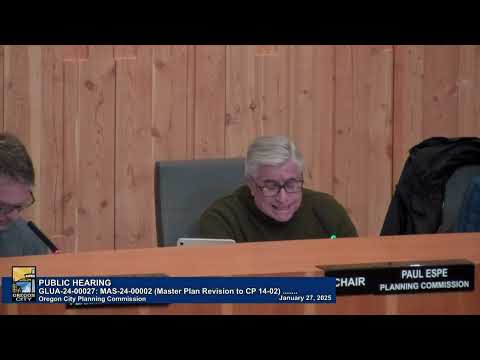
The Oregon City Planning Commission on Jan. 27, 2025, voted unanimously to recommend that the City Commission adopt amendments to the city's Flood Management Overlay District (Chapter 17.42) to implement FEMA's pre-implementation compliance measures tied to a 2016 National Marine Fisheries Service biological opinion.
The recommended amendment requires that, in addition to the city's usual permit information, developments within the floodplain submit a flood-habitat mitigation assessment prepared by a qualified professional. The assessment must describe existing conditions, quantify impacts to floodplain functions and identify mitigation measures sufficient to meet FEMA/NOAA "no net loss" standards for the functions of floodplain storage, water-quality performance and vegetation.
Aquila (staff), presenting for the planning department, said the changes are intended to keep Oregon City in the National Flood Insurance Program (NFIP) and to implement FEMA's short-term compliance pathway while FEMA finalizes a longer-term model ordinance. "We're adopting the relevant parts of the pre-implementation compliance measures so we can require applicants to provide the mitigation assessment now," Aquila said.
Under the permit-by-permit approach the commission recommended, applicants must provide a mitigation assessment prepared by a qualified expert (the FEMA guidance example cited a minimum of a bachelor's degree in wildlife or fisheries-related biology and four years of experience). City staff said their role will be to verify that a qualified report was submitted and to attach mitigation recommendations as permit conditions; specialized technical review will be handled by consultants where necessary.
Commissioners and public commenters raised concerns about the practical effects and costs. Ken Basinger, who represents a small group of Kanema-area homeowners, urged the commission to add specific thresholds and clear definitions so that minor, de minimis activities are not subject to costly mitigation requirements. Basinger described a prior local enforcement case in which seven yards of concrete triggered mitigation and legal costs he said ran into the tens of thousands of dollars for property owners.
"What is at what threshold is it necessary to enforce a rule?" Basinger asked. "Please try to establish some usable parameters. Establish a threshold. Don't waste your money, hours."
Staff acknowledged the compliance burden comes from FEMA's settlement obligations and said cities have limited flexibility under the timetable FEMA set. The amendments before the commission are deliberately narrowly tailored to implement the permit-level requirement now; staff plans to prepare the wider model ordinance language for subsequent hearings and broader public outreach before FEMA's model ordinance deadline.
Motion and outcome: The planning commission voted 5–0 to forward the proposed Flood Management Overlay District amendments to the City Commission with a recommendation for approval. The Planning Commission action is a recommendation; the City Commission must enact any final changes by ordinance.
What changes: The draft code adds definitions and language to Chapter 17.42 emphasizing floodplain natural and beneficial functions and requires that permit applications include a flood-habitat assessment by a qualified professional and that all mitigation measures identified in the report be included as permit conditions. Staff said the mitigation assessment will rely on FEMA-established proxies for the three functions (undeveloped space for storage, pervious surface for water quality, and trees for vegetation) and that consultants (city-hired reviewers) will assess technical sufficiency.
Next steps: The Planning Commission's recommendation will go to the City Commission for the formal legislative process; staff indicated the item will be scheduled for City Commission hearing in mid-February. Staff also said it will continue preparing the comprehensive model-ordinance language for later adoption to satisfy FEMA's longer-term requirements and engage stakeholders on thresholds and implementation details.