Get Full Government Meeting Transcripts, Videos, & Alerts Forever!
Get email alerts on the Land Use topic
No spam. Unsubscribe anytime.
Oregon City planning panel approves Confederated Tribes of Grand Ronde master plan amendment for tomata village at Willamette Falls
Summary
The Oregon City Planning Commission approved a master-plan amendment and associated detailed development plan elements for the Confederated Tribes of Grand Ronde's tomata village project at Willamette Falls, advancing street and shoreline access work while retaining two mill foundations for public integration.
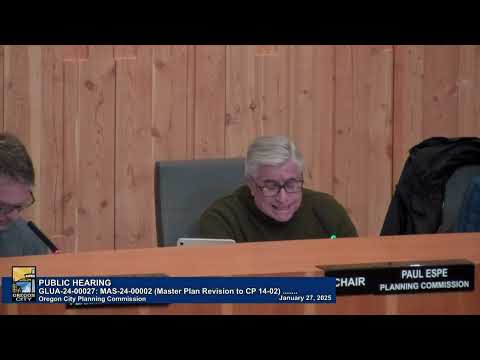
The Oregon City Planning Commission on Jan. 27, 2025, voted to approve a master-plan amendment to CP1402 and a consolidated detailed development plan that create a framework for future redevelopment of the former mill site now owned by the Confederated Tribes of Grand Ronde and branded as tomata village.
The amendment, approved by a 4–0 vote with one abstention, revises the 2014 framework plan to add a private street network with public access easements, identify a new Railroad Avenue for site circulation, preserve two mill foundations for integration into public open space, and keep the Riverwalk alignment and public-access requirements along the Willamette River. The commission also accepted the detailed development plan elements for streets and frontage improvements that are ready to move toward construction.
Staff and the applicant said the decision creates a clearer, shorter permitting path for future work on the 23-acre site while maintaining the city's code requirements for natural resources, floodplain review and Willamette River Greenway public access. The Confederated Tribes of Grand Ronde presented the proposal as tomata village, describing it as a tribe-led effort to restore habitat, deliver public shoreline access and establish mixed-use development, cultural spaces and jobs.
"This effort is about healing this sacred landscape while building a modern tribal village for our descendants," said David Harrelson, cultural resources department manager for the Confederated Tribes of Grand Ronde. Harrelson, a tribal member, spoke during the applicant presentation about cultural stewardship and partnerships the tribe has built with groups including the Chinese Diaspora Project and Oregon Black Pioneers.
Kristen Svakarovich, community development manager for the tribe, told the commission the project team completed intensive-level surveys of the site's buildings and that the tribe supports retaining the woolen mill foundation and the flour-mill/warehouse foundation while allowing other deteriorated structures to be removed. "We have done this comprehensive evaluation of the elements on-site and given them great consideration...we support condition of approval number 7, which retains the woolen mill and flour mill warehouse foundation," Svakarovich said.
City staff said the amended master plan removes some of the earlier boilerplate urban-design requirements and returns most future detailed development plans (DDPs) to the city's usual Type 2 staff-level review, while the master-plan amendment itself required this Type 3 hearing. Christina (staff planner) explained the change: the amendment consolidates a 20-year vision into a clearer framework and clarifies which future applications will come back to staff versus the commission.
Key elements in the approved amendment and supporting materials include: - A revised framework map adding Railroad Avenue to enable turning movements the site needs and relocating a public plaza into Block 2 where soils and restoration goals are more feasible; the tribe will integrate the flour mill foundation into that plaza. - Public-access commitments for the Riverwalk and pedestrian routes along the shoreline; public-access easements will be recorded when each segment of pedestrian route is built. - Retention of two foundations (woolen mill and flour-mill/warehouse) identified in the applicant's intensive-level historic assessment; other buildings were found by staff and consultants to lack integrity or be infeasible to adapt. - A site-specific fence standard and allowance for certain chain-link/security fencing in nonprominent areas during construction or for safety; that approach will be implemented through future DDPs and planning-commission review where required. - Streets as a private-street network with public-access easements (tribe proposes private streets to enable a bespoke design with public circulation) together with frontage work on McLaughlin Boulevard where ODOT is the permitting authority. - Carry-forward of off-site safety improvements identified in the ODOT memorandum of understanding: one project (tunnel lighting and advanced signage) is complete; another (a northbound left-turn prohibition/decoupling and deceleration refuge near the tunnel) is still planned; and a third project (a right-in/right-out or median treatment near Water Street) remains in the DDP scope. Staff noted the deceleration project will be triggered when site trip generation exceeds the mill's historic PM peak trips by one or more trips, and the city is seeking grant funding to build it sooner if awarded.
Ryan Webb, the tribe's engineering and planning manager, said the tribe has funding in hand to build the initial street network: the tribe received $2 million in congressional funding (2021) and has the street work on its tribal transportation plan; the DDP for Block 1 is at roughly 60% design and, with approvals, the tribe aims to break ground on the street work in summer 2025.
Public commenters during the hearing generally expressed support for the tribe's vision and public-access goals but raised concerns about traffic and safety in the Highway 99E/tunnel/Main Street area and about historic preservation. Sarah Thompson, an enrolled member of the Grand Ronde Tribe and a ceremonial fisher, told commissioners tomata village "represents the greatest opportunity to create a shared experience between everyone in this special place." Conversely, Paul Edgar, a local reviewer, urged caution about traffic volumes near the tunnel and said he feared congestion and safety impacts if peak trips exceed the MOU assumptions.
Commission deliberation cited the applicants' documentation, the updated structural and historic analyses, and staff findings. Commissioner comments noted the site's poor structural condition and the intensive-level surveys that informed staff and the tribe's recommendation to retain only the two identified foundations. Commissioner Schlagenhofer and several others thanked staff and the applicant for the comprehensive record.
Motion and outcome: Commissioner LaSalle moved to approve the master-plan revisions as described in Item 4(a) on the agenda; the motion was seconded and passed on roll call with the following votes: Commissioner LaSalle, aye; Commissioner Schlagenhofer, aye; Commissioner Stoll, aye; Commissioner Laws, abstain; Chair Espy, aye. The decision is a planning-commission final action on a Type 3 master-plan amendment and is appealable under city code per the notice of decision timeline.
The approval carries conditions of approval and several edits staff said will be corrected in the notice of decision (grammatical numbering and one duplicated condition). Staff also noted the material palette and vision document are included as background guidance and are not adopted as clear-and-objective standards that would restrict future DDP design choices.
What's next: The commission's action finalizes the master-plan amendment at the planning-commission level; future detailed development plans implementing blocks of the plan will be processed per the adopted conditions, will require recordation of public-access easements as segments are built, and will need applicable permits from ODOT for McLaughlin Boulevard frontage work. The notice of decision will include the formal findings, conditions and the appeal deadline.