Get Full Government Meeting Transcripts, Videos, & Alerts Forever!
Get email alerts on the Comprehensive Plan topic
No spam. Unsubscribe anytime.
Evanston Land Use Commission delays final recommendation on Envision Evanston 2045, citing need for more public review
Summary
The Land Use Commission heard hours of testimony on the draft comprehensive plan and voted unanimously to continue the public hearing to Feb. 26 after commissioners and residents said the Feb. 26 council timeline and a five‑day review window are inadequate.
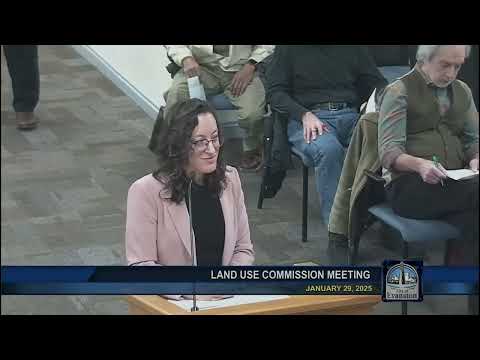
Evanston Land Use Commission members voted unanimously Jan. 29 to continue the public hearing on the draft comprehensive plan, known as Envision Evanston 2045, to Feb. 26 after commissioners and residents said the schedule proposed by staff did not give the public or the commission enough time to review a near‑final draft.
The continuation motion, moved by Commissioner Linwall and seconded by Commissioner Johnson, passed 9‑0 after a roll call. Staff told commissioners it expects to deliver a revised draft to the commission on Feb. 21; the commission will hold public discussion and accept testimony on Feb. 26.
Why it matters: Commissioners, neighborhood groups and downtown residents said the comprehensive plan is a generational document that requires more time, clearer graphics and easier access to red‑lined changes so the public and boards can evaluate policy tradeoffs before the plan goes to City Council. Several speakers urged separating land‑use policy from the zoning implementation or, at minimum, producing more illustrative graphics and a clear “to‑do” list to show what staff plans to change between drafts.
Staff timeline and commission response
“Allison Leipziger, policy and intergovernmental affairs manager, said the timeline that staff is proposing is based on city council’s recent discussion and that staff hopes to deliver a draft on Feb. 21 for the commission to consider on Feb. 26. Leipziger told commissioners the Feb. 21 delivery would give the commission five days to review the draft before the Feb. 26 hearing.
Commissioners said five days is not enough. “This is not final. This is another draft,” one commissioner said in objection to the compressed review window, and several members asked staff to provide a less‑rushed schedule that includes time for public review, red‑lined changes and follow‑up meetings. Commissioner Johnson said she would be more comfortable with four additional commission meetings to digest changes and gather public input; other commissioners suggested a minimum of three meetings as an absolute floor.
Public testimony: themes and examples
About a dozen residents and representatives of neighborhood groups spoke during the hearing. Jeff Smith, representing Central Street Neighbors, urged caution in changing neighborhood form and cited the Central Street planning process as an example of an intensive, draft‑driven effort that produced both community buy‑in and a zoning overlay. “If it ain’t broke, don’t fix it,” Smith said, arguing that the neighborhood’s overlay and the B1A district preserved a successful mixed‑use street and that the draft plan needed clearer justification for large changes.
David Galloway, speaking for Design Evanston, urged more graphics and neighborhood‑scale illustrations. “It should be a graphic document and a graphic investigation,” Galloway said, adding that visual examples help residents understand how policy language would translate into building form.
Several commenters raised housing and parking concerns. A public commenter cited a recent Urban Institute study and local analysis to argue that blanket upzoning of single‑family areas will not reliably yield affordable housing; another resident pointed to a roughly 7% housing vacancy rate in Evanston and urged the city to prioritize adaptive reuse of underused downtown commercial space rather than wide‑scale neighborhood rezoning. Others who live downtown warned against creating “canyonized” streets and asked the commission to consider embodied‑carbon impacts of very tall buildings.
What the commission asked staff to provide
Commissioners requested the following before the next discussion: - A word‑processor version of the draft (staff said it could provide a Word draft on Feb. 21) and clearer documentation of what changes were made (red‑line or a companion “to‑do” list). - Maps, charts and other graphics that show proposed land‑use and zoning changes at neighborhood scale (several commissioners said maps and comparative tables are essential to evaluate tradeoffs). - A clearer implementation framework or an outline of an implementation chapter, including suggested timelines and baseline metrics, while acknowledging a full implementation program may follow the plan.
Formal action
The commission took one formal vote: a motion to continue the comprehensive plan public hearing to Feb. 26, 2025. The motion was moved by Commissioner Linwall and seconded by Commissioner Johnson. Roll call vote: Commissioner Aravallo—yes; Commissioner Hallett—yes; Commissioner Johnson—yes; Commissioner Linwall—yes; Commissioner Mahbadi—yes; Commissioner Mangum—yes; Commissioner Bodenchev—yes; Commissioner Pektow—yes; Chair Rogers—yes. Outcome: approved (9‑0).
Next steps and context
Staff said it intends to deliver the next draft to the commission on Feb. 21; the commission will accept public testimony and deliberate on Feb. 26 and will then recommend a path forward to City Council. Commissioners emphasized that which body ultimately sets the calendar is City Council, but they signaled to staff and council that the Feb. 26 target for handing the plan off to council is unlikely to produce a recommendation that reflects the level of public review many commissioners want.
The hearing also included multiple technical and policy suggestions commissioners asked staff to consider in the rewrite: a more detailed community systems chapter (public buildings, service capacity, capital improvement needs), clearer land‑use goals that identify specific chapter‑level objectives, neighborhood‑sensitive approaches to “missing middle” housing, and an approach to parking policy that accounts for differences in household composition and neighborhood context.
The Land Use Commission will reconvene on Feb. 26 at 6 p.m. in Council Chambers to receive the Feb. 21 draft, take public comment and decide how many additional review meetings it will require before forwarding recommendations to City Council.