
Transit St. Louis plan update stresses safety, street-design framework and policy recommendations
Get AI-powered insights, summaries, and transcripts
Subscribe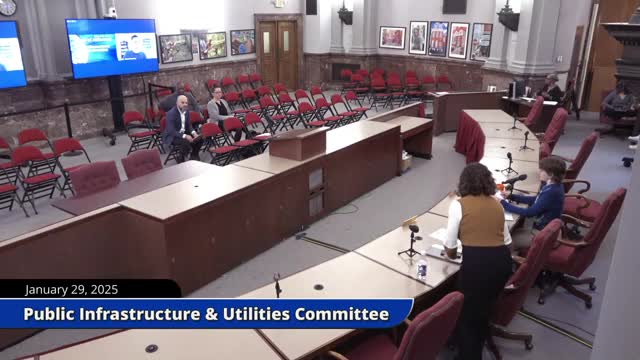
Summary
City planners and consultants updated the Public Infrastructure and Utilities Committee on the Transit St. Louis Transportation and Mobility Plan, reporting extensive public engagement and draft work on a Safety Action Plan, a street design framework and policy review; no formal decisions were taken.
Scott Oberle, program manager for Complete Streets in the City of St. Louis Planning and Urban Design agency, and Jackie Knight, project manager for Crawford, Murphy & Tilly, presented a mid‑term update Wednesday on the Transit St. Louis Transportation and Mobility Plan, saying the effort emphasizes safety, multimodal connections and maintenance priorities and will produce draft recommendations for policies and street design this spring.
The plan, the presenters said, is intended to provide the city’s first comprehensive transportation roadmap. "We don't currently have a transportation plan for the city of Saint Louis," Scott Oberle said, adding the project is about half complete and will move into public review in spring and early summer 2025.
The update matters because it aims to align future street projects, safety investments and policy changes under a single set of values and a citywide street‑type map. Jackie Knight told the committee that safety, connectivity and maintenance were the top three themes emerging from public engagement and staff workshops: "Safety is, is always coming in by far number 1." The plan will include a Safety Action Plan, a Street Design Framework and a policy and ordinance review intended to identify changes that would help implement the plan’s goals.
City and consultant staff described outreach already completed and the evidence the plan team is using. Knight said the team conducted a community survey and a statistically significant survey, reaching more than 1,500 community survey respondents and a 327‑person statistically significant sample at a 90% confidence level; in other outreach they reported more than 2,000 residents engaged in some form. The community survey showed that 81% of respondents always or frequently drive, 45% frequently walk, 21% frequently bike and 17% use MetroLink or MetroBus. Knight said 80% of community respondents reported that the mobility needs of children are unmet in the city; 51% said they had been involved in a traffic crash, and 21% said a loved one had suffered a life‑altering injury or death in a crash. She said about 50% of respondents do not feel comfortable navigating the city using their preferred travel method and that roughly 90% of respondents said they would accept slower travel speeds if it reduced reckless driving.
On the Safety Action Plan, presenters said they are building on the regional East‑West Gateway Regional Safety Action Plan while producing a city‑level appendix of corridor and hot‑spot reviews. The team showed an example appendix page for Grand Avenue, describing corridor profiles, fatality and serious‑injury charts by year, crash types by segment and a segmentation into multiple hot spots for targeted analysis and recommendations.
The Street Design Framework will pair a map of proposed street types with guidance, checklists and typical section imagery so staff and partners can better match street design to adjacent land use, design speed, traffic volume and local priorities. Oberle described the approach as moving away from a curb‑to‑curb, vehicular‑throughput model toward a context‑sensitive, “built‑in” framework that considers who uses each street and how.
The policy and ordinance review will examine capital budgeting and project selection, traffic safety and calming, development and private construction, asset management and data sharing, and community engagement processes. Knight said the review will compare current city practices with benchmarks from other cities and produce recommendations that are specific to St. Louis practice and staffing capacity. The team expects to submit a draft Safety Action Plan in February, a draft Street Design Framework in March, public engagement on the draft starting in April with open houses in May, a draft planning document in June and plan adoption in August 2025.
Committee members asked clarifying questions about how the plan will translate into enforceable practices and operations. Vice Chair Browning asked whether the ordinance review will lead to specific recommendations for the Board of Aldermen; Oberle replied that the plan will not draft ordinances but will make clear, context‑specific policy recommendations and goals staff and elected leaders can act on. Committee members also asked whether operational issues such as snow removal and enforcement would be addressed; presenters said operational practices are better expressed as departmental tactics but that the plan will state values and goals—such as accessibility and a state of good repair—that can be used to guide operational decisions.
No formal committee action was taken on the plan in the meeting. The committee did approve the minutes from its Jan. 22 meeting before the presentation; that vote was recorded 4‑0.
The presenters said they will return to the committee before plan completion and encouraged committee members and the public to review the project fact sheet and the plan website for additional details and upcoming public engagement opportunities.