Get Full Government Meeting Transcripts, Videos, & Alerts Forever!
Get email alerts on the Housing Affordability topic
No spam. Unsubscribe anytime.
Sequim housing committee outlines projects, legislative concerns as affordability tightens
Summary
Timothy Dalton, of the Housing Solutions Committee, summarized 2024 projects and regional housing challenges, citing local income and cost figures, recent developments funded with state and ARPA dollars, and statewide bills that could affect local housing options.
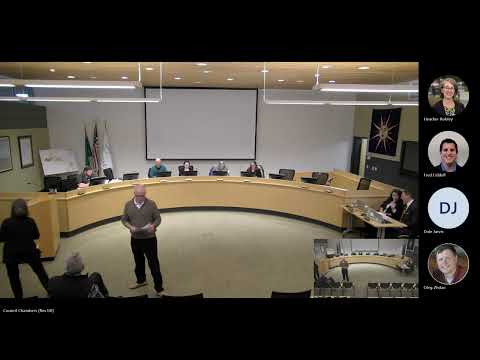
Timothy Dalton, a member of the Sequim Housing Solutions Committee, told the City Council on Jan. 27 that rising costs and policy changes are squeezing local housing options and outlined several county projects and state bills that he said matter to Sequim.
"One of our biggest problems in Clallam County is that when you're looking at housing for a 100% of AMI ... for 24 was $64,000 a year," Dalton said, using the household-income benchmark that underlies many housing programs. He described how that figure translates to monthly rents and typical qualifying prices for homebuyers in the region.
Dalton said the committee’s work spans 0–120% of area median income (AMI) and covered recent and planned projects. He noted Northview Apartments — a 36-unit permanent-supportive housing project under construction — and a 24‑unit, 60%‑of‑AMI development in unincorporated East Port Angeles that received a $1.5 million county allocation contingent on full funding and a $3 million award from the Washington Housing Trust Fund. He also described county ARPA allocations to local projects, including $500,000 for Habitat for Humanity’s Sequim brownfields effort and $800,000 for the Carlsberg development, and said the Peninsula Housing Authority used $200,000 of ARPA money to acquire Oxbow Apartments in Forks.
Dalton highlighted construction-cost and regulatory pressures. He said Clallam County’s prevailing wage for a carpenter—"$78.99 an hour," he reported—is far higher than nearby counties and that state energy and building requirements have raised development costs. He urged policies that encourage lot splitting, smaller-lot single‑family standards, and fee deferrals with deed restrictions so affordability is preserved if projects later convert to market rate.
The presentation also flagged several bills moving in the state Legislature. Dalton identified House Bill 1217 / Senate Bill 5222 as a rent‑stability measure drawing mixed views in committee, and he described House Bill 1443 (with a Senate companion) as a proposal that would allow RVs on lots more broadly and that local and regional groups have criticized for safety and sanitation gaps.
Dalton encouraged continued regional coordination among elected officials, planners, builders and nonprofits to expand workforce housing and multifamily options, and said the Housing Solutions Committee will press for joint planning and fee‑incentive strategies as comprehensive plans are updated.
The committee’s presentation did not include a council motion or vote. Dalton said he would provide supplemental materials referenced in the presentation to staff for distribution to council.